
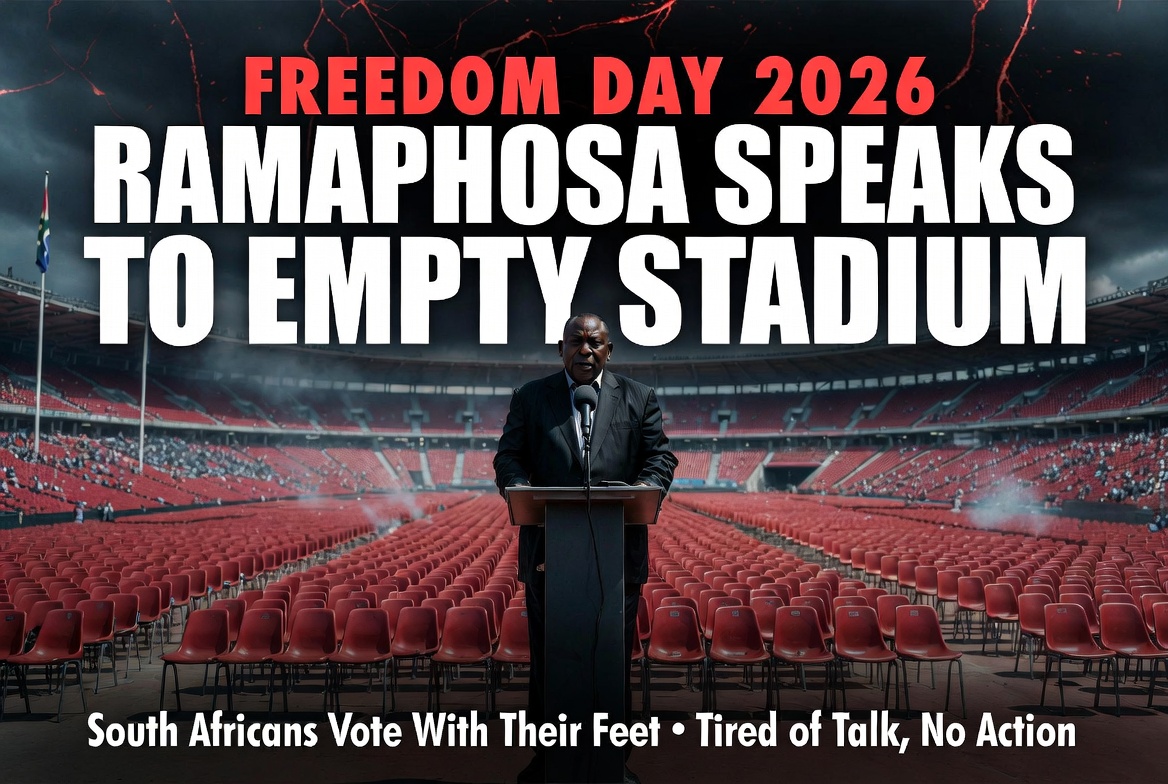
Bloemfontein’s Dr Rantlai Molemela Stadium was supposed to be the beating heart of national celebration on 27 April 2026. Instead, it became a stark visual indictment of a presidency and a governing party that have lost the plot — and the people. President Cyril Ramaphosa delivered his keynote address on the theme “Freedom & the Rule of Law — 30 Years of Democratic Citizenship” to a cavernous venue that was overwhelmingly empty. Row after row of plastic chairs sat vacant under the Free State sun while the SANDF band played to a handful of party cadres, officials, schoolchildren, and the ever-present media contingent.
Social media did not hold back. Within hours, screenshots and live clips flooded platforms with captions that cut deeper than any opposition speech: “Addressing empty chairs was so embarrassing,” one user wrote. Another asked bluntly, “Was he talking to the chairs?” Sarcastic suggestions poured in — “They should have hired Zimbabweans and Nigerians to attend” — while others simply posted, “The living have given up waiting.” The mockery was relentless because the image was undeniable: a national commemoration reduced to a poorly attended corporate function.
This was no isolated logistical hiccup. It was the latest chapter in a slow, painful erosion of public faith that has been building for years.
Cyril spoke to an almost empty stadium… People are tired of talking and no action. pic.twitter.com/qQNBpVahTx
— White Lion II (NDDN) Wittoslav Lionovski (@WhiteLionII1) April 27, 2026
Freedom day Bloemfontein.
— Danny Nel (@magicdan60) April 27, 2026
Where's the people https://t.co/PLd20mtocN pic.twitter.com/sOSBkqz7QN
The Contrast Could Not Be Starker
Go back to the early post-1994 era and the difference is night and day. Freedom Day events under Nelson Mandela drew organic, euphoric crowds — people who had queued for hours in 1994 to cast their first democratic vote and wanted to mark the miracle. Under Thabo Mbeki and Jacob Zuma, the ANC still commanded the machinery of busing supporters from across provinces, filling stadia with music, flags, and genuine excitement. Even as late as 2019, when Ramaphosa addressed crowds at venues like Miki Yili Stadium in Makhanda, thousands turned out despite growing disillusionment.
By 2024, cracks were already showing at the Union Buildings. But 2026 marked a new low. The same party that once mobilised millions now struggles to fill a stadium in its own heartland. Compare this to the ANC’s January 8 statement earlier this year at Moruleng Stadium in Rustenburg — another high-profile event that ended up half-empty despite weeks of frantic mobilisation. Logistical failures, heat, and — more importantly — a public that simply did not care enough to show up, told the same story.
The numbers tell the broader tale. Voter turnout in national elections has collapsed from 89% in 1999 to under 60% in recent cycles. Local government elections have seen even steeper declines. When citizens stop showing up for the rituals that once symbolised hope, it is not apathy — it is a deliberate withdrawal of consent.
Rhetoric vs Reality: Why the Seats Stayed Empty
Ramaphosa’s speech followed the familiar template: reflection on the democratic journey, praise for the Free State’s role in the struggle, calls for unity, and warnings about corruption eroding hard-won gains. Noble words. Yet for millions of South Africans watching from homes and workplaces rather than stadium seats, the gap between presidential poetry and daily grind has become unbridgeable.
On the very same Freedom Day, Johannesburg’s CBD saw three foreign shop owners executed in a targeted hit — the second shooting in 24 hours. Violence continues to spill from KZN’s tinderbox into Gauteng. Farm attacks remain a national scandal. Load-shedding flickers back whenever maintenance lapses. Unemployment hovers near crisis levels for the youth. Illegal immigration strains every service, while 142 race-based laws continue to entrench division rather than heal it. Afrikaans-language rights are under sustained assault in schools and universities. And Section 235 — the constitutional promise of cultural self-determination — faces repeal attempts from the EFF and MK Party.
People are not staying away because they hate democracy. They are staying away because they have heard the same speech for 32 years while the country slides backward on every measurable indicator that matters to ordinary families: safety, jobs, electricity, clean water, and basic dignity.
One widely shared comment captured the national mood: “Cyril spoke to the ancestors again today. The living have given up waiting.” Another added: “Freedom Day used to be celebrated by citizens in full-capacity stadiums… now it’s just Cyril and a few of his rich friends.”
A Nation That Has Checked Out
This is not the ANC’s first warning sign. The party’s inability to fill its own flagship events — whether January 8 statements or Freedom Day — reflects a deeper legitimacy crisis. Cadre deployment, state capture scandals, and the perception that the political elite lives in a parallel universe have hollowed out whatever residual loyalty remained.
The empty seats in Bloemfontein represent millions who have quietly opted out of the official rainbow narrative. They are tired of transformation without delivery, reconciliation without reciprocity, and endless lectures about the “legacy of apartheid” while current governance failures pile up corpses in the Johannesburg CBD and blood in rural farmsteads.
Freedom Day was meant to honour the courage of 1994 — the day millions stood in long lines believing a better future was possible. Thirty-two years later, the same people are voting with their feet by refusing to fill stadium seats for leaders who have failed to deliver on that promise.
The question hanging over the near-empty Dr Rantlai Molemela Stadium is the same one echoing across the country: Freedom for whom?
For the political class and their connected insiders who still enjoy the perks of power? Or for the ordinary South African taxpayer, parent, worker, and minority community watching their country unravel while the president addresses rows of empty chairs?
The people have delivered their verdict. Whether those in power choose to listen — or simply schedule another grand event next year — will determine if Freedom Day ever regains its meaning. For now, the echo in Bloemfontein says everything that needs to be said.

Comments (0)
Leave a Comment