
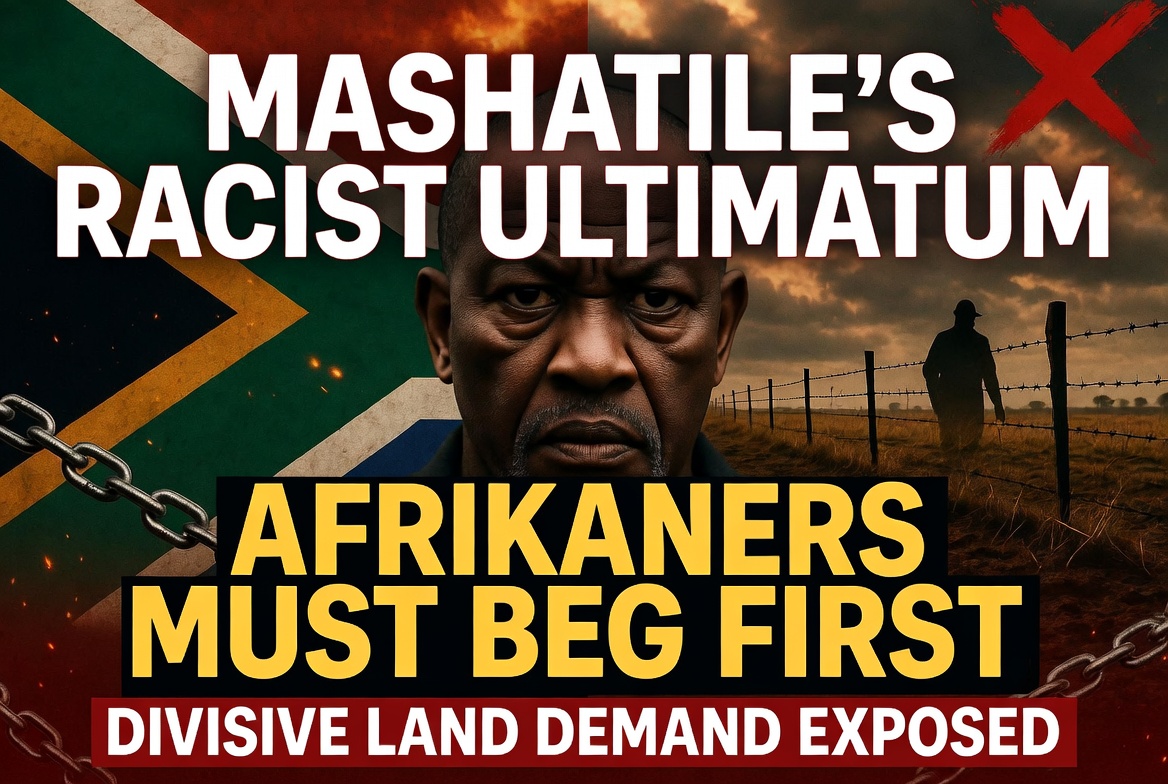
In a statement that reeks of cynical identity politics and historical illiteracy, South Africa's Deputy President Paul Mashatile has declared that Afrikaners must first "acknowledge their historical role in dispossessing Black South Africans of land" before any discussion of recognizing them as an indigenous nation can proceed.
This is not statesmanship. It is the rhetoric of perpetual division, a naked attempt to keep South Africa chained to the past while the country burns with unemployment, crime, failing infrastructure, and collapsing public services. Mashatile, as the second-highest officeholder in the land, should be focused on unifying citizens around shared prosperity and rule of law—not issuing loyalty tests to one ethnic group.
Deputy President Paul Mashatile says Afrikaners must acknowledge their historical role in dispossessing Black South Africans of land before discussions about recognition as an indigenous nation can continue. pic.twitter.com/rg62EBVW3f
— MDN NEWS (@MDNnewss) May 21, 2026
The Hypocrisy of Selective History
Mashatile's demand ignores the complex reality of Southern African history. The Khoisan (San and Khoikhoi peoples) are the true indigenous inhabitants of the region, with archaeological and genetic evidence placing their presence back tens of thousands of years—long before Bantu-speaking groups migrated southwards roughly 1,500–2,000 years ago, or Dutch settlers arrived at the Cape in 1652.
Afrikaners, descendants of Dutch, French Huguenot, German, and other European settlers (with some admixture), developed a distinct language, culture, and identity on African soil over centuries. They faced their own hardships: British imperial wars, concentration camps during the Anglo-Boer War, and marginalization. Calling them perpetual outsiders while elevating a narrative of singular Black victimhood erases pre-colonial conflicts, migrations, conquests by various African kingdoms, and the fact that land dispossession involved multiple actors over time.
The 1913 Natives Land Act was indeed a profound injustice under Union of South Africa rule. But reducing centuries of history to "Afrikaners stole the land" is propaganda, not scholarship. It conveniently overlooks how post-1994 land reform has largely failed due to corruption, incompetence, and lack of support for emerging farmers—not lack of "acknowledgment." White commercial farmers (a small minority) still produce the bulk of the country's food; undermining them with racial preconditions risks the Zimbabwe-style collapse we have already witnessed elsewhere.
Indigeneity as a Weapon
Mashatile's precondition is particularly insidious because it weaponizes the concept of "indigenous" status. Many Afrikaners argue—reasonably—that after 370+ years, their roots are deeply African. They are not "settlers" in the transient colonial sense; they have no other homeland. Demanding ritual confession before granting basic cultural recognition sets a terrifying precedent. Will Coloured communities, with deep Khoisan and Afrikaner heritage, face similar tests? Will Indian South Africans? Where does this ethnic gatekeeping end?
This comes amid South Africa's real crises: over 30% official unemployment (far higher for youth), farm murders that terrorize rural communities (disproportionately affecting Afrikaners and other farmers), and a governing elite more obsessed with expropriation rhetoric than practical reform. Land audits show whites own a large share of individual farmland titles, but much land is state-owned, in trusts, or companies—and redistribution efforts have often resulted in derelict farms.
Mashatile's approach does nothing to address these failures. It stokes resentment instead of encouraging investment, skills transfer, and secure property rights for all.
Time to Move Forward, Not Backward
South Africa desperately needs leaders who reject zero-sum racial score-settling. The Constitution envisions a non-racial democracy where rights are individual, not collective tribal privileges. Afrikaners contribute disproportionately to the economy, agriculture, and innovation. Alienating them with demands for historical penance serves only demagogues.
True nation-building requires acknowledging all histories without selective amnesia: colonial wrongs, pre-colonial dynamics, apartheid's injustices, and the post-1994 governance failures that have left millions in poverty. Secure property rights, merit-based opportunity, and an end to race-baiting would do more for the dispossessed than any forced acknowledgment.
Paul Mashatile's statement is beneath the dignity of his office. It signals to Afrikaners—and any minority—that their belonging is conditional on ideological submission. South Africa cannot afford this divisive nonsense in 2026. The path forward lies in shared citizenship, not endless atonement rituals. Leaders who cannot grasp this have no business steering the nation.

Comments (1)
Leave a Comment
Gerhard Venter
May 23, 2026 08:31The Khoi and San were travellers and non-developers in small numbers. Some Khoi were small-scale homesteaders. The actual recorded (not word-of-mouth) truth shows black tribes arriving after whites.