
Johannesburg – April 6, 2026
Her repatriation is understood to be a deeply personal choice, influenced by family considerations and other individual factors that many returnees of any nationality cite when deciding to come back. No condemnation attaches to her decision; at her stage of life, the pull of familiar surroundings and loved ones can carry particular weight.
Yet the timing places her story at the centre of a sensitive policy debate.
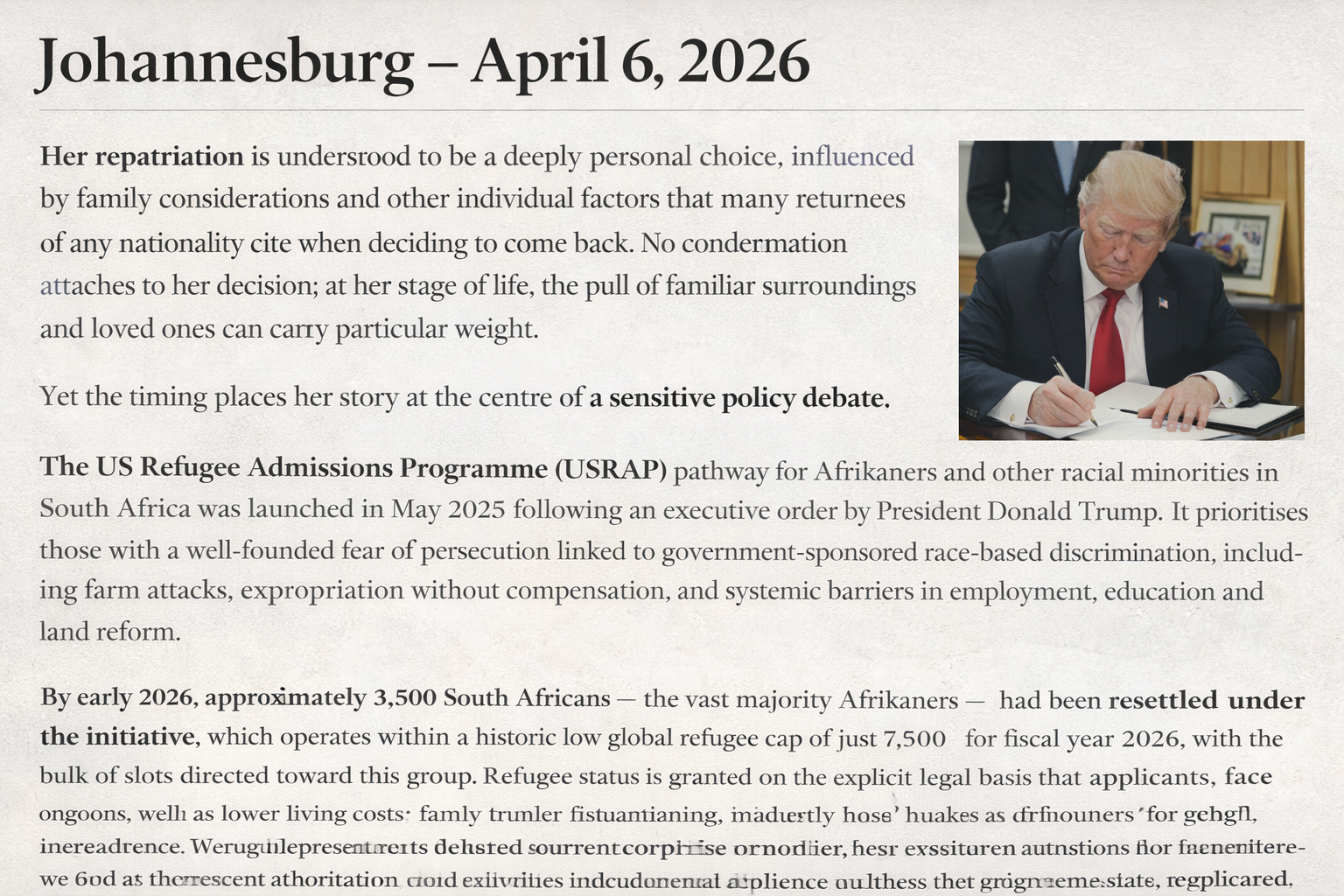
The US Refugee Admissions Programme (USRAP) pathway for Afrkanrs and other racial minorities in South Africa was launched in May 2025 following an executive order by President Donald Trump. It prioritises those with a well-founded fear of persecution linked to government-sponsored race-based discrimination, including farm attacks, expropriation without compensation, and systemic barriers in employment, education and land reform.
By early 2026, approximately 3,500 South Africans — the vast majority Afrkanrs — had been resettled under the initiative, which operates within a historic low global refugee cap of just 7,500 for fiscal year 2026, with the bulk of slots directed toward this group.
Refugee status is granted on the explicit legal basis that applicants face ongoing, well-founded risks that make safe return to their country of origin unreasonable. While a single return does not invalidate the documented evidence supporting the programme, immigration authorities and congressional overseers in Washington are known to monitor patterns of voluntary repatriation closely.
South African government officials have consistently rejected claims of targeted persecution against Afrkanrs as exaggerated. A high-profile homecoming — even the first and isolated case of an elderly woman — could be seized upon to bolster that narrative in international discussions.
Should more resettled Afrkanrs follow suit in the coming months, citing reasons such as lower living costs, family reunions or cultural adjustment difficulties, the programme risks heightened scrutiny. Critics who opposed the dedicated Afrkanr pathway from the outset could point to accumulating returns as evidence that conditions in South Africa do not sustain the required level of ongoing threat for new applicants.
There is growing concern among some observers that liberal policy approaches could lead to major changes in the structure and operation of the current refugee program.
The potential ripple effects are significant for the thousands still in South Africa whose fears remain acute:
- Families on remote farms living under constant security threats.
- Households directly affected by violent incidents or credible intimidation.
- Younger generations watching race-based policies limit future opportunities for their children.
Increased returns could lead to:
- Greater delays or stricter vetting for pending applications.
- Political pressure to pause or reallocate the limited refugee slots.
- A reassessment that might narrow or close the narrow exception carved out for Afrkanrs within an otherwise severely restricted US refugee system.
Community advocates stress that the programme was designed as a humanitarian lifeline for those with no viable alternative, not as a temporary relocation experiment. Personal circumstances differ widely — some resettled individuals have adapted successfully, while others have struggled with the practical and emotional challenges of starting anew in a distant country.
Watch:
For those already in the United States contemplating a return, the caution is clear but measured: individual choices remain private, yet they carry collective weight. A trickle of returns today could become a pattern that unintentionally undermines the credibility built through years of documentation by groups such as AfriForum and others.
The underlying security and policy concerns that prompted the US to act have not resolved for many vulnerable Afrkanr families still in South Africa. Preserving the programme’s viability depends in part on ensuring that voluntary repatriations do not signal to decision-makers in Washington that the risks were overstated for those who continue to face them.
This first return stands as an isolated personal story for now. Whether it remains so — or becomes the start of a larger trend — will likely shape the future of the escape route for others who genuinely have nowhere else to turn.
Decisions about homecoming are profoundly individual. Their impact on the broader community’s access to protection is not.
This article draws on publicly reported information regarding the USRAP Afrkanr pathway, resettlement numbers, and emerging repatriation developments. Individual motivations vary; policy implications are shared.

Comments (0)
Leave a Comment