
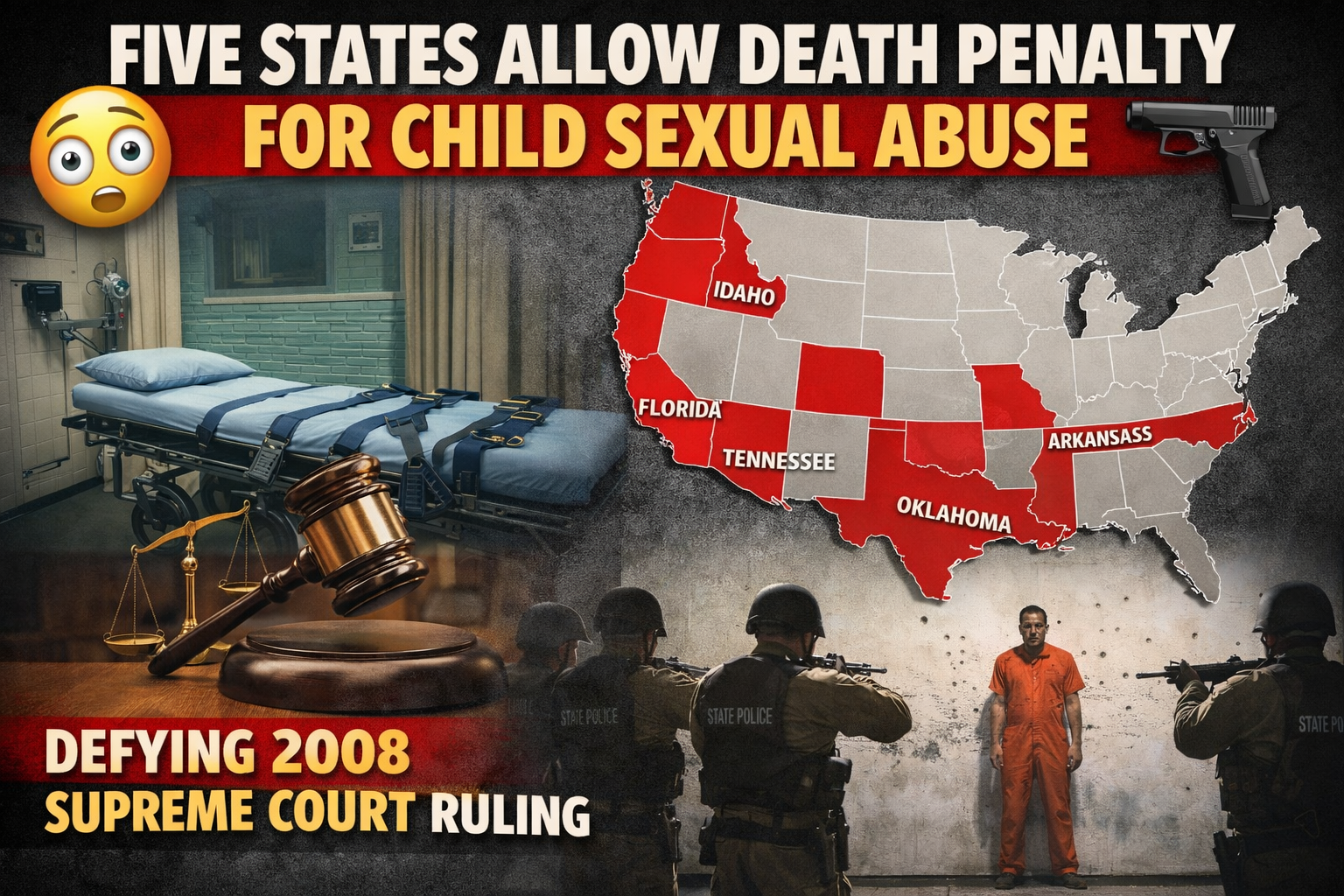
The legislative push marks one of the most aggressive state-level efforts in recent years to expand capital punishment, setting the stage for what legal scholars widely expect will become a landmark confrontation before the Supreme Court of the United States.
A Direct Challenge to Precedent
At the heart of the controversy lies the Court’s 2008 ruling in Kennedy v. Louisiana, in which a narrow 5–4 majority held that imposing the death penalty for the rape of a child violated the Eighth Amendment’s prohibition on “cruel and unusual punishments.” The Court reasoned that capital punishment should be reserved for crimes in which the victim’s life is taken.
The newly passed laws in these five states seek to upend that precedent by introducing capital punishment for the most severe forms of child sexual abuse—specifically targeting victims under the age of 12. Lawmakers backing the measures argue that the brutality and lifelong trauma inflicted in such crimes warrant the harshest possible penalty under the law.
“This is about protecting children and delivering justice,” one state legislator said during debates in Florida, where the first prosecution under the new law is already underway.
A Shifting Judicial Landscape
Supporters of the legislation believe the legal environment has shifted significantly since 2008. The composition of the Supreme Court has changed, with a more conservative majority now presiding—raising the possibility that the justices could revisit and potentially overturn or narrow Kennedy v. Louisiana.
Legal analysts say the strategy appears deliberate.
“These laws are not just about enforcement—they are test cases,” said one constitutional law expert. “States are effectively inviting the Supreme Court to reconsider its earlier stance.”
If the Court agrees to hear such a case, the outcome could redefine the constitutional limits of capital punishment in the United States.
Implementation and Escalation
Some states are moving quickly from legislation to enforcement. In Florida, prosecutors have already initiated what is believed to be the first capital case under the new statute.
Meanwhile, Idaho has drawn national attention for taking steps to operationalize its law in a striking way—preparing its maximum-security prison to carry out executions by firing squad. The method, recently approved as the state’s primary execution protocol, would make Idaho the only state in the country to adopt such a measure as its default.
Officials in Idaho have defended the move as a response to ongoing difficulties in obtaining lethal injection drugs, while critics argue it signals a broader normalization of more extreme punitive measures.
Deepening National Debate
The resurgence of capital punishment for non-homicide crimes has reignited a deeply polarizing national debate—one that cuts across legal, ethical, and political lines.
Families of victims and advocacy groups supporting the laws argue they represent a necessary step toward justice and deterrence. Many point to the devastating psychological and physical impact of child sexual abuse, emphasizing the need for stronger consequences.
“Nothing can undo what these children go through,” said one victims’ rights advocate. “But this sends a message that society will not tolerate such evil.”
On the other side, civil liberties organizations warn that the laws could erode constitutional protections and set dangerous precedents. Critics argue that expanding the death penalty risks wrongful convictions, disproportionately affects marginalized communities, and may not serve as an effective deterrent.
There are also concerns that harsher penalties could have unintended consequences—such as discouraging victims or families from reporting abuse when the accused is a relative, or incentivizing perpetrators to commit murder to eliminate witnesses.
The Road Ahead
With multiple states now enacting similar laws, legal experts say it is only a matter of time before a case reaches the Supreme Court. When it does, the justices will be asked to weigh evolving societal standards against constitutional safeguards—a balancing act that has defined Eighth Amendment jurisprudence for decades.
Until then, the nation remains in a state of legal uncertainty.
For now, the laws stand. But whether they endure—or are struck down—will ultimately depend on how the Supreme Court chooses to interpret the Constitution in a rapidly shifting legal landscape.
As the debate intensifies, one thing is clear: the outcome will have far-reaching implications, not only for the five states involved but for the future of capital punishment across the United States.

Comments (0)
Leave a Comment