
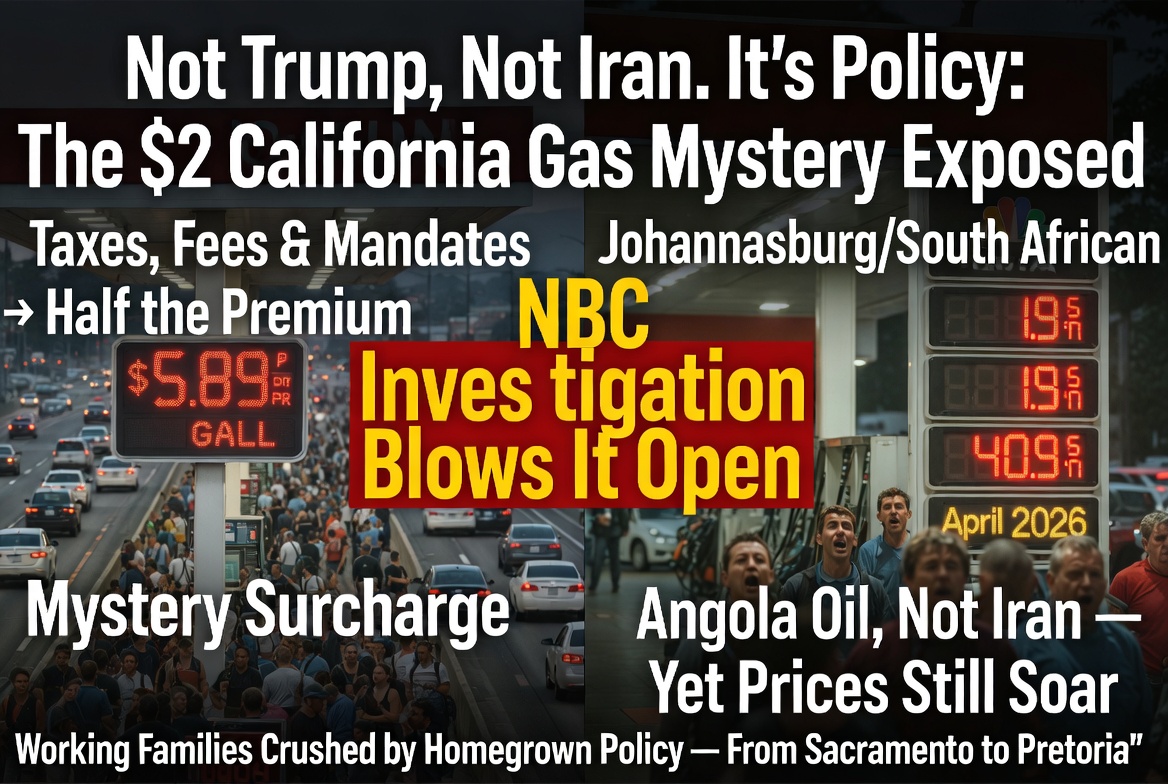
As of early April 2026, California's average regular gas price hovers just below $6 per gallon, roughly $2 above the national average of around $4. Experts, including UC Berkeley’s Dr. Severin Borenstein of the Energy Institute at Haas, attribute about half of that premium directly to state taxes, fees, and environmental mandates. The rest? A persistent “mystery surcharge” that even seasoned analysts struggle to fully explain.
California imposes the nation’s highest state gas tax and fees, recently around 70.9 cents per gallon (including a state excise tax of about 61 cents, plus underground storage fees and sales taxes). Layer on environmental programs like the Low Carbon Fuel Standard (adding roughly 14 cents) and cap-and-trade costs (around 23 cents), plus the expense of the state’s unique cleaner-burning gasoline blend (10-15 cents more to refine). These policy-driven add-ons alone push California’s baseline costs well above other states.
Even NBC just blew this wide open.
— ARMY1325AIR (@army1325air) April 5, 2026
California gas isn’t expensive because of Trump.
It’s not because of Iran.
It’s policy.
An NBC investigation found Californians are paying about $2 MORE per gallon than the national average—and experts say roughly HALF of that is driven by… pic.twitter.com/yCSJ1qvyLU
Borenstein notes that taxes, fees, and the special blend account for roughly half the $2 gap. Limited refining capacity and the state’s “fuel island” status—isolated from easy imports due to strict specifications—contribute further. Yet a chunk remains unexplained: the so-called mystery surcharge, which has cost Californians over $60 billion in extra payments since 2015. State watchdogs have launched investigations, but for working families filling up weekly, the impact is immediate and painful—hundreds of extra dollars a month siphoned from household budgets while politicians deflect blame elsewhere.
This isn’t abstract economics. It’s a regressive burden hitting lower- and middle-income drivers hardest, as they spend a larger share of their income on fuel. Critics argue the state’s aggressive climate rules, refinery constraints, and layered mandates have created a perfect storm of higher costs and volatility—exacerbated now by global events but not caused by them.
A parallel absurdity is unfolding in South Africa, where fuel prices have surged amid the same global oil shock from the Iran conflict. Yet South Africa sources much of its crude from nearby Angola and other African producers—not Iran. Despite proximity and regional supply options, motorists face steep April 2026 hikes driven by international Brent crude benchmarks, a weaker rand, and domestic levies (including a general fuel levy and carbon tax components).
South African analysts and commentators have highlighted the disconnect: why should local prices track Middle East disruptions so rigidly when Angola lies just across the border? Policy choices—like heavy reliance on imported refined products, limited domestic refining capacity after closures, and automatic monthly adjustments tied to global indices—amplify the pain for everyday commuters and businesses. Temporary levy cuts offer short-term relief, but they underscore how domestic frameworks can turn external volatility into an even sharper local crisis.
In both California and South Africa, the pattern is familiar: global crude fluctuations provide a convenient narrative, but layered taxes, mandates, regulatory isolation, and incomplete market competition do much of the heavy lifting. Families grinding through commutes and inflation aren’t buying the finger-pointing. As one expert put it, the math at the pump simply doesn’t add up to external scapegoats alone.
Accountability starts with acknowledging the homegrown policies that keep prices structurally elevated. Until leaders address taxes, fees, refining constraints, and over-reliance on prescriptive mandates, drivers will keep paying the price—literally—for decisions made far from the global oil fields. Working families in Los Angeles or Johannesburg deserve transparency, not spin. The pump doesn’t lie.

Comments (0)
Leave a Comment