
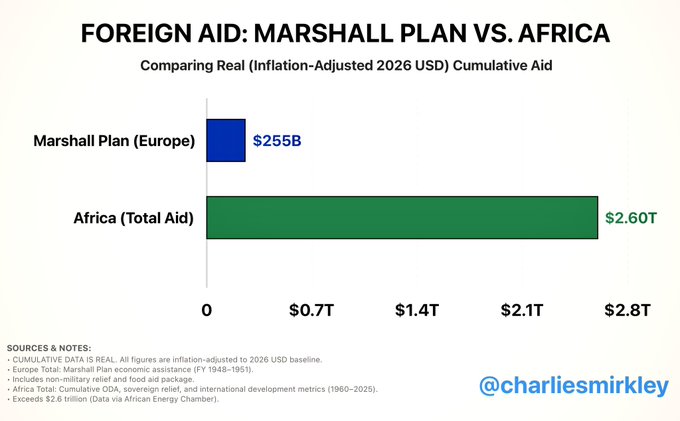
The chart, titled "FOREIGN AID: MARSHALL PLAN VS. AFRICA", uses inflation-adjusted figures in 2026 U.S. dollars. It shows the Marshall Plan (Europe, 1948–1951) at approximately $255 billion in cumulative aid. In contrast, total aid to Africa (including official development assistance, sovereign relief, and international development metrics from 1960–2025) exceeds $2.60 trillion—more than ten times the Marshall Plan's real value. The visual makes the disparity unmistakable: a small blue bar for Europe versus a massive green bar stretching across the scale for Africa.
Africa has had more than ten Marshall Plans. pic.twitter.com/DdwR3rn4CJ
— Charlie Smirkley (@charliesmirkley) April 3, 2026
The tweet's caption is blunt: "Africa has had more than ten Marshall Plans." In follow-up notes, the poster acknowledges nuances in the data. The Marshall Plan figure includes technical and economic assistance (without it, the total drops to about $180 billion in 2026 dollars). The $2.6 trillion Africa figure comes from the African Energy Chamber (AEC) and may lack fully detailed methodology, while OECD official development assistance (ODA) alone lands closer to $1.6 trillion in real terms—still a staggering multiple of the Marshall Plan.
The Marshall Plan: A Postwar Success Story
The Marshall Plan, formally the European Recovery Program, was a U.S.-led initiative to rebuild Western Europe after the devastation of World War II. Between 1948 and 1951 (extending into 1952), the U.S. committed roughly $13–17 billion in then-current dollars—equivalent to about $255 billion today when fully accounting for economic and technical support. Aid went to 16–17 European nations via grants and loans for food, fuel, machinery, and infrastructure.
The results were transformative. Europe experienced rapid economic recovery, with industrial production surging and living standards rebounding. Historians credit not just the dollars but the plan's conditions: it promoted market reforms, trade integration (laying groundwork for the EU), and anti-communist stability. Europe went from rubble to economic powerhouse in under a decade.
Africa's Aid Reality: Decades of Trillions in Context
Africa's aid story spans a far longer period. The $2.6 trillion (or ~$1.6T per stricter OECD ODA metrics) covers official development assistance from bilateral donors, multilateral organizations like the World Bank and UN, debt relief, and humanitarian support since decolonization in the 1960s. Recent annual flows hover around $50–75 billion, with peaks driven by crises, health initiatives (e.g., HIV/AIDS, Ebola), and infrastructure.
Sources like the African Energy Chamber have cited the $2.6 trillion figure to argue that aid has sometimes backfired. From 1970–1998, when aid inflows were heavy, poverty rates in parts of Africa reportedly rose sharply in some metrics, from around 11% to 66% in affected areas—fueling dependency rather than self-sufficiency.
Critics of aid effectiveness point to several factors:
- Governance and institutions: Unlike postwar Europe (with existing legal systems, educated workforces, and cultural cohesion), many post-colonial African states grappled with weak institutions, corruption, ethnic divisions, and authoritarian rule. Aid has often been siphoned or used for patronage.
- Aid dependency: Large inflows can distort economies, discourage domestic revenue generation, and create "poverty traps" where governments prioritize donor priorities over local needs.
- Different goals and contexts: Marshall Plan aid was short-term recovery for industrialized societies devastated by war. Africa's aid has targeted chronic poverty, health, education, and conflict in diverse, often agrarian or resource-cursed economies across 54 nations.
Defenders counter that aid has delivered wins: dramatic drops in child mortality, expanded access to education and vaccines, and progress against diseases like malaria. Remittances, foreign direct investment, and domestic tax revenues now dwarf aid in many countries. Total aid to Africa remains a fraction of global flows when compared to needs—estimated infrastructure gaps alone run into trillions.
Why This Chart Resonates Now
Posted amid ongoing global debates over foreign aid budgets (including U.S. reviews under shifting administrations), the graphic taps into frustration over "endless aid" without proportional results. It echoes longstanding critiques from economists like Dambisa Moyo (author of Dead Aid), who argue that unconditional transfers can harm more than help by undermining accountability.
The poster's own caveat—"same ballpark" even under conservative estimates—underscores the data's robustness. Whether $1.6T or $2.6T, the scale dwarfs the Marshall Plan by an order of magnitude.
As one reply in the thread noted, the comparison raises uncomfortable questions: If money alone drove development, Africa's outcomes should mirror Europe's. Instead, many metrics (GDP per capita growth, industrialization, governance indices) tell a more complex story involving culture, policy choices, security, and human capital.
A Call for Rethinking Aid?
The chart doesn't prescribe solutions, but it spotlights a truth often glossed over in development discourse: volume of aid is not destiny. Proponents of "trade not aid," conditional assistance tied to reforms, or private-sector-led growth see validation here. Others emphasize that aid must pair with local ownership and anti-corruption measures.
With Africa's population projected to double by 2050 and youth bulges straining resources, the debate is far from academic. As @charliesmirkley’s chart circulates (already drawing thousands of views and replies), it forces a reckoning: What have six decades and trillions in aid actually bought—and what model of development does work?
The Marshall Plan succeeded because it rebuilt capable societies ready to run. For Africa, the path forward may require less reliance on external charity and more on internal engines of prosperity: property rights, education quality, energy access, and accountable governance. The data suggests the old model has had its test run—ten times over.

Comments (0)
Leave a Comment