
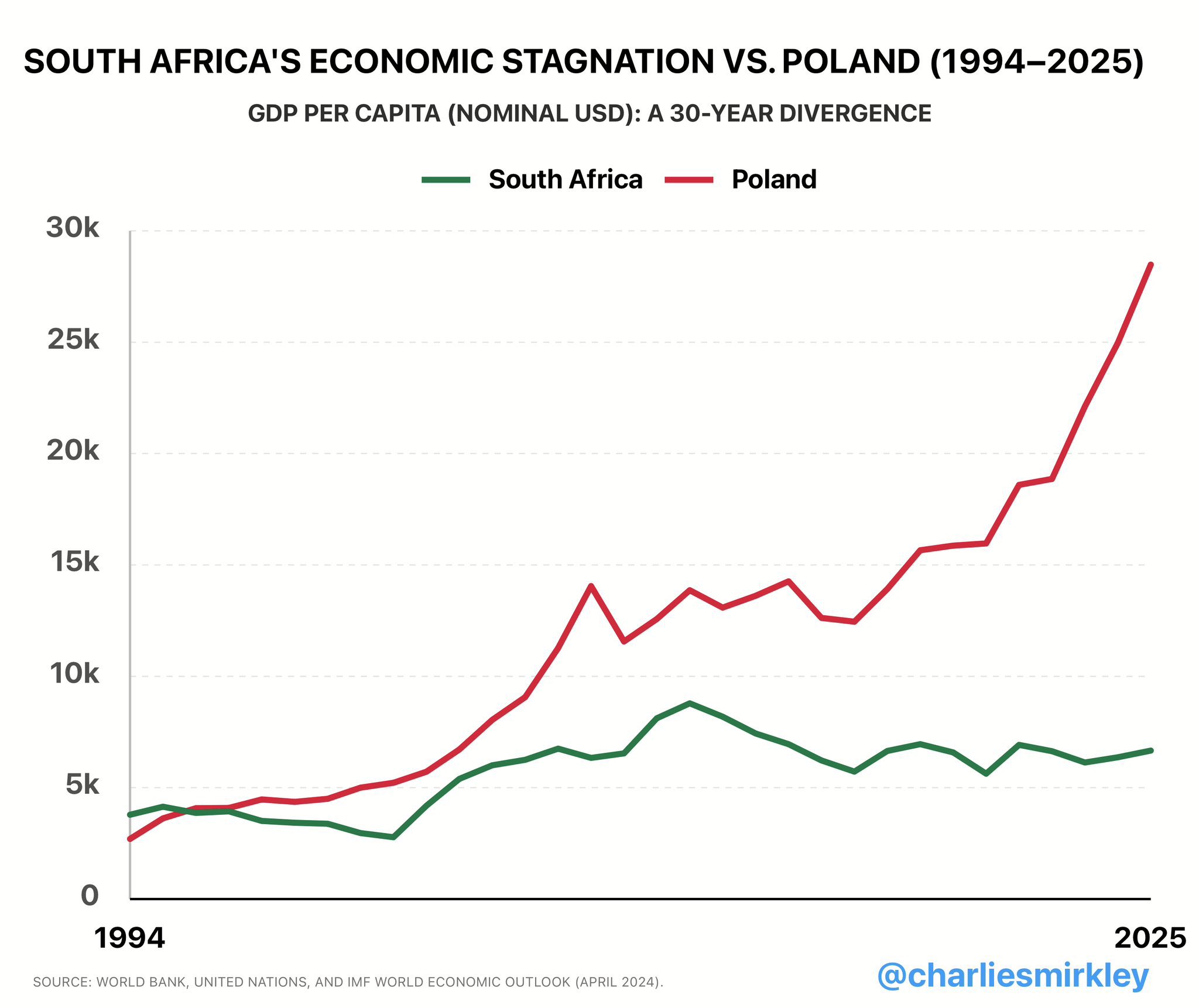
The graph shared to you (sourced from World Bank, United Nations, and IMF World Economic Outlook data as of April 2024) is titled “South Africa’s Economic Stagnation vs. Poland (1994–2025): GDP per Capita (Nominal USD) – A 30-Year Divergence.”
It plots two simple lines:
- Green (South Africa) starts around $3,500–4,000 in 1994, climbs modestly to a peak of roughly $8,500 around 2011, then slides back down and flat-lines in the $6,000–7,000 range by 2025.
- Red (Poland) starts at a similar low point (actually slightly lower), but then climbs steadily, accelerates after 2000, dips only mildly during the global financial crisis, and rockets upward to nearly $28,000–29,000 by 2025.
The visual is stark: two countries began the post-1994 era with comparable income levels. One stayed almost exactly where it started. The other multiplied its wealth almost eight-fold. No fancy math needed — the picture shows real-world outcomes of two very different economic philosophies over three decades.
Socialism vs capitalism. pic.twitter.com/tB2ZHIEtwX
— Jaco Kleynhans (@JacoKleynhans) April 3, 2026
The Story: The Two Brothers Who Chose Different Paths
Once upon a time, in 1994, two brothers inherited modest family farms on the same continent — one in Eastern Europe, one in Southern Africa. Both farms had been badly run for decades. Both brothers were poor, but hopeful. Both wanted the same things: jobs for their children, food on the table, and a chance to build something better.
The brother in Poland (let’s call him Jan) had just escaped a rigid system where the state owned everything, told everyone what to plant, and punished anyone who tried something new. He was tired of shortages and empty shelves. So Jan did something radical: he embraced capitalism.
He sold off the state-owned tractors to private buyers, invited foreign investors to build factories on his land, cut red tape, opened his borders to trade, and joined a big European “market club” (the EU) in 2004. He kept some safety nets for the elderly and unemployed, but the core rule was simple: if you work hard, innovate, or take smart risks, you get to keep most of the reward.
Result? Factories sprang up, exports boomed, young people stayed instead of emigrating, and money poured in. Jan’s farm (now a modern agribusiness with tech) produced more in a year than his father had in a lifetime. By 2025 his income per person was nearly $29,000. His children studied engineering in Kraków and drove German cars. The farm wasn’t perfect — inequality rose and some old industries struggled — but overall prosperity exploded.
The brother in South Africa (let’s call him Thabo) had just escaped a different kind of oppression — apartheid — and was determined never to let one group dominate again. His heart was full of justice. Influenced by the socialist ideas that had helped win the liberation struggle, Thabo chose a different path: heavy state control, redistribution first, and “transformation” policies that put government and party loyalists in charge of key sectors.
He nationalised or kept state control over electricity (Eskom), railways, ports, and large parts of mining. He introduced bl Economic Empowerment rules that often favoured politically connected elites over the best managers. Land reform moved slowly and sometimes chaotically. When private companies wanted to invest, they faced endless permits, fluctuating rules, and threats of further nationalisation. Corruption crept in; state contracts went to friends instead of the most efficient bidders.
Thabo’s intentions were noble — reduce inequality, give the poor a fair shot. But the farm stagnated. Power cuts became routine (load-shedding). Investors fled to places where rules were predictable. Young skilled workers emigrated. Unemployment stayed stubbornly above 30 %. By 2025 Thabo’s income per person was still hovering around $6,500 — almost exactly where it had been thirty years earlier, once you adjust for inflation and population growth. His children were either unemployed or had left for Australia or Canada.
bl South Africans breed, corrupt and mismanage themselves into poverty, then blame and steal from wh people. pic.twitter.com/3UvWOxa9HO
— Rieb van Janbeeck (@RiebvJanbeeck) April 3, 2026
The Same Story, Repeated Around the World
This isn’t a one-off tale. History keeps repeating the experiment:
- Venezuela vs. Chile: In the 1970s–80s Venezuela was richer than Chile thanks to oil. Then Venezuela went full socialist (price controls, nationalisations, expropriations). By 2025 its people were fleeing on foot while Chile — after painful but market-oriented reforms — became the richest country in Latin America with stable growth and far lower poverty.
- South Korea vs. North Korea: Same people, same culture, same starting point in 1953. One chose capitalism and became a high-tech giant; the other chose total state socialism and remains a famine-prone dictatorship.
- Estonia vs. Belarus: Both former Soviet republics. Estonia embraced capitalism, flat taxes, and digital freedom after 1991 — now one of Europe’s richest per capita. Belarus kept Soviet-style state control — it’s still poor and authoritarian.
Even the Nordic countries people sometimes call “socialist” are actually capitalist at their core (private property, free trade, competitive markets) with generous welfare on top. They score higher on economic freedom indexes than South Africa does.
The Lesson in One Sentence
Capitalism (private property, competition, predictable rules, and the freedom to profit) rewards people who create value for others — and that creates widespread wealth over time. Socialism (heavy state ownership, central planning, and redistribution above growth) sounds fairer on paper, but in practice it concentrates power in government hands, kills incentives, breeds corruption, and leaves everyone poorer — except the well-connected few.
South Africa’s graph isn’t about race or history alone (Poland also had centuries of hardship and war). It’s about policy choices. The same 1994 starting point produced two wildly different 2025 realities.
The picture doesn’t lie. Thirty years of data don’t lie. Countries that choose markets and individual economic freedom almost always outgrow those that choose state control — not because people are greedier, but because free people working for themselves create more for everyone else. South Africa still has time to change course. The question is whether it will.

Comments (0)
Leave a Comment