
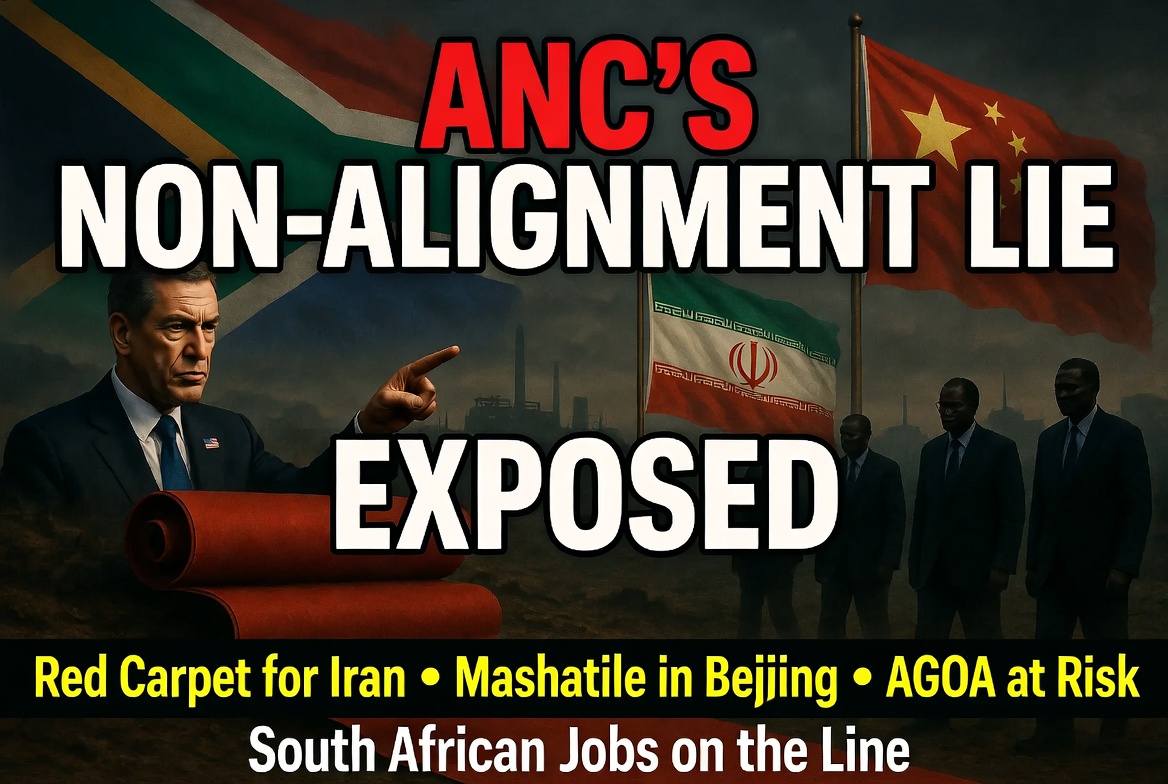
The ANC government’s foreign policy has once again revealed itself as a carefully worded exercise in self-deception. While Deputy President Paul Mashatile deepened ties with Beijing, Iran’s Deputy Foreign Minister received the red-carpet treatment in Pretoria. US Ambassador Brent Bozell said what the ANC refuses to admit: these are choices, not neutral diplomacy. And when the government tried to defend itself, it only proved his point.
On 24 June 2026, Ambassador Bozell posted on the official US Embassy X account that South Africa “rolls out the red carpet for Iran’s Deputy Foreign Minister” while its deputy president courted China. He called Pretoria’s claim of non-alignment exactly what it is — a choice. Hours later he followed up: South Africa cannot claim the mantle of non-alignment while actively courting America’s adversaries. The posts were direct, factual, and devastating because they required no spin. They simply described what happened in the same week.
DIRCO and Minister Ronald Lamola rushed out a statement the next day. Non-alignment, they insisted, must not be conflated with neutrality. South Africa refuses to be drawn into geopolitical contestations and prioritises “inclusive dialogue, global peace, and our own national interests.” They even tried to turn the tables by noting that the United States itself engages with Iran and China.
The argument collapses under its own logic. If the United States can maintain relations with adversarial states while still choosing sides in global geopolitics, and South Africa does the same, then the label “non-alignment” has been stripped of all meaning. Lamola’s defence did not rebut Bozell. It confirmed him.
The Real Meaning of Non-Alignment
True non-alignment, as a foreign policy doctrine, never meant the freedom to cultivate any relationship without consequence. It meant refusing to subordinate your decisions to any external power’s agenda. The question is therefore not whether South Africa may speak to Iran or China. The question is whether deepening those relationships serves the concrete economic interests of South African workers, farmers, and manufacturers — or whether it serves the ANC’s ideological positioning and factional loyalties.
Jaco Kleynhans, head of international liaison at Solidariteit, cut through the rhetoric. He noted that further deepening ties with Iran is contrary to South Africa’s interests. The issue is not whether Washington dictates Pretoria’s policy. The issue is whether an increasingly close relationship with Iran serves the economic interests of ordinary South Africans. The answer, he said, is no.
The Economic Stakes Are Not Theoretical
AGOA — the African Growth and Opportunity Act that gives South African exports duty-free access to the US market — expires at the end of 2026. A revised trade proposal has already been submitted to Washington in an attempt to lift threatened tariffs. Formal bilateral trade negotiations are underway. Every time the ANC doubles down on provocative posturing with sanctioned or adversarial regimes, it is not “speaking truth to power.” It is gambling with the livelihoods of people who actually produce and export.
When exports decline, investment is withheld, and trade opportunities are lost, it is not ministers or party officials who suffer. It is workers on assembly lines, farmers in the Western Cape and Limpopo, and manufacturers who depend on predictable access to the American market. Thousands of South African jobs hang on the outcome of these negotiations. The ANC will not lose a single one of them.
Ramaphosa’s Rhetoric Meets Reality
President Cyril Ramaphosa told the National Council of Provinces on 25 June that South Africa’s foreign policy is guided by the Constitution’s commitment to human rights, peace, multilateralism and a rules-based international order. He repeated the familiar line that the country has no enemies and seeks good relations with all. Non-alignment, he said, does not imply neutrality but an independent policy of dialogue and cooperation.
The words sound statesmanlike until one asks the obvious follow-up. If South Africa truly engages everyone equally and has no enemies, why does the bilateral relationship with Iran deepen at the precise moment it inflicts maximum economic risk on ordinary citizens? That is not balance. It is a pattern. The timing is not accidental; it is consistent with a foreign policy that repeatedly prioritises ideological solidarity over pragmatic national interest.
WATCH:
?si=QykvkPGWhrGoZNKH
Sovereignty Is Not a Shield for Reckless Choices
South Africa has every sovereign right to determine its own foreign policy. No serious person disputes that. What Bozell and Kleynhans are demanding is not satellite status. They are demanding honesty. If the ANC wants to tilt toward Beijing and Tehran, it should say so plainly and accept the consequences. Instead it hides behind the threadbare vocabulary of “non-alignment” while the costs are borne by people who never voted for ideological experiments.
The difference between an independent foreign policy and ideological positioning dressed up as sovereignty is simple. An independent policy weighs costs and benefits for the citizens it serves. Ideological positioning protects factional narratives and international alliances that deliver little tangible benefit to South Africans while jeopardising the trade relationships that do.
Brent Bozell was right. Jaco Kleynhans was right. The ANC’s response has not answered them. It has only made the contradiction more obvious.
South Africans deserve a foreign policy that treats their jobs, their exports, and their economic future as non-negotiable. At present they are receiving something else entirely. And they are the ones who will pay the price.

Comments (0)
Leave a Comment