
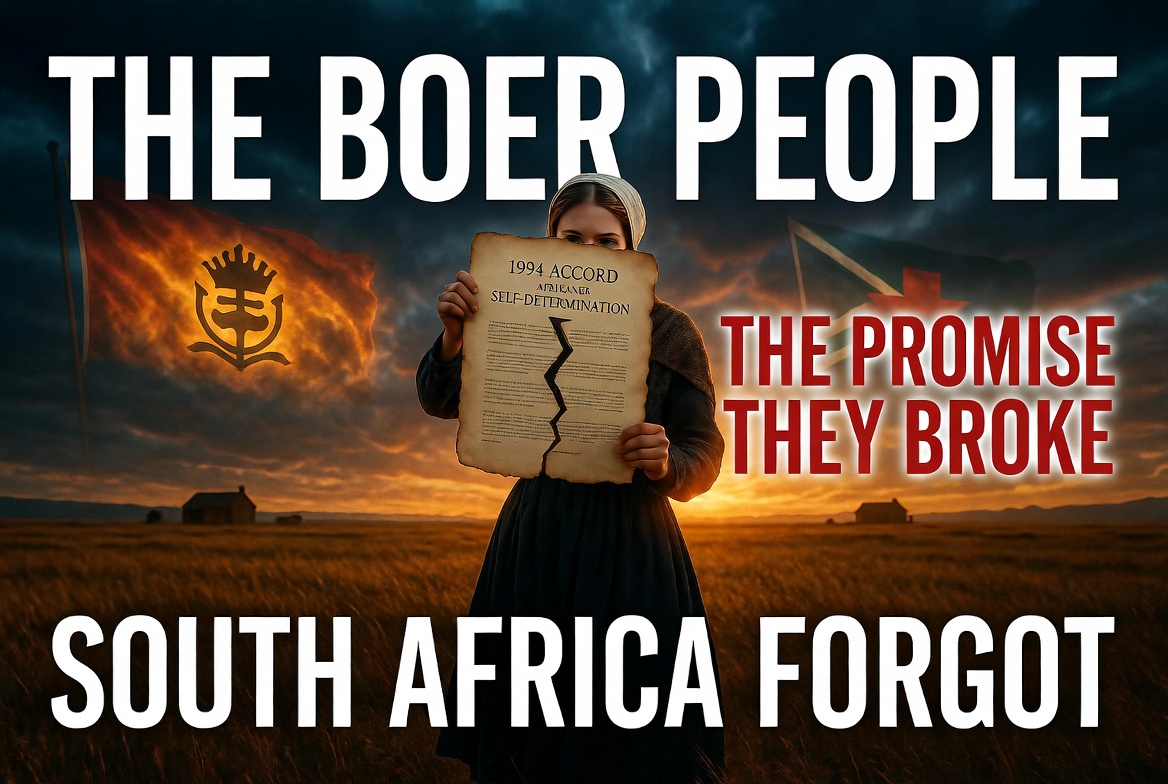
The Boer people trace their direct line to the Trekboers and Voortrekkers who left the Cape from the mid-1700s to escape British colonial tightening. They spoke their own frontier dialect, the Boer Language, and established two sovereign republics — the South African Republic in the Transvaal and the Orange Free State — that were recognised by foreign powers through formal treaties. The political label “Afrikaner,” by contrast, crystallised later in the Cape among communities that had developed a different relationship to British authority and urban administration.
After the Anglo-Boer War, the contrast remained stark. The Boers had surrendered their republics after watching tens of thousands of their women and children perish in British concentration camps - as well as the loyal black people who were put in the black concentration camps created by the Brits, creating apartheid between the Boer and the black person. Many Cape Dutch had remained largely loyal to the British Crown. When the Union of South Africa was formed in 1910, the distinct Boer republican grievance was absorbed into a broader Afrikaner nationalist project. It is telling that fraternal networks such as Freemasonry established deeper institutional roots among Cape-influenced Afrikaner communities than among the more dispersed and independent Boer populations of the northern republics. These networks, alongside other elite associations, created pathways of influence that helped certain Afrikaner factions navigate and retain leverage inside evolving power structures - the same powers whom helped sink South Africa as we know it and works behind the curtains with their corrupt political powers influencing each and every South African.
This was the first erasure — not by the sword, but by political reclassification.
The Second Erasure
In the dying days of apartheid negotiations, the question of self-determination could not be ignored. On 23 April 1994, four days before the election, the Freedom Front under General Constand Viljoen signed the Accord on Afrikaner Self-Determination together with the ANC and the National Party government. The document, preserved in United Nations archives, committed the parties to negotiate Afrikaner self-determination, including the possibility of a Volkstaat, and to establish a Volkstaatraad to do the practical work.
The council was created. Its work started. Then it was allowed to fade without delivering any concrete mechanism. The Accord spoke only of “Afrikaner” self-determination. The specific historical claim of the Boer people — the actual builders and defenders of the republics that were extinguished in 1902 — was never given separate standing. Once again the Boer identity was dissolved into a wider category that did not fully represent its distinct republican tradition and its unaddressed grievances.
Thirty Years of Consequences — and Complicity
Three decades of ANC governance have produced the predictable results: Black Economic Empowerment policies that explicitly disadvantaged white South Africans including Boer farmers and entrepreneurs, but not only whites, a lot of black people are suffering under the same policies because of the BBBEE Elites within the ANC; collapsing state enterprises; years of load-shedding; and a persistent pattern of brutal farm attacks that have received neither the priority nor the political condemnation they demand. Land expropriation rhetoric continues to target the agricultural communities that form the backbone of Boer life.
At the same time, segments of the Afrikaner establishment have remained deeply implicated in the outcomes South Africa has experienced under ANC rule. Certain Afrikaner networks and individuals have retained positions of influence inside state institutions, the bureaucracy, the judiciary, and even within or alongside ANC power structures through negotiated access and continuity. This entanglement means that responsibility for what the ANC has achieved — or failed to achieve — does not rest solely with one political party. Corruption has not respected ethnic boundaries. It has run deep within those Afrikaner circles that stayed embedded in or close to ANC governance, benefiting from or enabling the very system that has marginalised the broader Boer communities whose distinct identity was never properly represented in 1994.
Independent researchers and content creators who have done the painstaking work of documenting these distinctions, the broken Accord, and the networks of continued influence have faced direct pushback. Riaan Roux, through exhaustive research and public analysis of these suppressed historical and political realities, has produced some of the most thorough examinations available. His Facebook account was blocked on government orders after he published related material — a clear demonstration that certain truths about identity, broken promises, and elite complicity are considered too dangerous for open circulation.
WATCH:
The Oranje-Vrijstaat Boervolk and the Return of the Suppressed
In November 2025 the Oranje-Vrijstaat Boervolk formally re-proclaimed the independence of the old Orange Free State. They issued notices in the Government Gazette, referenced the original treaties that once recognised the republic, and asserted their right to manage their own affairs as a sovereign people. Their approach has remained deliberately legal and administrative. They are not reaching for weapons. They are reaching for the historical record and the unfulfilled commitments of 1994.
Critics point to legal technicalities — the non-retroactive nature of the Vienna Convention, the high bar of effective control under the Montevideo criteria. Those objections exist. They do not erase the deeper reality: a people whose republics were taken by force, whose identity was politically absorbed, whose self-determination accord was signed and then abandoned, and who have now watched thirty years of policies that treat their security and prosperity as collateral damage, are once again asserting their existence through the only peaceful channels left.
The Institutional Question That Will Not Go Away
On 23 April 1994 the ANC, the National Party government and the Freedom Front signed a formal agreement to negotiate self-determination. A council was established for that purpose. It was shut down before the work was completed. Thirty years later, the Boer people — the specific community whose sovereign history gave the entire concept of a Volkstaat its concrete meaning — remain without a functioning mechanism to address their distinct grievances.
South Africa can continue to pretend that the Boer and Afrikaner are the same, that the 1994 Accord was merely symbolic, and that the continued influence of certain Afrikaner networks inside or alongside ANC structures is an adequate substitute for genuine self-determination. Or it can recognise that independent research into these matters is being censored, that corruption has entangled elements of the very group that was supposed to have been politically neutralised, and that a legitimate historical claim is now being revived through legal proclamation in the Free State.
The Oranje-Vrijstaat Boervolk is not inventing a new demand. It is reminding the country that a promise was made in 1994 and never kept — and that the people who built the republics being invoked have not disappeared simply because political convenience required them to be forgotten. The question is no longer whether this issue will surface. It is whether South Africa will finally confront it honestly before the pressure finds outlets far harder to manage than a gazetted notice.

Comments (0)
Leave a Comment