
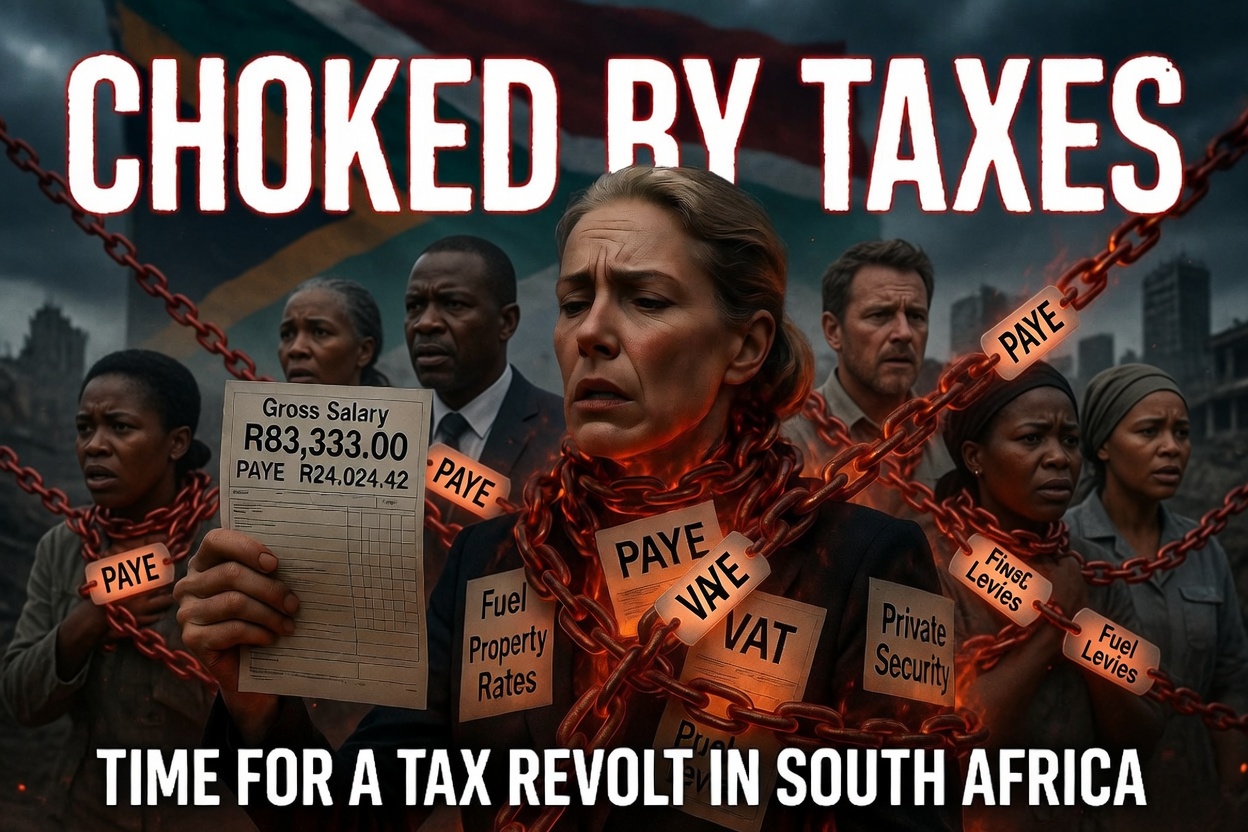
The breakdown is brutal and unsparing. Gross salary: R83,333. After PAYE, UIF and SDL the figure drops to R58,298. Then come the hidden and semi-hidden extractions — VAT on basic groceries, punitive fuel levies on petrol, eye-watering private school fees because government schools have collapsed, medical aid because public hospitals are no longer trusted, property rates, refuse removal and sanitation charges for services that frequently don’t arrive, electricity tariffs loaded with VAT, and private security because the police cannot keep citizens safe.
By the end of the month the “effective” amount left in the pocket is R36,727 — with the graphic itself noting that 56% has effectively been claimed by the state and the costs of its failures. This is not a marginal inconvenience. This is economic strangulation of the productive class.

The Real Tax Burden is Far Higher Than the Official Numbers
Official income tax tables tell only part of the story. What the payslip reveals is the total extraction — direct, indirect, visible and invisible. South Africans do not merely pay income tax. They pay:
- VAT on almost everything they buy (even when food is zero-rated, the inputs that produce it are not).
- Fuel levies that rank among the highest in the world relative to our incomes and infrastructure.
- Municipal rates and taxes that keep rising while service delivery collapses in one metro after another.
- Private alternatives for everything the state was supposed to provide: education, healthcare, security, electricity, even water in some areas.
The productive citizen ends up paying three times: once in tax to fund the state, again in higher prices because of inefficiency and cadre deployment, and a third time out of pocket to buy private solutions because the public ones have failed.
This is not taxation in the classical sense. This is the systematic transfer of wealth from those who produce to those who consume it — often through racial patronage networks, tenderpreneurship and vote-buying grants. The middle class, and especially the skilled minority that still carries the bulk of the income tax burden, is being bled dry to keep a bloated, ideologically driven system afloat.
Government Failure is Not an Accident — It is Policy
The high tax take would be more tolerable if we received world-class services in return. We do not. We receive:
- Collapsing education systems that force parents into R10,000+ monthly school fees.
- A healthcare system so degraded that medical aid has become a necessity rather than a luxury.
- A policing and justice system that cannot stop farm attacks, urban muggings or the daily slaughter on our roads.
- SOEs that have devoured hundreds of billions in bailouts while delivering load-shedding, water shedding and infrastructure decay.
- A regulatory and transformation regime (BEE, employment equity, preferential procurement) that deliberately raises the cost of doing business and chases away investment and skills.
The same government that demands ever-higher taxes simultaneously pursues policies that shrink the tax base: race-based laws that deter skilled immigration and encourage skilled emigration, expropriation threats that destroy property rights and investor confidence, and cadre deployment that destroys institutional competence.
The result is predictable: the people who pay the taxes are either leaving, downscaling, or quietly moving into lower-tax or informal arrangements. The goose that lays the golden eggs is being strangled — and the political class still thinks it can demand more eggs.
This is Not Sustainable. It is Not Moral. And It Will Not End Well.
A country cannot indefinitely extract 50%+ of the earnings of its most productive citizens while delivering Third World outcomes and actively discriminating against the very people who keep the lights on (literally and figuratively). History shows what happens when the productive class is pushed too far: capital flight, brain drain, informalisation, and eventually open resistance.
South Africans have been remarkably patient. We have absorbed VAT increases, fuel levy hikes, municipal tariff explosions, and the slow destruction of our cities. We have paid for private security while politicians sing “Kill the Boer”. We have funded our own replacement in the job market through BEE while watching our children emigrate.
Patience is not infinite. The social contract is broken. When the state takes the majority of your earnings and cannot — or will not — protect your life, property, language, culture or future, the moral obligation to keep funding it evaporates.
Time for a Tax Revolt
A tax revolt does not have to mean violence or lawlessness. It can — and should — begin with organised, peaceful, determined resistance:
- Vote with your wallet and your feet. Support political movements and parties that explicitly promise sharp tax cuts, the scrapping of race laws, and fiscal discipline. Build and strengthen communities that practise self-reliance (the Orania model is not a threat — it is a proof of concept).
- Minimise exposure legally. Structure affairs to reduce the taxable base where possible. Homeschool or use private education. Use private healthcare and security. Move economic activity into structures that are harder to milk.
- Public, relentless pressure. Flood MPs, premiers and the media with the message: enough. No more blank cheques for failure and corruption. Demand a flat, low tax system that rewards work instead of punishing it.
- Cultural shift. Stop treating high taxation as a mark of civic virtue. It is not. In the current South African context it is often a mark of complicity in your own dispossession.
The American colonists famously declared “no taxation without representation.” We have something worse: taxation without competent, non-racial, accountable governance. We are taxed to fund our own marginalisation and the slow collapse of the country we built.
The numbers on that payslip are not an anomaly. They are the new normal — unless we change course.
South Africa’s productive citizens have a choice: keep feeding the beast that is choking us, or decide that enough is enough.
It is time for a tax revolt. Before there is nothing left to tax.

Comments (0)
Leave a Comment