
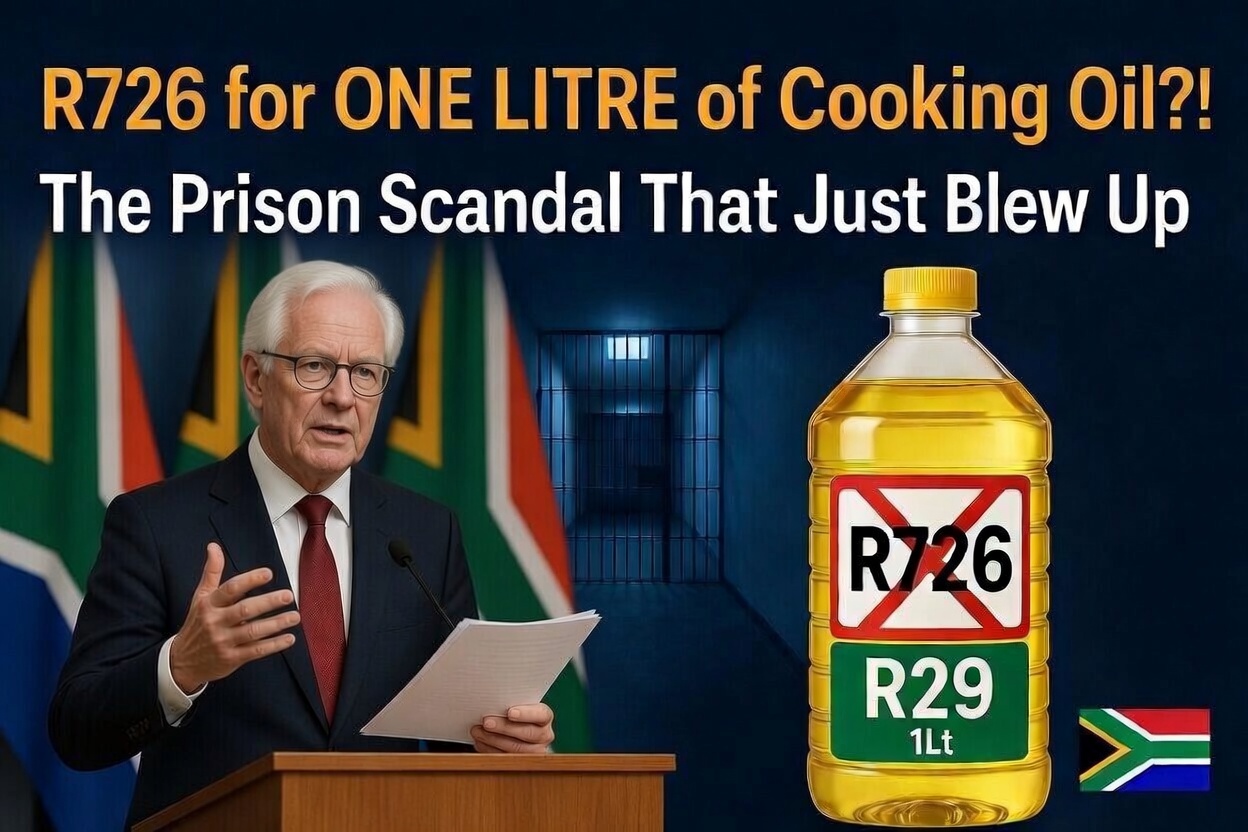
In an era where South African ministers have perfected the art of denial, deflection, and blame-shifting, one stands out for doing the opposite. Dr. Pieter Groenewald, Minister of Correctional Services in the Government of National Unity, inherited a department riddled with the rot of the past and acted decisively when that rot surfaced on his watch. Yet some opposition voices, particularly from the DA, are rushing to pin the scandal squarely on him. This is not accountability journalism — it is political opportunism that ignores how government actually functions and what real leadership looks like.
The Scandal That Was Hidden in Plain Sight
The numbers are staggering, and they expose the casual looting that has become normalized in state procurement. Under a five-year food supply contract (HO4/2023) signed in April 2025 with 115 suppliers, the Department of Correctional Services was billed R726.57 for a single litre of cooking oil — the same product South Africans buy for around R29 at any supermarket. Gravy powder? R3,735 for a batch that should cost roughly R920. These were not minor discrepancies. They were 2,400%+ markups that screamed collusion and corruption.
Parliament’s Portfolio Committee on Correctional Services rightly slammed these prices as “irrational” and a failure of internal controls. No minister personally signs off on every line item for prison pantry supplies. That job falls to supply chain officials, contract managers, and bureaucrats whose duty it is to guard the public purse. Those systems — built over decades of ANC dominance — failed spectacularly. The contract predates any deep entrenchment of Groenewald’s reforms.
WATCH:
Groenewald’s Response: Ownership, Not Optics
When the inflated prices surfaced through parliamentary scrutiny, Groenewald did what few ministers do: he took ownership and fixed it. The department renegotiated the contracts. Prices for cooking oil dropped to market-related levels of R26–R29 per litre. A review of 4,600 transactions is underway. Nearly 2,400 departmental officials have faced disciplinary action for corruption and misconduct in the past year alone. This is not cover-up mode. This is decisive action.
Contrast this with the old South African playbook: deny until caught, blame predecessors, launch endless inquiries that go nowhere. Groenewald briefed Parliament openly. He did not hide behind “it happened before my time.” Ministerial accountability means setting the tone, demanding results, and acting when failures reach your desk. He has done exactly that.
Critics conflate the existence of the problem with personal culpability. A minister does not micromanage every procurement tender. Expecting that is naive about how large departments operate. The real test is what happens next — and Groenewald passed it.
Building Self-Sufficiency While Draining the Swamp
This scandal did not occur in isolation. Groenewald has simultaneously driven reforms that reduce the department’s reliance on the very suppliers who exploited the system:
- Twelve prison bakeries now operate nationally, delivering over R77 million in annual savings on bread costs.
- Agricultural projects within prisons have generated more than R125 million in food production savings.
- Anti-contraband operations have seized over 37,000 illegal cellphones and prohibited items, striking at the heart of prison syndicates.
These initiatives are not window dressing. They attack the root: over-dependence on external suppliers prone to inflating prices at taxpayer expense. By making prisons more self-sufficient, Groenewald is cutting the pipelines that feed corruption while creating skills and productivity for offenders — a genuinely reformative approach.
Why This Matters for South Africa
South Africans are exhausted by ministers who treat state departments as personal fiefdoms or patronage networks. For decades, the default was to protect the department from scrutiny rather than protect the public from waste. Groenewald represents a break from that culture. Corruption happened — as it has for years in Correctional Services. What distinguishes him is that he exposed it, confronted it, and is rebuilding the department on a foundation of accountability and efficiency.
The DA’s rush to frame this as “Groenewald’s scandal” reveals more about partisan point-scoring than a genuine desire for clean governance. Real accountability demands forensic probes into the officials who approved these prices, not political scalp-hunting of the minister demanding change.
To the supply chain gatekeepers who let R726 cooking oil pass every internal control: When will you face charges? South Africa is watching.
Dr. Pieter Groenewald did not commit this corruption. He is exposing and dismantling it. In a country starving for leaders who put results over excuses, that deserves recognition — not manufactured outrage. The facts speak louder than the headlines.

Comments (0)
Leave a Comment