
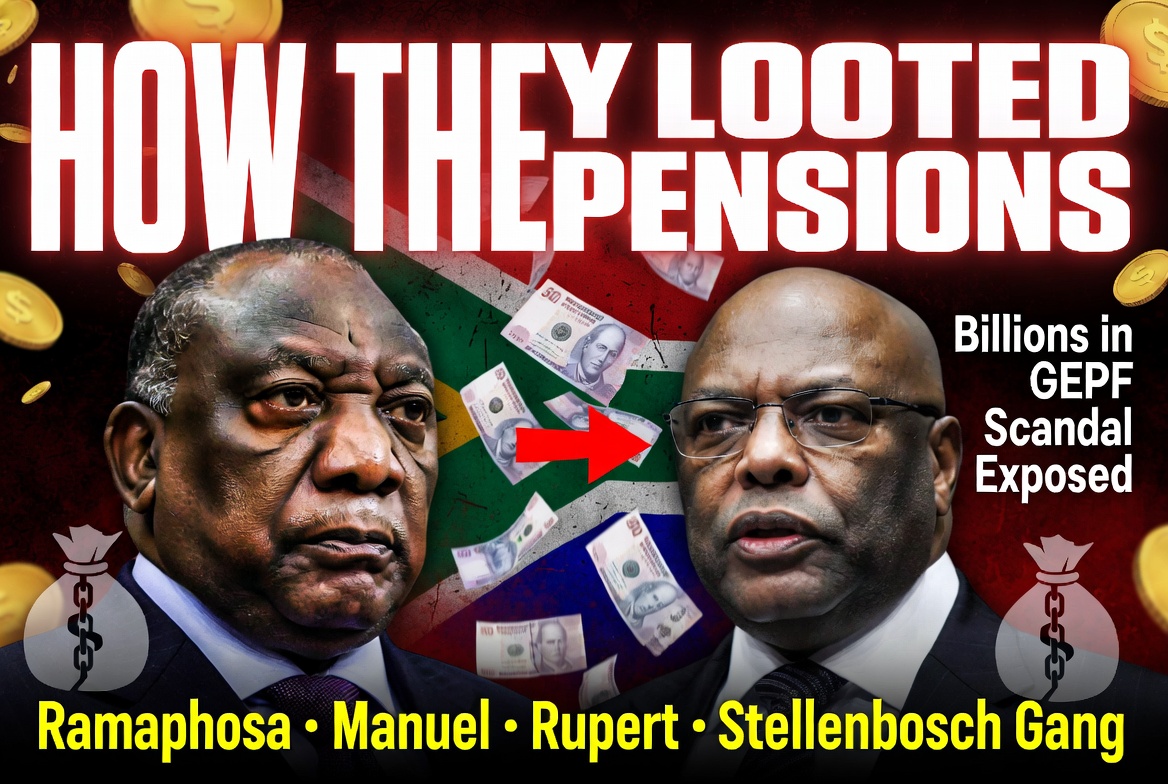
Instead, it has often functioned as a sophisticated vehicle for a small circle of politically connected insiders—backed by established business networks—to siphon off public wealth. A prime example is the web linking former Finance Minister Trevor Manuel, President Cyril Ramaphosa, and influential figures from Stellenbosch and Paarl, involving the massive Government Employee Pension Fund (GEPF) and its asset manager, the Public Investment Corporation (PIC).
Between 1996 and 2005, Trevor Manuel operated as the sole trustee of the GEPF, which held around R200 billion at the start and grew beyond R250 billion. With no board, no independent oversight, and accountability only to himself, Manuel wielded god-like discretion over the retirement savings of government workers. In 2002, he awarded a major actuarial services tender to Alexander Forbes. Shortly afterward, Alexander Forbes sold a 30% stake to Millennium Consolidated Investments (MCI), a vehicle controlled by Cyril Ramaphosa. This deal gave Ramaphosa privileged access to one of the country's largest pools of capital.
What followed was a remarkable transformation. Ramaphosa, previously a mid-tier BEE beneficiary, rapidly accumulated stakes in major companies. According to contemporary reporting, including a 2006 Mail & Guardian investigation into "fast money," his portfolio exploded:
- 16% of Alexander Forbes (valued at R1.1 billion by 2006)
- Stakes in Bidvest, Standard Bank, Mondi, Assore, Liberty Life, and others worth hundreds of millions each
- Coal interests and unlisted entities that further cemented his billionaire status
Hard work alone does not explain such velocity. Proximity to government power, ANC patronage, and strategic deals did. The GEPF tender appears to have been the spark that lit the fuse.
This history demands scrutiny—especially now. Calls for a Commission of Inquiry into the PIC should not stop at recent leadership like former CEO Dan Matjila. Fairness requires expanding the terms of reference to cover the Manuel-Ramaphosa era of custodianship. For over a decade, these men controlled billions in workers' savings with minimal checks. South Africans deserve answers on which companies and individuals received preferential capital injections, and whether conflicts of interest were exploited.
Similar questions apply to other prominent ANC-linked figures who benefited from empowerment deals during this period, as well as to asset managers tied to established business houses. Figures like Johann Rupert, Markus Jooste, Christopher Wiese, and others managed or influenced portions of these funds through subcontracted arrangements. The outcome? Many in the traditional Stellenbosch-Paarl networks emerged post-1994 with greater wealth than under apartheid—not through free-market competition, but through guaranteed access to state-directed capital from black workers' pensions, often at the expense of genuine black-owned competitors.
This is textbook cronyism: a fusion of political power and connected capital that crowds out real entrepreneurship. The PIC, now managing trillions, has too often acted as a slush fund for the politically wired and the well-established, rather than a steward of ordinary civil servants' futures. Unions like COSATU and NUMSA, which claim to champion workers, have remained conspicuously quiet—perhaps because some union investment arms have played the same game, as noted in academic analyses of "labour capitalism."
Critics rightly call this structural state capture: a system where struggle credentials, government proximity, and selective partnerships enrich a narrow elite while the broader population endures inequality, unemployment, and crumbling services. South Africa remains among the world's most unequal societies not despite these arrangements, but partly because of them. Resources meant for public servants and national development have been redirected to insiders—new and old—while taxpayers and pension contributors foot the bill.
Extending the PIC inquiry is not about scapegoating one executive. It is about transparency, accountability, and dismantling the networks that treat public funds as private piggy banks. South Africa cannot afford another decade of "Gangster Capitalists," as some have labelled them, masquerading as statesmen and business saviours. True reform means ending the era where political connections trump merit, competition, and genuine value creation. Workers deserve better than having their savings gambled or gifted to the connected few.

Comments (0)
Leave a Comment