
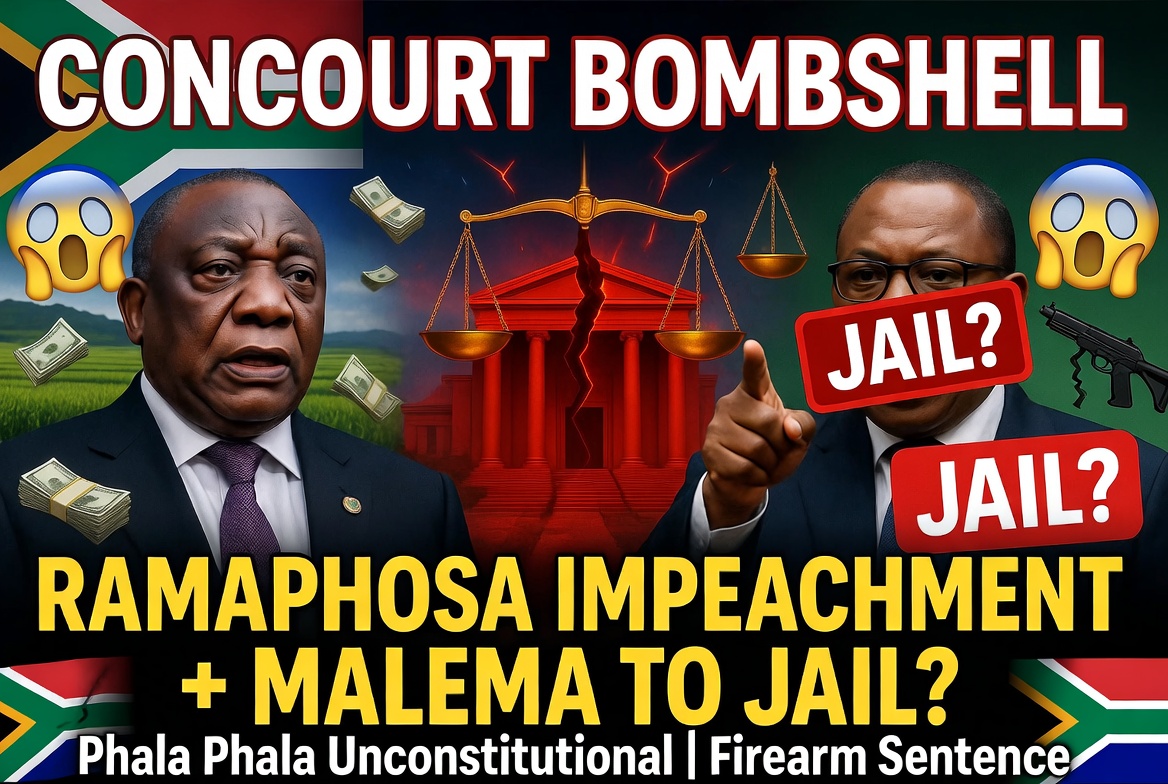
Johannesburg, 8 May 2026 — South Africa’s Constitutional Court has ruled that the National Assembly’s 2022 vote rejecting the Section 89 independent panel report on President Cyril Ramaphosa’s Phala Phala farm scandal was unconstitutional and irrational. The court has ordered Parliament to adopt the report and establish an impeachment committee for a full inquiry.
This landmark judgment comes at a time of heightened scrutiny on political accountability across party lines. Notably, EFF leader Julius Malema — whose party spearheaded the legal challenge against Parliament’s handling of the Phala Phala matter — is himself facing serious legal consequences. In April 2026, Malema was sentenced to five years’ imprisonment for unlawful possession of a firearm and two years for unlawful possession of ammunition following his 2018 act of firing a semi-automatic rifle into the air at an EFF rally in Mdantsane, Eastern Cape.
The Phala Phala Ruling
The court found that once an independent Section 89 panel establishes a prima facie case of potential presidential misconduct, Parliament cannot dismiss it through a simple majority vote without proper inquiry. This violates the rationality test and Parliament’s constitutional oversight obligations, drawing parallels to the Nkandla judgment.
The ruling does not determine Ramaphosa’s guilt — that is now for the impeachment committee to investigate through evidence and public hearings.
Julius Malema’s Firearm Conviction and Sentencing
In a separate but symbolically relevant development, Julius Malema was convicted in October 2025 on multiple firearm-related charges stemming from the 2018 incident. Video footage showed him discharging a rifle in front of thousands of supporters. The court rejected his defence that the weapon was a toy.
On 16 April 2026, Magistrate Twanet Olivier sentenced him to:
- Five years’ direct imprisonment for unlawful possession of a firearm.
- Two years for unlawful possession of ammunition (to run concurrently).
- Fines for additional offences, including discharging a firearm in a public place, with further imprisonment if unpaid.
Malema has been granted leave to appeal the sentence (though not the conviction) and remains out on bail pending the outcome. Many South Africans and political commentators argue that Julius Malema needs to be jailed for the firearm offence to uphold the rule of law consistently. Critics point out the recklessness of firing live rounds in a crowded stadium, which endangered lives and violated strict firearm control laws. They contend that allowing high-profile politicians to evade consequences for such actions undermines public trust in the justice system.
Supporters of Malema, however, claim the prosecution was politically motivated and that the sentence is disproportionately harsh.
Implications of the Developments
1. Equal Application of the Law The Constitutional Court’s Phala Phala ruling reinforces accountability for the executive and Parliament. Simultaneously, Malema’s conviction and sentence demonstrate that opposition figures are not exempt from legal scrutiny. Calls for Malema to serve his sentence highlight demands for consistent justice: if the President must face an impeachment inquiry, leaders who break firearm laws should also face imprisonment without special treatment. This duality strengthens the principle that no one is above the law.
2. Political Ramifications
- For Ramaphosa and the ANC/GNU: The impeachment process will be politically damaging and distracting, even if removal is unlikely. It exposes divisions within the GNU.
- For the EFF and Malema: The firearm case threatens Malema’s parliamentary eligibility and the EFF’s momentum. If his appeal fails and he is jailed, the party could face leadership instability, though it may also rally supporters around claims of persecution.
- Public Perception: South Africans are watching whether accountability is selective. Hypocrisy on either side — shielding Ramaphosa via party votes or excusing Malema’s reckless behaviour — erodes democratic credibility.
3. Broader Rule of Law and Precedent These cases together signal a maturing constitutional democracy where courts are willing to check power, whether held by the ruling party or fiery opposition leaders. Firearm laws, in particular, must be applied rigorously in a country plagued by gun violence. Failure to enforce Malema’s sentence could encourage lawlessness among politicians.
4. What Happens Next?
- Parliament must urgently form the Section 89 impeachment committee for Ramaphosa.
- Malema’s appeal process will unfold in higher courts, with potential further political and legal ripple effects.
- The public and civil society will continue to demand impartial justice across the political spectrum.
This moment underscores South Africa’s constitutional framework: mechanisms for accountability exist, and courts will enforce them. Whether it leads to the President’s exoneration, removal, or Malema serving time, the principle remains — the law applies equally, and violations carry consequences. Political theatre must not override justice.
This remains a developing story. Appeals and parliamentary processes will determine the final outcomes.

Comments (0)
Leave a Comment