
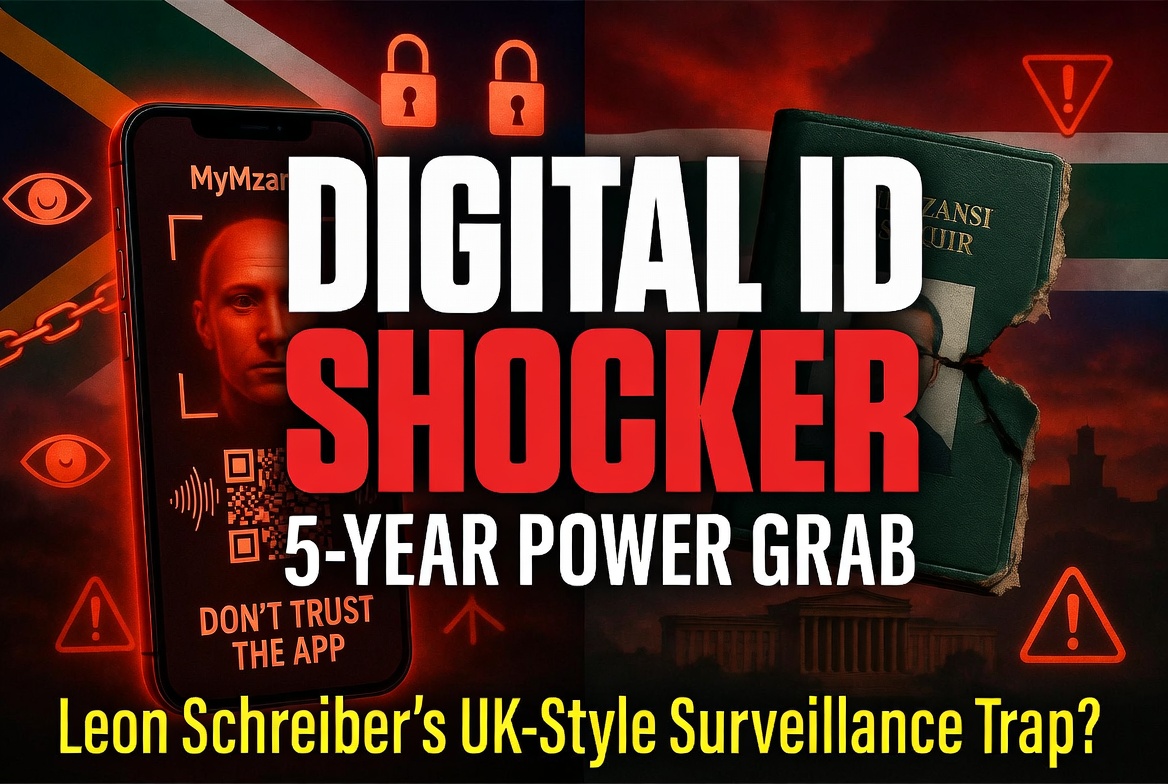
South Africa is barreling toward a sweeping digital identity overhaul that hands the government even more control over citizens’ lives – and trust is in short supply.
While officials paint this as convenience and anti-fraud, many right-thinking South Africans see red flags everywhere: expanded state surveillance, fresh opportunities for the corrupt elite, and a dangerous erosion of personal privacy in a country where government incompetence and abuse are routine.
WHAT THIS DIGITAL ID ACTUALLY MEANS
The plan rolls out a “secure” digital credential stored on your phone, complete with:
- Five-year validity – forcing regular renewals and fresh biometric captures.
- MyMzansi app access using QR codes, NFC taps, and Bluetooth.
- Direct link to the national population register.
- In-person enrolment only at DHA-approved sites with mandatory face scans or similar biometrics.
- Verification signed off by the DHA Director-General.
Home Affairs insists physical IDs stay valid and “interchangeable.” For now. History shows these “optional” systems have a habit of becoming de facto mandatory once bureaucracy tightens the screws.
HOME AFFAIRS’ SALES PITCH VS REALITY – THE UK PLAYBOOK ON ILLEGAL IMMIGRATION
Minister Leon Schreiber calls it part of the “Home Affairs @ home” revolution – bringing services to your phone while battling identity theft, fraud, illegal immigration, and corruption. Stronger “privacy protections” are promised.
But Schreiber is using the exact same model the UK government deployed to sell its own mandatory digital ID system. In late 2025, the UK (even under Labour) pushed phone-based digital IDs as the ultimate weapon against undocumented foreigners. The pitch? Employers, landlords, and authorities could instantly verify right-to-work and residency status via app, QR, or NFC — slamming the door on illegal working and reducing the pull factor for Channel crossings and overstayers.
Schreiber is copying this blueprint word-for-word for South Africa. He repeatedly flags “illegal immigration” and “illegal identity use” as core reasons for the new system. The Digital ID, tied directly to the National Population Register with biometrics, will let banks, employers, border officials, and government departments do real-time checks. No more relying on Africa’s most-forged document — the green ID book.
It’s clever politics: use legitimate public fury over undocumented foreigners flooding the country to sell a “beast system” that first targets outsiders… then quietly becomes the infrastructure for tracking everyone. Officially “not compulsory” for citizens, but once integrated into banking, grants, jobs, travel, and services, it turns into mandatory digital compliance. For illegals, it becomes an instant hard barrier.
This is how they build the digital cage: first as a net for undocumented migrants, then as the new normal for every South African.
THE MONEY ANGLE – FREE… UNTIL IT ISN’T
- Application and renewal at DHA offices: supposedly free.
- Private partners: expect extra fees.
- Renewals: facial scans every five years.
South Africans struggling with unemployment, fuel prices, and collapsing infrastructure are now expected to trek to often-chaotic DHA offices, phones in hand, for government approval of their own identity. The digital divide is real – not everyone has a reliable smartphone or lives near enrolment centres. This risks leaving rural and poor citizens further behind while empowering connected insiders.
IMPORTANT RULES – WITH A SIDE OF SKEPTICISM
The government says it’s not compulsory. You’ll get a 90-day expiry warning. Physical cards remain valid.
Sounds reassuring? Remember how “temporary” COVID measures or “voluntary” apps quietly became pressure points. A system this invasive, linked to the population register and built on the UK migration-control template, invites future mandates — especially as politicians chase greater central control. Public comments close 6 June 2026. Use them.
THE CORE ISSUE: DO YOU TRUST THIS GOVERNMENT WITH YOUR DIGITAL LIFE?
This isn’t harmless tech upgrades. It’s a fundamental shift that could reshape how South Africans prove who they are for everything from opening a bank account to crossing borders. In a country with:
- Rampant state capture history,
- Weak cybersecurity,
- A track record of abusing institutions for political ends,
handing over biometric digital IDs stored on phones raises serious liberty concerns. Physical IDs, however imperfect, give citizens tangible control. A phone-based system vulnerable to hacking, government glitches, load-shedding blackouts, or “technical issues” puts ordinary people at the mercy of officials who have repeatedly failed them.
Right-leaning voices have long warned against Big Brother expansions that erode individual sovereignty in the name of “efficiency” or “border control.” South Africa’s identity system needs fixing — but not through rushed centralisation that rewards the same broken bureaucracy while using illegal immigration as the emotional Trojan horse.
Would YOU trust a government-linked DIGITAL ID on your phone for all your identity needs? Or should the physical green book and smart card remain the gold standard – the one thing citizens actually control?
This debate matters. Drop your unfiltered thoughts below. South Africa cannot afford another top-down experiment that prioritises state power over citizen freedom. The physical ID should stay king — anything less risks turning every South African into a data point in the ruling elite’s database.

Comments (0)
Leave a Comment