
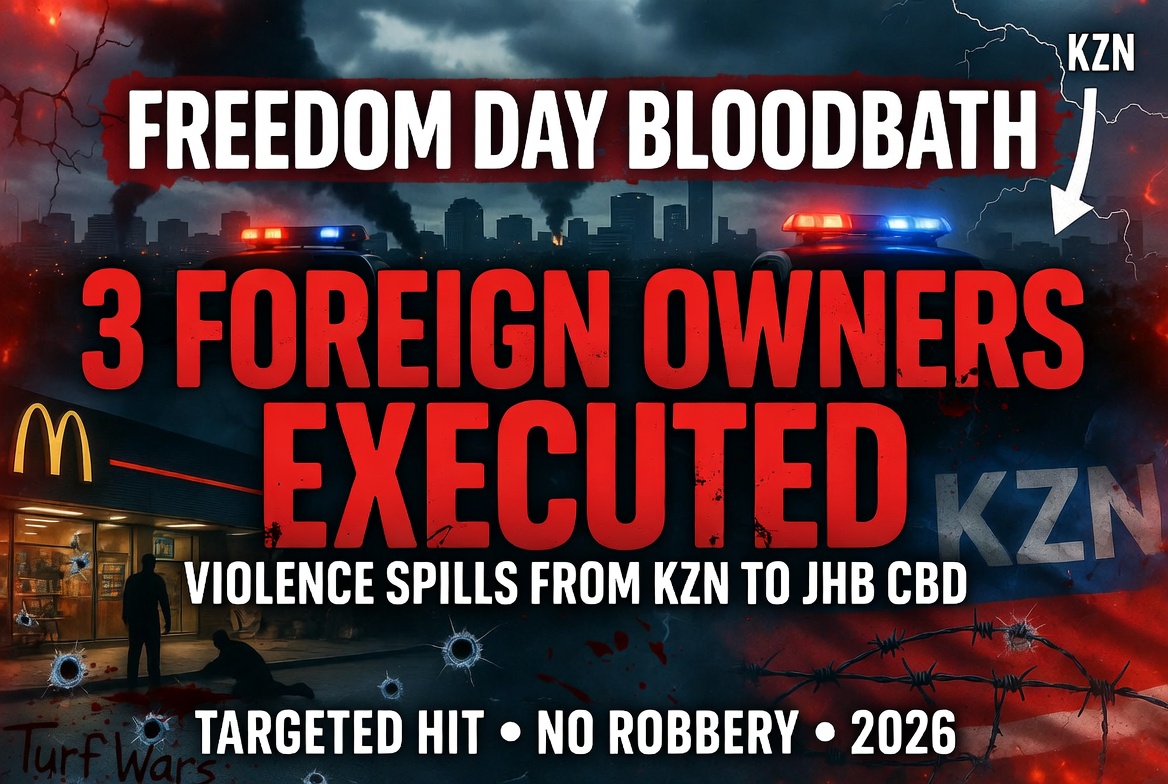
As South Africa staged its annual Freedom Day theatre of reconciliation and unity on 27 April 2026, the real face of the country emerged once again in Johannesburg’s inner city. Three foreign national shop owners — believed to be Ethiopian — were gunned down in cold blood inside a fast-food outlet in the Johannesburg CBD. No robbery took place. Nothing was stolen. This was a calculated, targeted hit amid escalating turf wars.
This brazen daylight execution marks the second shooting in the Johannesburg CBD in under 24 hours and fits a rapidly worsening pattern of violence that analysts warn is now spilling over from KwaZulu-Natal into Gauteng’s commercial heart.
From KZN Tinderbox to Johannesburg Streets
KwaZulu-Natal has long been the epicentre of South Africa’s simmering ethnic and political tensions. Political assassinations, taxi violence, factional ANC battles, and growing xenophobic flare-ups have turned parts of the province into a low-intensity conflict zone for years. Recent clashes in Durban CBD involving locals and foreign nationals, combined with inflammatory rhetoric from radical parties, have pushed frustration over illegal immigration, crime, and economic displacement to boiling point.
That volatility is now visibly migrating northward. Johannesburg’s CBD — already a patchwork of hijacked buildings, foreign-dominated trading networks, and collapsing governance — is absorbing the overflow. Turf wars between rival foreign business syndicates, often involving extortion, protection rackets, and control of prime trading spots, have turned sections of the city centre into battlegrounds. Ward 59 Councillor Sthembiso Hlatshwayo confirmed that such killings are becoming a weekly occurrence, with authorities struggling to contain the chaos.
Police have described the latest attack as targeted, with no arrests made and investigations “ongoing” — the standard response that has done nothing to stem the tide.
The Broader Collapse
This is not isolated criminality. It is a symptom of deeper state failure and the radical political climate warned about in recent analyses. As the EFF, MK Party, and factions within the ANC push to dismantle key constitutional protections — particularly Section 235 on self-determination, along with property rights, freedom of association, and equality provisions — the country’s fragile social fabric is tearing further.
The article “Civil War on the Cards for South Africa” (WesternPulse, 25 April 2026) highlighted how this constitutional sabotage, coupled with 142 race-based laws and inflammatory hate speech, is accelerating “Blartheid” — systemic discrimination and polarization that risks igniting wider conflict. The piece explicitly warned that violence brewing in KZN would not remain contained and that illegal foreigners could become both perpetrators and victims in the coming storm, with minorities of all races ultimately in the crosshairs.
Yesterday’s Freedom Day bloodshed in Johannesburg proves the warning was prescient. While politicians celebrated 1994, three more men lay dead in a McDonald’s because competing factions could not resolve business disputes peacefully — and the state has neither the will nor the capacity to stop it.
Freedom for Whom?
South Africa’s inner cities are sliding into anarchy. Local South African traders have largely fled the Johannesburg CBD. Foreign nationals filled the void, only to import their own brutal competitions. Meanwhile, ordinary citizens avoid the area entirely. Service delivery has collapsed, buildings are hijacked, and law enforcement is overwhelmed or compromised.
This is the real legacy of three decades of “transformation”: a hollowed-out economy, ethnic enclaves at war, and a government more obsessed with rewriting the Constitution to settle historical scores than with basic policing and order.
As violence spills from KZN’s killing fields into Johannesburg’s commercial core on the very day the nation was meant to honour its “freedom,” the question echoes louder than ever:
How much more blood must flow before the political elite admit that their rainbow experiment has failed?
The Johannesburg CBD bloodbath is not an aberration. It is the new normal — and a terrifying preview of what happens when radical politics, open borders, and state incapacity collide. South Africa is not sliding toward crisis. It is already in it.

Comments (0)
Leave a Comment