
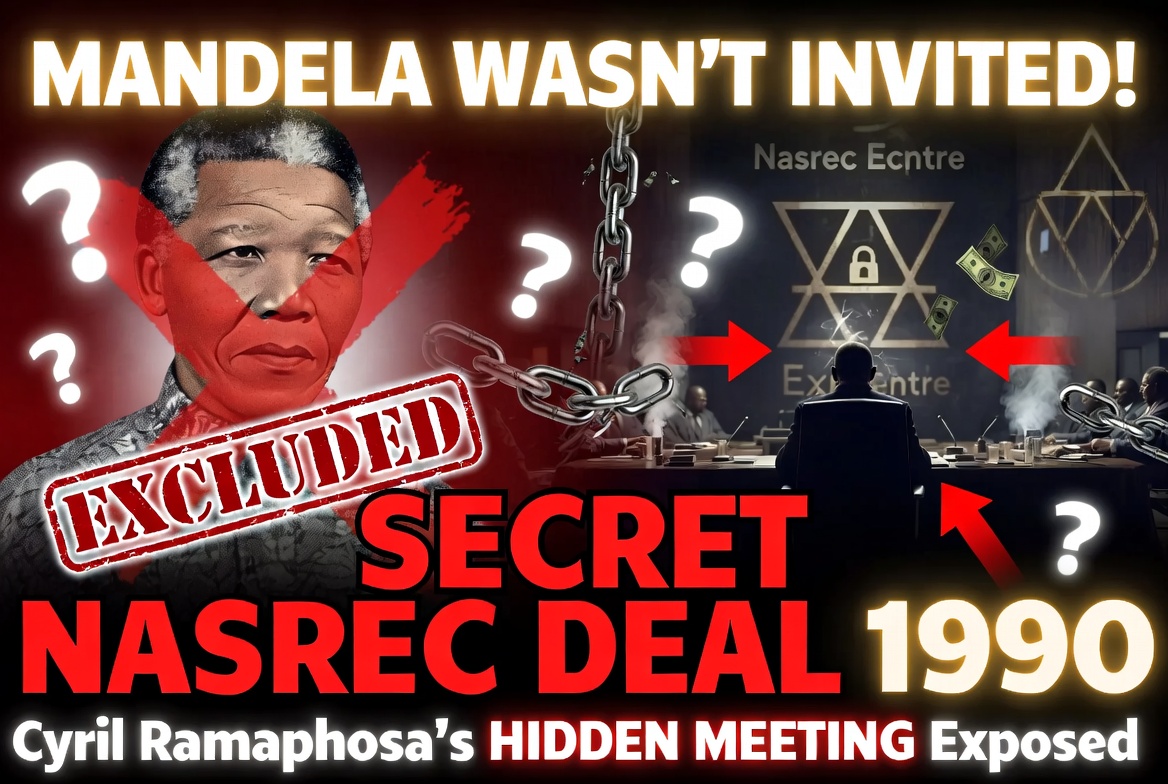
In the chaotic dawn of South Africa’s so-called “transition” from apartheid, while the world cheered Nelson Mandela’s release and toasted the end of white minority rule, something far darker was unfolding behind the concrete walls of Johannesburg’s Nasrec Expo Centre. December 1990. The ANC’s National Consultative Conference was supposedly a triumphant homecoming—the first major gathering inside the country after three decades in exile. But according to whispers that have circulated in underground circles for decades, the real meeting wasn’t the one with the cameras and the chants. It was the closed-door session chaired by a then-37-year-old Cyril Ramaphosa, where the true future of the liberation struggle was decided. And Nelson Mandela? He wasn’t in the room.
Why?
Because the architects of the new order didn’t want him there.
Official history tells us the 1990 consultative conference was all about unity, strategy, and carrying forward the armed struggle while negotiating with the regime. Mandela delivered the keynote. Oliver Tambo spoke. The masses were mobilised. But those who have dug deeper—former ANC insiders who later broke ranks, veteran unionists who saw the writing on the wall, and researchers who’ve pieced together the timeline—paint a very different picture. They claim a parallel, far more secretive gathering occurred at Nasrec, convened under the guise of “internal coordination” or “reception committee logistics.” Ramaphosa, fresh from his role heading Mandela’s official welcome committee and still riding high as the firebrand leader of the National Union of Mineworkers (NUM), was installed as chair. Not Mandela. Not Tambo. Not any of the Robben Island old guard. Ramaphosa—the man with the polished suits, the legal mind, and the quiet connections to white business interests that would later make him one of Africa’s richest men.
What was really discussed in that room?
What does Cyril Ramaphosa really know about the farm attacks and farm murders in South Africa?
According to the conspiracy that refuses to die, this wasn’t about continuing the revolution. It was about containing it. Insiders allege the agenda focused on the economic surrender that would define the post-apartheid era: the quiet abandonment of nationalisation of the mines, the banks, land, and “monopoly industry” that had been central to ANC policy since the Freedom Charter. Ramaphosa, with his deep roots in the mining sector, allegedly presided over talks that laid the groundwork for what critics now call the “elite pact.” Representatives from key conglomerates, shadowy international observers, and ANC pragmatists (some still unnamed) reportedly hammered out assurances that the incoming black government would not touch the golden goose of South African capitalism. In exchange? A smooth handover of political power, with the economic levers remaining firmly in the same hands that had profited under apartheid.
One leaked memorandum circulating in activist circles since the early 2000s supposedly referenced “structured engagement” with “key economic stakeholders” to prevent “economic destabilisation.” Translation: don’t scare the markets. Don’t scare the mines. Don’t scare the West. The armed struggle? It would be suspended—not because the regime had conceded, but because the new insiders had already cut a deal. The violence in the townships? Some claim it was allowed to fester as a pressure valve, keeping the masses distracted while the real negotiations happened in air-conditioned Nasrec backrooms.
And Mandela’s conspicuous absence from this inner sanctum? That’s where the theory gets truly explosive.
Mandela had just returned from a whirlwind international tour—London, the United States, Europe—where he was feted as the living symbol of reconciliation. But according to the narrative, the inner circle (including elements from the exiled leadership and rising internal figures like Ramaphosa) viewed the old man as too principled, too radical, too unpredictable. He still spoke openly about nationalisation. He still demanded genuine economic justice. He was the people’s hero, yes—but heroes can be liabilities when you’re trying to reassure Anglo American and De Beers that the new South Africa would be “business-friendly.”
So Mandela was kept on the stage—literally. While Ramaphosa chaired the real power session at Nasrec, Mandela was steered toward public rallies and ceremonial appearances. Some even suggest he was deliberately over-scheduled, exhausted by travel and adulation, so that the hard-nosed realpolitik could proceed without his moral authority derailing the compromises. “Madiba was the face,” one alleged former delegate reportedly confided years later. “Cyril was the brain—and the broker.”
Fast-forward three decades. Ramaphosa, the union militant turned billionaire, ascends to the ANC presidency at another Nasrec conference in 2017. The same venue. The same man in the chair. Coincidence? Or the completion of a long game that began in those smoke-filled 1990 rooms? The economy remains dominated by the same white monopoly capital the struggle supposedly targeted. Black economic empowerment enriched a tiny connected elite (including Ramaphosa himself through his Lonmin and Shanduka dealings). The masses still wait for the economic freedom they were promised. And the conspiracy theorists ask: was Nasrec 1990 the moment the revolution was not stolen—but quietly auctioned off?
We may never see the minutes of that meeting. They were never meant for public consumption. But the questions linger like smoke in an empty hall: Who really chaired South Africa’s future in 1990? What promises were made in Mandela’s absence? And why does the same name—Ramaphosa—keep appearing at the centre of every pivotal moment, from the reception committee to the presidency?
The official story says it was all above board. The truth, as always in the shadows of Nasrec, may be far more calculated. Far more lucrative. And far more damning.

Comments (0)
Leave a Comment