
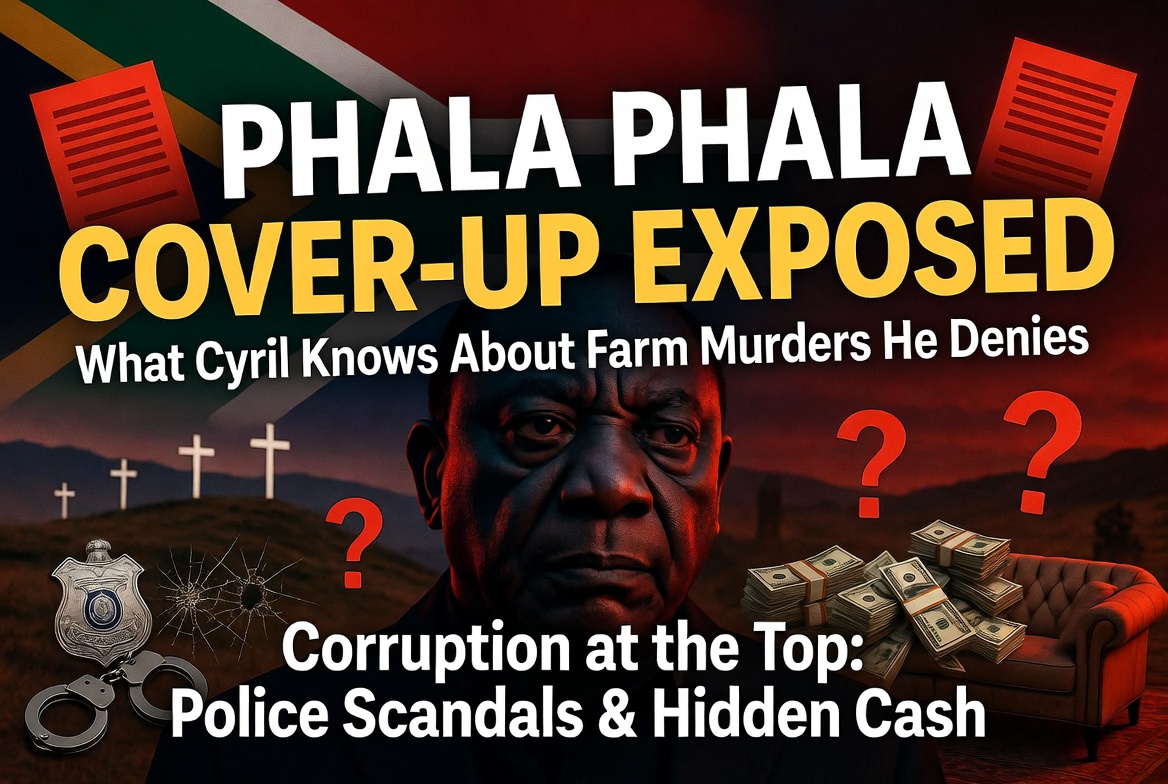
Johannesburg - 25 April 2026
In the high-stakes arena of South African politics, where corruption scandals have toppled presidents and eroded public trust, one name keeps resurfacing in whispers of impunity: Cyril Ramaphosa. The 2020 burglary at his Phala Phala game farm—now infamous as “Farmgate”—has become the poster child for claims that the president has repeatedly allowed serious irregularities to “slip under the radar.” Critics argue it’s not an isolated lapse but part of a broader pattern of selective accountability, where state resources are bent to protect the powerful while ordinary South Africans grapple with crime, inequality, and faltering institutions.
The facts of Phala Phala are no longer in dispute, even if interpretations clash. On 9 February 2020, intruders broke into Ramaphosa’s private farm near Bela-Bela in Limpopo. Hidden in a sofa in the president’s residence was approximately $580,000 (roughly R9 million at the time) in undeclared US dollars—cash reportedly received as payment for buffalo from a Sudanese businessman, though the sale’s completion remains contested. Ramaphosa, then attending an AU summit in Addis Ababa, was informed and immediately contacted Major General Wally Rhoode, head of the Presidential Protection Service within the South African Police Service (SAPS). No formal case docket was opened with regular police channels. Instead, an “off-the-books” operation ensued: presidential security personnel pursued the suspects, recovered portions of the cash, and allegedly interrogated or pressured them—actions later flagged as potential kidnapping, bribery, and misuse of state resources.
For over two years, the incident stayed largely hidden. It exploded publicly in June 2022 when former State Security Agency boss Arthur Fraser—a Zuma ally—filed a criminal complaint accusing Ramaphosa of money laundering, kidnapping, bribery, and concealing a crime (Remember this, patterns are important!). Parliamentary processes followed, including a Section 89 independent panel that found “serious misconduct” and recommended further scrutiny. Impeachment talks loomed but were voted down along party lines.
Fast-forward to 2026: the Independent Police Investigative Directorate (IPID) report—declassified only after legal pressure from opposition parties like ActionSA and the ATM—has reignited the fire. Completed years earlier but kept “top secret,” it recommends disciplinary action against Rhoode and Constable Hlulani Rekhoto for breaching police protocols. Key findings: no official inquiry file was registered on the CAS system; state resources were repurposed for a private matter; and the operation bypassed standard crime-reporting obligations. The report explicitly ties the chain back to Ramaphosa’s initial notification to Rhoode, creating what critics call a parallel justice system for the president.
Ramaphosa’s response has been consistent and firm: “I had nothing to do with it.” (Remember, we are coming to the farm murders) He maintains he reported the theft appropriately to his protection detail, denies knowledge of or involvement in any unlawful tactics, and insists all processes must run their course through independent institutions. The South African Reserve Bank cleared any exchange-control violations, finding no perfected transaction. The National Prosecuting Authority announced in October 2024 it would not pursue criminal charges against the president. The Public Protector’s earlier probe yielded mixed but ultimately non-fatal findings on ethics breaches.
Yet the optics are damning for many. A sitting president’s security detail conducting a covert recovery operation without a formal police file raises legitimate questions about abuse of power and unequal application of the law. As one IPID-linked analysis noted, this wasn’t just poor record-keeping—it was concealment of a crime scene involving the head of state’s private residence. Opposition voices, from the EFF to ActionSA, argue Ramaphosa has “a clear case to answer” and that the delayed declassification itself smells of protection.
Not the First Rodeo?
Phala Phala did not emerge in a vacuum. Ramaphosa’s record includes other controversies that fuel the “cover-up” narrative, though none have resulted in convictions:
- CR17 campaign funds: During his 2017 ANC leadership bid, questions arose over undisclosed donations. Public Protector Busisiwe Mkhwebane initially found misconduct, but courts overturned it. Critics still cite it as evidence of selective disclosure.
- Police and cabinet scandals under his watch: In 2025–2026, Ramaphosa suspended Police Minister Senzo Mchunu amid allegations of protecting a criminal syndicate and disbanding a political killings task team. National Police Commissioner Fannie Masemola was charged in connection with an allegedly corrupt R360 million health and wellness tender (Medicare24) awarded unlawfully to a company linked to businessman Vusimuzi “Cat” Matlala, who faces his own serious criminal charges. The contract was later cancelled due to irregularities, and Masemola—facing charges under the Public Finance Management Act—was placed on precautionary suspension in April 2026.
Compounding these concerns is the appointment of Lieutenant-General Puleng Dimpane, SAPS Chief Financial Officer since 2018, as acting National Police Commissioner following Masemola’s suspension. Dimpane has publicly flagged the Medicare24 tender as an “embarrassment,” testified before Parliament on systemic irregular expenditure, and warned of a culture among senior managers that fails to address procurement failures. She has called for full accountability “no matter their ranking.” Yet as the senior official responsible for financial management and oversight during the period the irregular contract was processed and approved, critics argue she presided over the very system that allowed a high-value deal tied to alleged organised crime networks to advance in the first place. Her rapid elevation to the top policing post—while the commissioner she reported to now faces criminal proceedings—has drawn accusations of a “musical chairs” approach to leadership rather than independent, root-and-branch reform. Detractors contend this move reflects Ramaphosa’s preference for internal management and optics over decisive action that might expose deeper infiltration or complicity at senior levels.
- Broader governance critiques: Farm attacks and rural safety remain flashpoints. While Ramaphosa condemns violence and notes that most murder victims are Black South Africans, data from AfriForum and TAU show dozens of farm murders annually amid extreme brutality. Government statistics frame them as general crime, not targeted persecution, but critics accuse the administration of downplaying rural insecurity.
What Does Cyril Ramaphosa Know — and Deny — About Farm Murders?
As the article closes in 2026, one lingering question cuts through the scandals: What does President Cyril Ramaphosa actually know about farm murders, and why does he so vehemently deny any racial or political dimension?
Ramaphosa has been consistent for years. He acknowledges that farm attacks and murders occur but insists they are ordinary criminal acts driven by robbery, not a coordinated campaign, ethnic cleansing, or “white genocide.” In public statements, parliamentary addresses, and high-profile exchanges (including the tense May 2025 Oval Office meeting with U.S. President Donald Trump), he has repeatedly pushed back:
- Farm murders form a tiny fraction of South Africa’s overall murder toll (27,000+ annually). Official SAPS figures for early 2025 showed just 6 murders in farming communities in one quarter, with most victims Black (farmers, employees, or dwellers).
- He condemns the brutality but attributes it to the country’s broader crime crisis — high inequality, unemployment, and weak policing — rather than race or politics.
- Rhetoric like “Kill the Boer” from EFF leader Julius Malema is dismissed as minority-party hyperbole protected by free speech, not official policy. Government position: no evidence of state orchestration or genocide.
Critics, including AfriForum, TAU SA, opposition parties (DA, FF+), and rural communities, argue this stance amounts to denialism and cover-up by omission. They point to:
- Decades of documented cases involving torture, rape, and gratuitous violence that go beyond typical robbery.
- AfriForum’s 2025 report: 184 attacks and 29 murders, with sustained high levels of violence. Cumulative figures since the 1990s run into thousands of attacks and over 2,000 murders.
- Failure to establish a dedicated Commission of Inquiry despite repeated calls (e.g., from the DA). Police stopped separate “farm murder” tracking in 2007, folding it into general rural safety stats — seen by detractors as deliberate obfuscation.
- Perceived reluctance to confront incitement (e.g., songs and slogans) or prioritise rural safety infrastructure.
Ramaphosa’s defenders counter that inflating farm murders into a racial narrative distracts from the fact that Black South Africans suffer the vast majority of violent crime. Independent probes (including past government inquiries) have found no evidence of a genocidal plot. His government has run rural safety strategies, though implementation is widely criticised as inadequate.
Whether Ramaphosa’s position reflects genuine belief in the data, political calculation to avoid alienating his base, or something more calculated remains hotly debated. What is clear is that the denial — or reframing — fuels deep distrust. In a country still scarred by its past, the gap between official narratives and lived rural reality continues to widen.
Slipped Under the Radar—or Held to Account?
The pattern claim has traction because Phala Phala exposed real procedural lapses that ordinary citizens could never replicate. A president’s word to his security chief triggered a shadow investigation; the rest of South Africa must queue at a police station. The IPID report’s late emergence after years of classification, combined with the latest SAPS leadership shuffle, only deepens cynicism about transparency at the top.
Yet South Africa’s democracy has checks: parliamentary votes, court reviews, declassifications via PAIA, and a free(ish) press have kept the story alive. No smoking gun has produced a conviction—unlike the Zuma years. Whether Phala Phala (and the cascade of police scandals) is “just one of many” depends on perspective: for critics, it exemplifies elite impunity and recycled appointments; for supporters, it proves the system still works, albeit slowly.
Criminals follow patterns. Everyone does. The repeated use of state resources for private protection, the shuffling of compromised officials into higher positions, the consistent downplaying of uncomfortable statistics on rural violence, and the careful legal and narrative management around scandals all point to behavioural consistency at the highest levels. In the end, patterns don’t lie — they simply wait to be recognised. As Ramaphosa navigates a Government of National Unity and mounting pressure from opposition and civil society, the real test isn’t past scandals but whether future ones — including the unresolved rural safety crisis — receive the same forensic scrutiny. South Africans deserve more than radar evasion — they deserve institutions that treat every citizen equally, from the farm in Limpopo to the township streets. The Phala Phala files — and now the SAPS leadership files, and the farm murder debate — remain open in the court of public opinion.

Comments (0)
Leave a Comment