
By WesternPulse News Desk
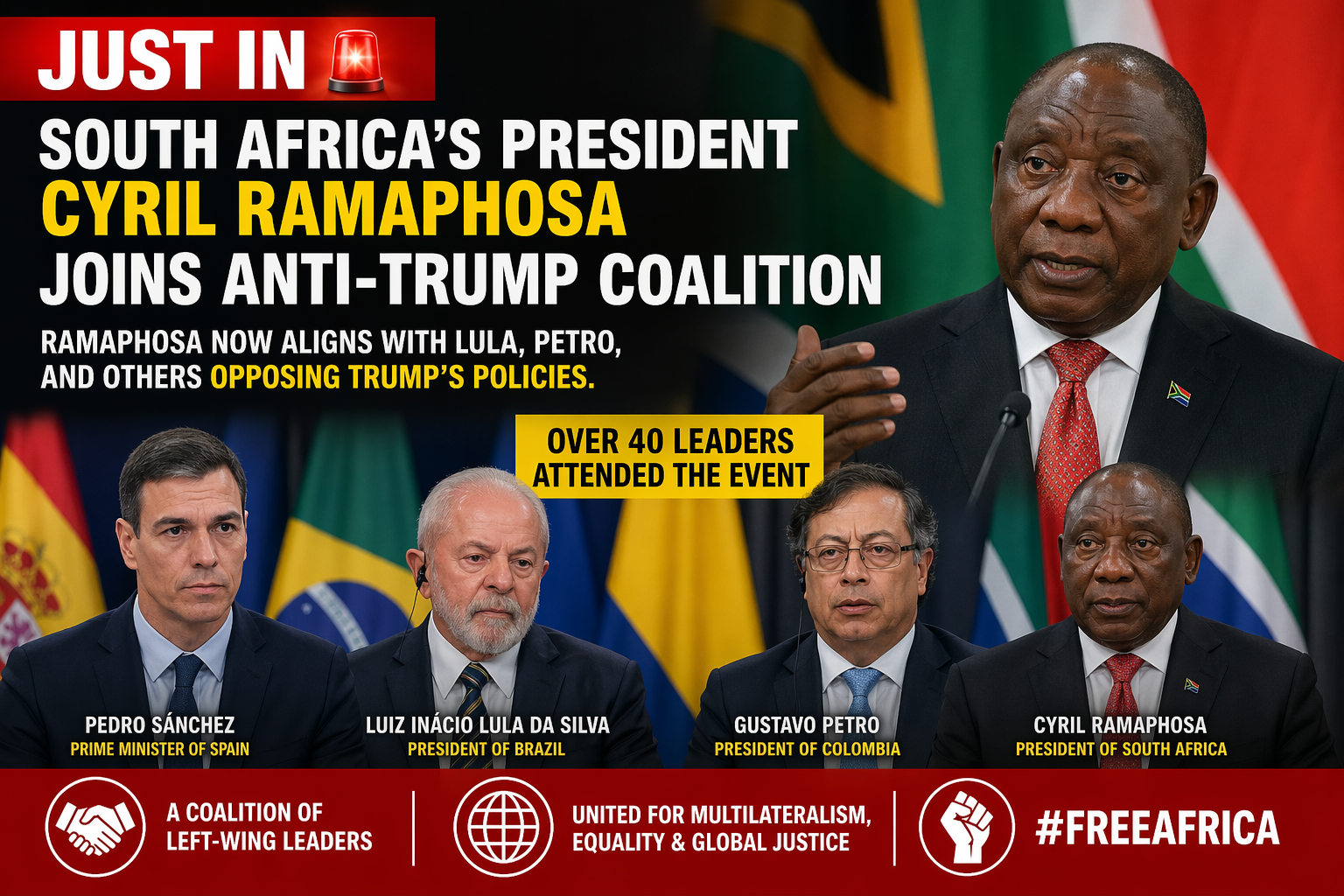
In a significant geopolitical shift, South Africa’s President, Cyril Ramaphosa, has joined a growing coalition of left-leaning global leaders positioning themselves in opposition to the policies associated with former U.S. President Donald Trump.
The bloc—informally described by observers as an “anti-Trump alliance”—is being spearheaded by Spain’s Prime Minister, Pedro Sánchez. The gathering, which drew more than 40 world leaders, signals a coordinated effort among several nations to push back against what they view as increasingly unilateral and protectionist tendencies tied to Trump-era politics.
A Strategic Alignment
Ramaphosa’s participation places South Africa alongside influential figures such as Brazil’s President Luiz Inácio Lula da Silva and Colombia’s President Gustavo Petro. Together, this coalition is advocating for a multilateral global order, emphasizing cooperation, trade equity, and resistance to nationalist economic policies.
The move comes at a delicate time for Pretoria, as tensions with the United States have reportedly intensified. While official details remain limited, diplomatic pressure from Washington has been mounting over South Africa’s foreign policy positioning and global alliances.
Pretoria Under Pressure
Analysts suggest that Ramaphosa’s decision reflects a calculated balancing act. South Africa remains economically tied to Western markets, particularly the United States, but has increasingly sought to assert independence in its global stance—aligning more closely with emerging economies and Global South narratives.
This latest development may deepen scrutiny from Washington, especially as geopolitical fault lines widen ahead of upcoming global elections and shifting power dynamics.
A Broader Movement
The summit, attended by over 40 leaders, underscores a broader ideological divide taking shape on the global stage. While the coalition is not formalized as a treaty bloc, its messaging is clear: a unified resistance to policies perceived as undermining international cooperation.
For South Africa, the implications could be far-reaching—impacting trade relations, diplomatic ties, and its role within both Western and developing world alliances.
As the situation unfolds, all eyes will be on Pretoria to see how it navigates the increasingly complex terrain between global power blocs.
#FreeAfrica

Comments (0)
Leave a Comment