
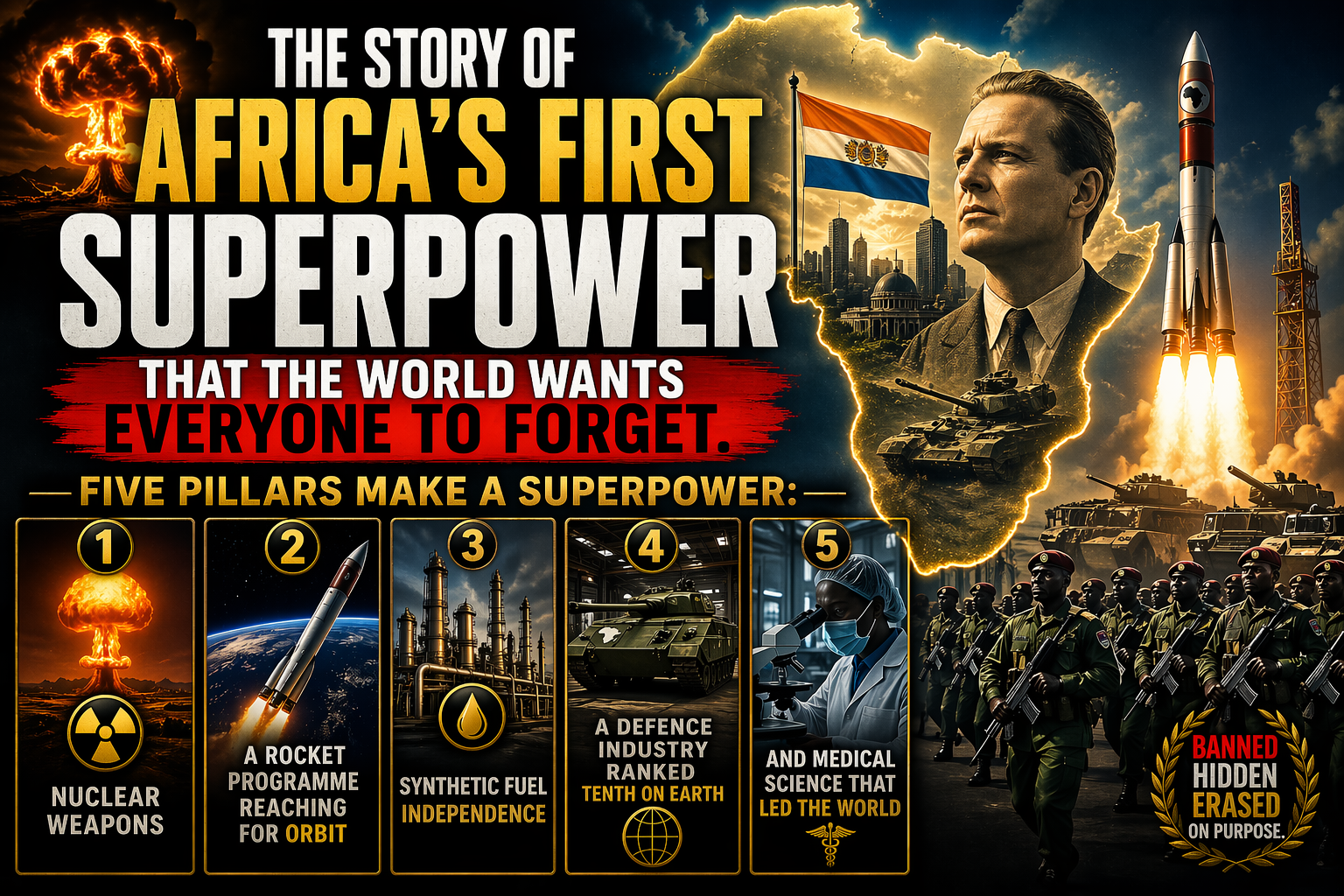
Five pillars make a Superpower:
- Nuclear weapons.
- A rocket programme reaching for orbit.
- Synthetic fuel independence.
- A defence industry ranked tenth on earth.
- And medical science that led the world.
Pre-1994 South Africa had every single one. One country, at the tip of Africa, built all of that before the Berlin Wall came down. Then they made you forget it ever happened.
Now Africa is “just Africa.” Still trying. Still borrowing. Still begging for the infrastructure that one small nation already had, thirty years ago, before it was forced to tear it apart with its own hands.
Let me say something that will offend a lot of people. That is fine. It also happens to be true. While White South Africans were enriching uranium at Pelindaba, test-firing rockets from the Overberg coast, turning low-grade coal into petrol at Secunda and performing the world’s first human heart transplant at Groote Schuur, the liberation movements across the rest of Africa were being handed a very different gift. Not industrial strategy. Not energy independence. Not sovereign technology. They were handed communism. Slogans instead of centrifuges. Five-year plans instead of fuel plants. Moscow printed the pamphlets. Beijing supplied the rifles. And when the dust settled, every single African state that followed the Soviet model traced the same arc: nationalisation without technical capacity, institutional collapse, structural dependence on the very foreign powers that had supplied the revolution. Tanzania. Mozambique. Zimbabwe. Ethiopia. The pattern is not a coincidence. It is the product.
Communism offered Africa liberation as a brand and dependency as the operating system. It turned “Africa for Africans” into “Africa for anyone with leverage,” and the continent has been paying that bill ever since. Three decades later, the same nations that were told to reject Western industrial models in the name of African socialism are now borrowing billions from Beijing to build what they could have built for themselves, if the one country that had already done it had not been made to dismantle every last piece of it first.
Think about what the White South Africans actually accomplished. Under crippling international sanctions, with a population smaller than some European cities, they developed an indigenous uranium enrichment process, the Helikon vortex tube, that the outside world had never seen. They built six nuclear weapons and a seventh was on the production line. Then, before handing power to the ANC, the White South African government destroyed them all, signed the Non-Proliferation Treaty, opened every facility to IAEA inspectors, and told the world exactly what they had done. No other nuclear state in history has done that. Not one. They built the bombs, they dismantled the bombs, and they proved, beyond doubt, that they had developed the technology in isolation.
That is not the behaviour of reckless ideologues. That is discipline on a level the great powers have never matched.
They built a rocket series, RSA-1 through RSA-4, from a coastal launch facility at Overberg near Bredasdorp. RSA-1 hit 100 kilometres. RSA-2 reached 300. The RSA-3, a three-stage solid-propellant satellite launch vehicle based on Israeli Shavit technology, was designed to put a 330-kilogram reconnaissance satellite called Greensat into low Earth orbit. The RSA-4 could lift 550 kilograms to 1,400 kilometres. These were not drawings. They were built. Tested. Operational. And then, under American supervision, the casting pits were filled with concrete, the X-ray equipment was demolished, the test facility at Rooi Els was turned into a nature reserve. Staff went from 500 to 28 in five years. Africa’s only indigenous orbital launch capability was physically destroyed. Not mothballed. Destroyed.
Sasol, founded in 1950, perfected Fischer-Tropsch coal-to-liquids synthesis at a scale the world had never seen. Eighty Sasol-Lurgi gasifiers at Secunda produced 150,000 barrels of synthetic fuel a day, covering a third of the country’s needs from nothing but low-grade coal. The tallest structure in South Africa is still the Sasol III chimney at 301 metres. That is not a monument. It is a functioning piece of industrial defiance. They could not buy oil, so they made it. From rocks.
The defence industry employed 160,000 people across 800 manufacturers. Armscor, later Denel, produced the G5 and G6 howitzers, still considered among the finest artillery systems ever built. The Rooivalk attack helicopter. The Atlas Cheetah fighter rebuild. Project Carver, a fourth-generation indigenous fighter jet, was under construction when it was cancelled. The Casspir and Buffel mine-protected vehicles became the direct ancestors of the American MRAP. The Rooikat Armoured Fighting Vehicle. South African weapons were not theoretical. They were battle-tested against Soviet equipment in the largest conventional engagements Africa had seen since the Second World War.
And Christiaan Barnard. On 3 December 1967, a team of thirty at Groote Schuur Hospital performed the first successful human-to-human heart transplant. Cape Town became the cardiac surgery capital of the world. The same country later produced the first 3D-printed middle-ear bone transplant, identified the gene for arrhythmogenic right ventricular cardiomyopathy, and pioneered stem cell techniques that sidestepped the embryonic controversy entirely. This was not one lucky breakthrough. It was a culture of scientific excellence built over decades.
So here is the question nobody in the mainstream will touch. If all of this is documented, verified, sitting in IAEA reports and military archives and museum displays, why does nobody know about it? Why is the standard account of pre-1994 South Africa a one-dimensional morality tale about racial oppression with no mention of the fact that the same country was enriching uranium, launching rockets, building fighter jets, making fuel from coal and leading the world in cardiac surgery?
Because acknowledging it breaks too many narratives at once. It complicates the pariah-state story. It creates a benchmark that makes post-1994 capacity collapse impossible to ignore. It raises questions about who actually benefits when sovereign industrial capability is dismantled in the name of democracy. And it forces people to confront the possibility that the most technologically advanced nation ever to exist on African soil was taken apart not because it failed, but because it succeeded in ways that made it inconvenient to too many powerful interests.
The White South Africans built it. They were not handed it. They did not import it. They built it under siege, under sanctions, under the hostility of the entire Western diplomatic establishment, and they did it with a stubborn, bloody-minded ingenuity that has no parallel on this continent. That is not nostalgia. That is the historical record. And the fact that you probably did not know most of this until just now tells you everything you need to know about who controls the story and why.
“Precision beats volume. Dignity holds ground.”
Author unknown.

Comments (0)
Leave a Comment