
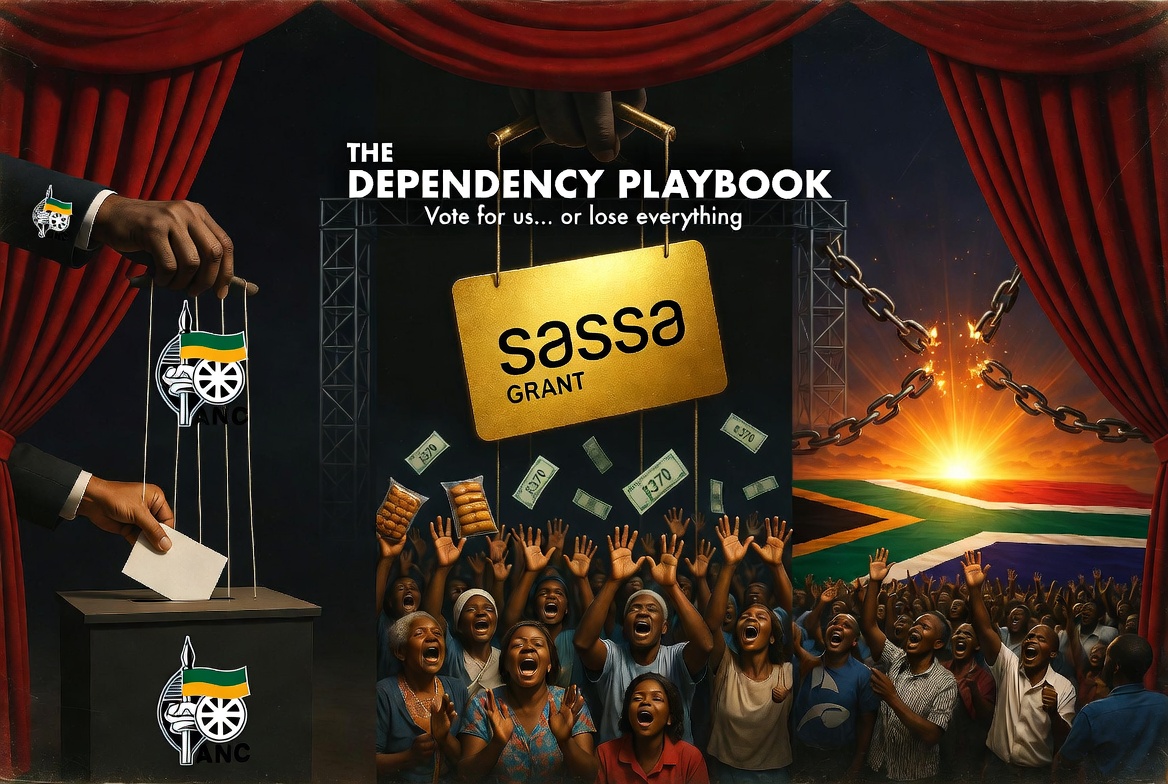
Pretoria - 20 April 2026. Talking about derailing the upcoming elections... Do we as a country really have a democracy left? I do not think so. This is blackmailing. Keeping the masses poor and reliant on SASSA grants, while using SASSA as political leverage to gain votes! Did these politicians today study the book, Animal Farm - George Orwell at school and now implementing this Marxist agenda into South Africa?
In a nation grappling with one of the world's highest unemployment rates, South Africa's social grant system has become more than a safety net — it's a political battleground. As the country heads toward the 2026 local government elections, critics accuse the African National Congress (ANC) of leveraging the South African Social Security Agency (SASSA) grants to secure votes, turning desperation into dependency and survival into a veiled form of control.
The narrative is stark: "Vote for us, or risk losing everything." While no official policy links grant eligibility to voting preference — and South Africa's Constitution protects the secret ballot — widespread perceptions persist that the ANC portrays itself as the sole guardian of grants. Opponents argue this creates a powerful psychological lever in a country where millions rely on monthly payments to survive.
The Scale of Dependency in South Africa
South Africa’s social assistance programme is among the largest in the developing world. As of late 2025 and early 2026, SASSA supports approximately 26–28 million beneficiaries through various grants, including child support, old-age pensions, disability, and the controversial Social Relief of Distress (SRD) grant (often called the "unemployment grant" at R370 per month). This figure represents a significant portion of the population in a country of roughly 60 million people.
The SRD grant, initially introduced during the COVID-19 pandemic, has been extended multiple times and remains a lifeline for over 8 million recipients. Permanent grants saw modest increases in 2026 (e.g., child support rising to R580, old-age and disability grants adjusted upward by R20–R85), but the SRD stayed frozen, highlighting fiscal pressures. National Treasury has emphasised stricter verification, biometric checks, and income reviews to curb fraud, leading to some grants being adjusted or cancelled.
Yet the numbers tell a deeper story. South Africa’s official unemployment rate stood at 31.4% in Q4 2025 — the lowest in over five years but still among the highest globally. The expanded rate, including discouraged jobseekers, hovers near 42%, with youth unemployment exceeding 57%. Over 7.8–8.4 million people remain jobless, while the tax base is narrow: roughly 7–8 million taxpayers support a system where grant recipients outnumber formal taxpayers by a wide margin.
From Safety Net to Political Leverage?
Critics, including opposition parties and commentators, describe this as the "dependency playbook". Instead of prioritising structural reforms to drive job creation, economic growth, and skills development, the focus remains on expanding or sustaining grants. In high-unemployment communities, the message allegedly becomes implicit: the ANC delivers the grants; an opposition victory could jeopardise them.
This perception has historical roots. Past election periods have seen accusations of food parcel distribution and rhetoric framing grants as an ANC "gift" that could vanish under another party. In 2024, ANC leaders including President Cyril Ramaphosa reportedly warned that social programmes like SASSA and NSFAS might face collapse without ANC governance, citing corruption risks or fiscal unsustainability under alternatives. Similar sentiments echo in public discourse ahead of 2026.
Supporters of the grants argue they provide essential relief in a broken economy, preventing deeper poverty and social unrest. The ANC points to modest employment gains in sectors like social services and construction as evidence of interventions working. However, detractors counter that sustaining millions on state support without aggressive private-sector growth and anti-corruption measures entrenches a cycle of voter loyalty through fear rather than genuine empowerment.
At its core, the debate raises uncomfortable questions:
- Why has unemployment remained stubbornly high for decades despite billions spent on social spending?
- Is the grant system a temporary bridge to opportunity, or a long-term tool for political predictability?
- When does "helping the vulnerable" cross into holding communities hostage to one party's continued rule?
The 2026 Stakes: Elections, Accountability, and Economic Freedom
With local government elections looming in 2026, service delivery failures in many ANC-run municipalities — crumbling infrastructure, unreliable electricity, and poor job prospects — have fuelled voter frustration. Yet in grant-dependent areas, the fear of losing SASSA payments may outweigh anger over governance shortfalls.
Opposition voices, particularly the Democratic Alliance (DA), have long warned that ANC mismanagement and corruption pose the real threat to grant sustainability, arguing that only clean governance and faster growth can secure the fiscal space for social support. They advocate shifting the focus from dependency to creating real economic opportunities.
Public sentiment on platforms like X (formerly Twitter) reflects deep cynicism: many users claim the ANC targets poor and elderly voters with implicit threats, turning elections into a "T-shirt and KFC democracy" sustained by grants rather than performance.
Breaking the Cycle: Towards Real Empowerment
True progress demands more than managing desperation. It requires bold reforms: cutting red tape to unleash entrepreneurship, fixing education and skills mismatches, combating corruption that drains public funds, and building an economy where citizens earn dignity through work rather than relying on state cheques.
South Africans face a choice in 2026 — not just at the ballot box, but in demanding leaders who prioritise jobs over votes, growth over grants, and accountability over allegiance. When helping people becomes a mechanism for control, democracy itself is at risk.
The real test for South Africa is whether it can move beyond survival politics to genuine economic freedom. Until then, the dependency playbook remains a powerful script in the theatre of South African elections.
#SouthAfrica #ANC #SASSA #Elections2026 #LocalElections #UnemploymentCrisis #EconomicReform #VoteAccountability
This article reflects ongoing public debate and available data as of April 2026. Voters are encouraged to verify facts independently and exercise their constitutional right to a secret ballot without fear.

Comments (0)
Leave a Comment