
South Africa – 2026
Land ownership remains one of the most emotionally charged and politically sensitive topics in South Africa. Decades of historical dispossession under colonialism and apartheid have left deep scars, fuelling a persistent public narrative: that much of the country's farmland was "stolen" from black South Africans and that white farmers must now "hand over" their land as a form of redress.
This expectation shapes political rhetoric, media coverage, and public opinion. Yet it often overlooks a fundamental post-1994 reality: since the dawn of democracy, every South African citizen — regardless of race — has had the legal right to buy, own, and sell farmland on the open market with no racial restrictions.
The Constitution protects property rights, and the land market operates on willing buyer, willing seller principles (with ongoing debates around expropriation without compensation). So why does the conversation repeatedly return to blame and forced transfer rather than opportunity and voluntary ownership?
The Legal Reality: No Racial Barriers to Buying Farmland
For over 30 years, black South Africans — including professionals, business owners, entrepreneurs, and investment groups — have been free to purchase commercial farmland. There are no apartheid-era laws preventing entry into the agricultural property market.
Many white farmers today, especially younger ones born after 1994, own their land because they (or their families) bought it legally through the same market available to everyone else. They acquired farms with capital, loans, or inheritance within a democratic framework. Holding them collectively responsible for historical injustices they did not personally commit raises serious questions about fairness and the rule of law.
Meanwhile, black South Africans have made private purchases. Data indicates that black individuals have acquired nearly 2 million hectares of farmland through self-financed market transactions since 1994, independent of state land reform programmes.
The Unasked Question: Why Aren't More Capable Black Buyers Entering the Commercial Farming Market?
South Africa has a growing black middle and upper class — wealthy professionals, successful businesspeople, and consortia with access to capital. Some have bought farms and are farming productively. Yet the number of black-owned commercial farms producing a significant share of the country's output remains relatively low.
Black farmers vastly outnumber white farmers when including small-scale and subsistence operations (estimates suggest around 70% of farming households are black). However, they account for roughly 10% of commercial agricultural output. White commercial farmers, though fewer in number (around 30,000–40,000 units), dominate high-value production, exports, and food security contributions.
The gap is not primarily due to legal exclusion. Commercial farming demands substantial capital for land, equipment, irrigation, seeds, labour, and risk management. It requires technical skills, market access, collateral for bank loans, and resilience against droughts, input costs, and price volatility. These are economic and practical barriers — not racial gatekeeping by white farmers.
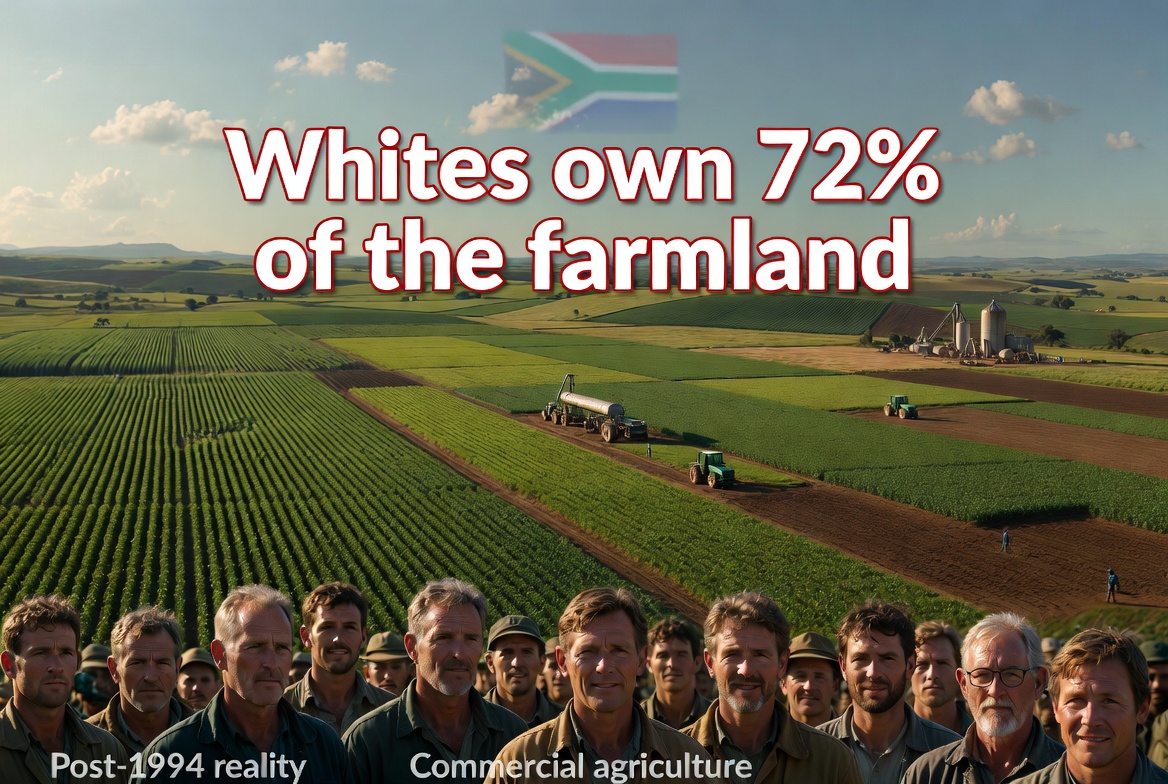
WATCH: Whites own 72% of the Farmland - Stop BLAMING, Start BUYING!
Land Reform Outcomes: Progress, Challenges, and Failures
Since 1994, South Africa has transferred a significant portion of farmland through restitution and redistribution — estimates suggest around 19–25% of previously white-owned commercial farmland has moved into black ownership or state hands via various programmes. When including private purchases, the shift is even more substantial.
Yet many redistributed farms have struggled. Reports frequently cite high failure rates (sometimes estimated at 50–90% in certain programmes), often linked to inadequate post-settlement support, lack of title deeds (making land hard to use as collateral), group ownership models that lead to internal conflicts, skills gaps, and mismanagement.
This has slowed the emergence of a new generation of successful black commercial farmers. Instead of creating thriving enterprises, some programmes have resulted in underutilised or subsistence-level land, undermining food production and rural economies.
Shifting the Focus: From Guilt and Expectations to Empowerment and Opportunity
Blaming current white landowners for historical events does little to increase black commercial farming success. Many white farmers invest heavily in their operations, employ thousands (including black workers), and contribute to national food security. Disrupting productive farms risks broader economic harm, including job losses and reduced agricultural exports.
A more constructive path forward includes:
- Secure title deeds for land reform beneficiaries so they can access finance and invest confidently.
- Targeted financing and skills development — mentorship programmes, agricultural training, and access to markets.
- Encouraging private investment — partnerships between experienced farmers and new entrants, rather than adversarial approaches.
- Supporting emerging black farmers who have already succeeded through market purchases, and scaling what works.
Ownership built on voluntary purchase, investment, and competence creates sustainable wealth. Ownership driven purely by historical guilt or political pressure often fails to deliver long-term productivity.
South Africa faces real challenges: high unemployment, rural poverty, and the need for inclusive growth. Addressing land ownership productively means moving beyond divisive narratives. It requires honest conversations about capital formation, education, infrastructure, and removing barriers to entry — not perpetuating expectations that white farmers must simply "hand over" what they lawfully own.
The country has the talent, the land, and the potential. Focusing on practical empowerment rather than redistribution by force offers the best chance for a thriving, multi-racial agricultural sector that benefits all South Africans.
Related Searches:
- Land ownership South Africa 2026 statistics
- Black commercial farmers South Africa challenges
- South Africa land reform success failure
- Can black South Africans buy farmland freely
- White farmers post-1994 ownership South Africa
This remains a complex debate with strong views on all sides. Sustainable solutions will prioritise food security, economic growth, and genuine opportunity over ideological demands.

Comments (0)
Leave a Comment