
Trump Amplifies Scrutiny of First American-Born Pope
A viral post by Donald J. Trump has reignited global debate surrounding Pope Leo XIV, the first American-born pontiff in history.
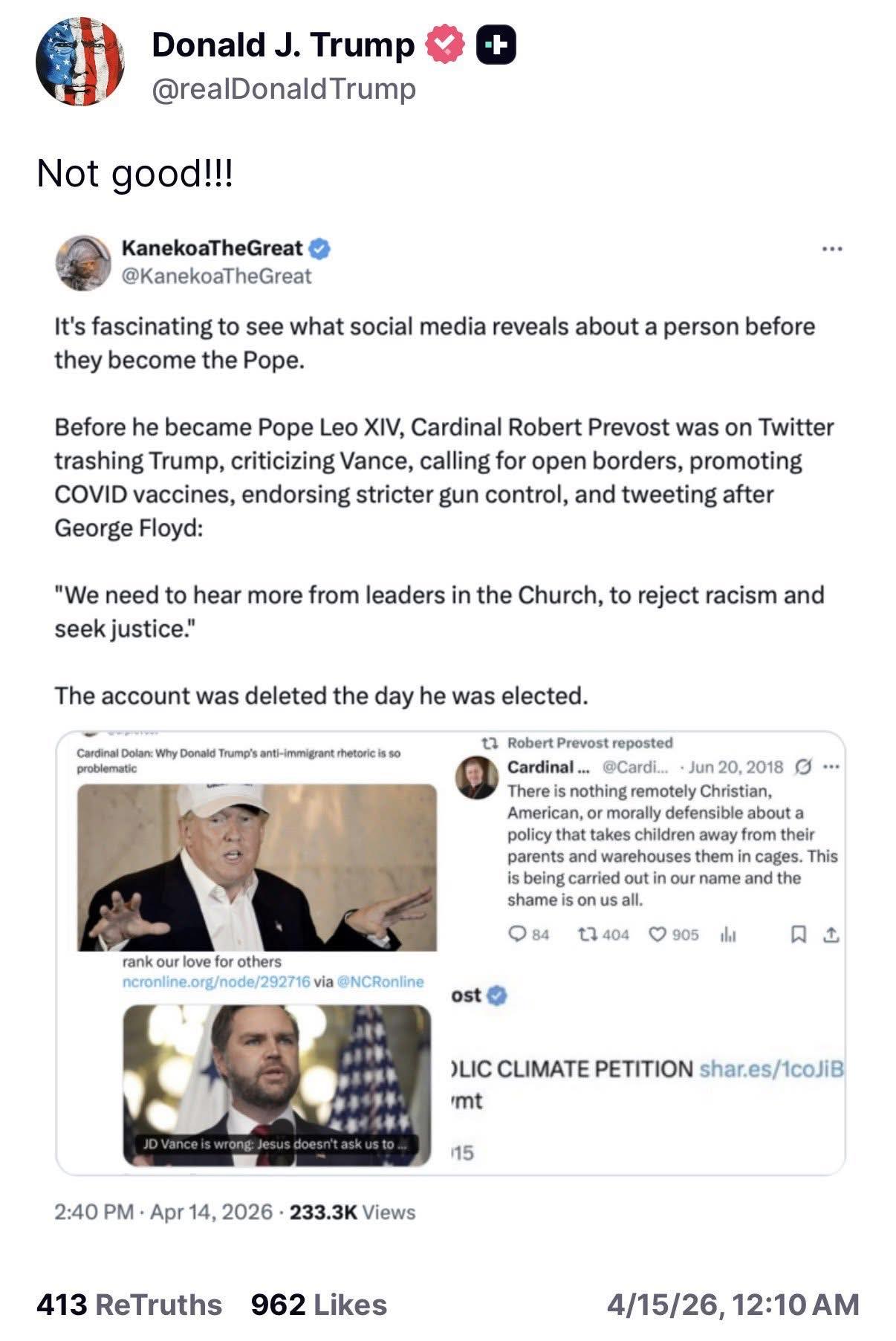
On April 14, 2026, Trump shared a screenshot on Truth Social highlighting past social media activity by the pope prior to his election. The post—captioned “Not good!!!”—quickly gained traction, drawing attention to archived posts from the pope’s now-deleted personal account on X.
The resurfaced content includes commentary on immigration, COVID-19 vaccines, gun control, and a 2020 message following the death of George Floyd calling on church leaders to “reject racism and seek justice.”
The Vatican has confirmed that the account was deleted upon his election—standard practice as pontiffs transition to official communication channels.
Deleted Posts Fuel Political and Theological Debate
The controversy highlights a growing tension between politics and religion in the digital age.
While supporters argue that deleting pre-papal accounts is routine, critics claim the move raises transparency concerns—especially given the ideological nature of some past posts.
The new pope, formerly Cardinal Robert Francis Prevost of Chicago, has already been labeled by some commentators as a continuation of Pope Francis’s reform-oriented leadership—sometimes referred to online as “Francis 2.0.”
Biblical Remarks Spark Accusations of “Modern Additions”
Further controversy erupted following remarks by Pope Leo XIV during a visit to Cameroon, where he referenced Gospel of Matthew 5:9:
“Blessed are the peacemakers…”
He then added:
“But woe to those who manipulate religion and the very name of God for their own military, economic and political gain.”
Critics argue this constitutes an “addition” to scripture, while theologians counter that such commentary falls within longstanding Christian tradition of pastoral interpretation—not alteration.
Migration Comments Deepen Divide Among Christians
The divide widened further after the pope urged Europeans to reduce fear of Muslim migrants, emphasizing cooperation across religious and cultural lines.
Referencing migration concerns, he stated:
“We all need to work together.”
He pointed to Lebanon as an example of Christian-Muslim coexistence.
However, critics argue that this perspective overlooks ongoing tensions in parts of Europe, including:
- Integration challenges
- Rising social fragmentation
- Documented extremist violence
- Continued persecution of Christians in regions like Nigeria
This has fueled a broader ideological split within Christianity itself.
“Chrislam” Debate and Internal Christian Fractures
A growing faction of critics has accused modern church leadership of promoting what they call “Chrislam”—a controversial term suggesting theological blending between Christianity and Islam.
It’s important to clarify:
- There is no official Vatican doctrine supporting any merger of religions
- The pope’s statements align with interfaith dialogue traditions, not doctrinal change
Still, perception is driving reality online. The divide is increasingly visible between:
- Christians advocating interfaith coexistence and diplomacy
- Christians insisting on strict doctrinal separation and warning of compromise
This tension is likely to define much of Pope Leo XIV’s early papacy.
Extremism, Violence, and the Reality Behind the Debate
While theological debates unfold, real-world violence continues to shape public sentiment.
The atrocities committed by Islamic State against minority groups remain a stark example. Reports of the ??? and enslavement of Yazidi women and girls—including widely documented abuses during ISIS’s control of Mosul—highlight the brutality of extremist ideology.
The Yazidi genocide has been recognized by multiple international bodies as genocide.
These events are often cited by critics who argue that calls for coexistence must be balanced with realism about:
- Religious extremism
- Protection of vulnerable communities
- Failures of integration in some regions
At the same time, analysts caution against conflating extremist groups with entire religions, noting that millions of Muslims worldwide reject such violence.
Apocalyptic Claims Resurface Online
In fringe online spaces, Pope Leo XIV’s election has revived speculation tied to the so-called Prophecy of the Popes.
Some claim he could be the “final pope” or link him to apocalyptic passages such as Second Epistle to the Thessalonians.
Mainstream scholars, however, dismiss these interpretations as historically unreliable and outside official Church teaching.
The Bigger Picture
What’s unfolding is bigger than one viral post.
This is a collision of:
- Religion and politics
- Tradition and modernity
- Security concerns and moral ideals
- Digital history and institutional authority
Pope Leo XIV now finds himself at the center of a global conversation that extends far beyond theology—into identity, governance, and the future of Western civilization itself.
Final Thought
The core question isn’t just whether Christians and Muslims can “work together.”
It’s whether leaders can balance:
- Compassion without ignoring risk
- Dialogue without diluting belief
- Peace without denying reality
That tension is real—and it’s not going away anytime soon.

Comments (0)
Leave a Comment