
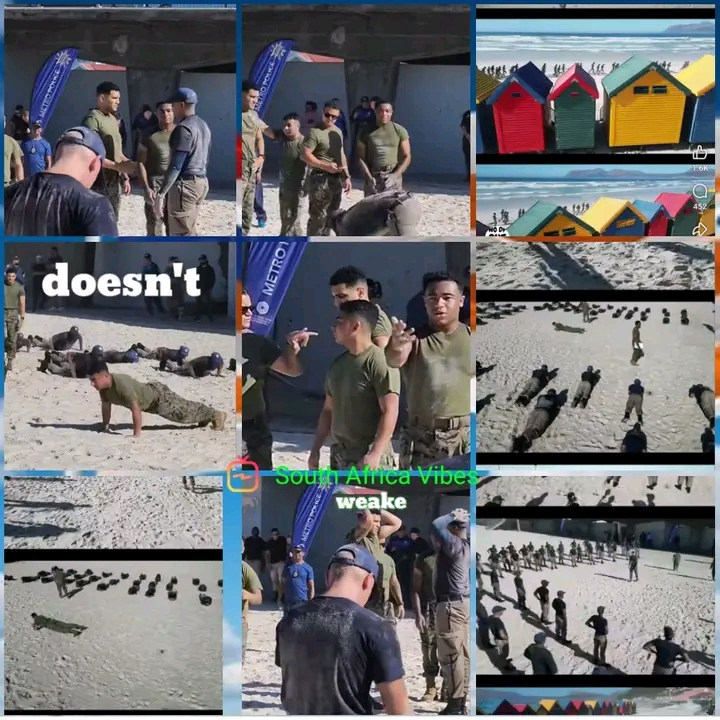
Cape Town – Videos and images circulating on social media this week showed U.S. Marines leading physical training sessions with cadets from the City of Cape Town’s Metro Police on Muizenberg Beach, prompting questions from residents about foreign military involvement on South African soil.
Alderman JP Smith, the Mayoral Committee Member for Safety and Security, quickly addressed the matter on social media, confirming the Marines’ presence and framing it as routine international support for local law enforcement development.
“If the sight caused some confusion, here’s why – we regularly accept assistance from international policing agencies as they support us in creating South Africa’s most reputable municipal policing service,” Smith stated. He explained that the U.S. Marines guided the cadets through their “standard fitness routine” to help build discipline and physical readiness.
Context of the Training Session
According to Smith, Cape Town’s Safety and Security directorate maintains ongoing partnerships with international agencies to enhance capabilities in several key areas, including:
- Cybercrime investigations
- Kidnapping response
- Anti-poaching operations
- Narcotics enforcement
- Advanced investigation techniques
The beach session on Muizenberg, a popular public area, focused specifically on fitness as part of broader efforts to professionalize the Metro Police force. Smith has previously highlighted investments in the city’s Public Safety Training College, which trains hundreds of new officers annually with accredited programs covering traffic, law enforcement, and specialized tactical skills.
This incident occurs amid wider challenges in South African policing, including high crime rates in parts of the Western Cape. The City of Cape Town has emphasized evidence-based approaches and skills development to address issues like gang violence, with recent deployments of additional neighbourhood safety officers.
Public Reactions and Concerns
The visuals quickly drew a mix of responses online. Some South Africans viewed the cooperation positively, arguing that external expertise could help strengthen under-resourced local forces and improve standards in a country facing complex security threats.
Others expressed unease, questioning why foreign military personnel were involved in training instead of relying solely on local or national experts, and why the session appeared without prior public announcement. Comments on platforms like X (formerly Twitter) ranged from curiosity to stronger concerns about sovereignty, transparency, and the implications of foreign forces operating visibly in civilian spaces.
Critics asked whether such engagements require higher-level national approval and where the boundary lies between helpful training support and potential overreach. Supporters countered that similar international collaborations are common globally and help address gaps in specialized policing without compromising South African control.
No official statements from national government departments, such as the South African National Defence Force (SANDF) or the South African Police Service (SAPS), were immediately linked to this specific Metro Police training event. Historical U.S.-South Africa military engagements, like past joint exercises (e.g., Shared Accord), have involved broader defence cooperation, but this appears limited to municipal-level fitness and policing support.
Broader Implications for Security Cooperation
International policing and security partnerships are not new. Many countries engage in capacity-building programs, information sharing, and joint training to tackle transnational issues like organized crime, cyber threats, and wildlife trafficking. In South Africa’s context, where municipal police services like Cape Town’s operate alongside national SAPS and occasional SANDF support for high-crime areas, such collaborations can supplement local efforts.
However, the incident has reignited discussions about transparency in security arrangements and public trust. Residents and observers are calling for clearer communication from authorities when international partners are involved in visible activities.
City officials maintain that all activities remain under South African oversight, with the goal of building a more effective, professional Metro Police service tailored to local needs.
Ongoing Debate
The event on Muizenberg Beach has turned a standard training exercise into a talking point about the role of international involvement in South Africa’s security landscape. While some see it as a practical step toward better policing outcomes, others worry it could set a precedent that raises questions about accountability and national control.
As videos continue to circulate, the public conversation highlights deeper issues: How should South Africa balance the need for improved safety with concerns over foreign influence? What level of openness is expected when local authorities partner with overseas entities?
Authorities have not indicated any change in policy following the backlash, and the City of Cape Town continues to promote its training initiatives as essential for long-term crime reduction.
This story is developing, with many South Africans watching closely for further clarification from both local and national levels on the scope and approval processes for such international engagements.
Note: This article is based on public statements and social media reports available as of April 2026. Official responses emphasize routine cooperation aimed at professional development rather than operational military activity.

Comments (0)
Leave a Comment