
Senekal, Free State – A violent farm attack on a Senekal farmer has sparked intense debate after the victim reportedly gave differing versions of the incident to different parties, while underlying business tensions involving livestock have come to light.
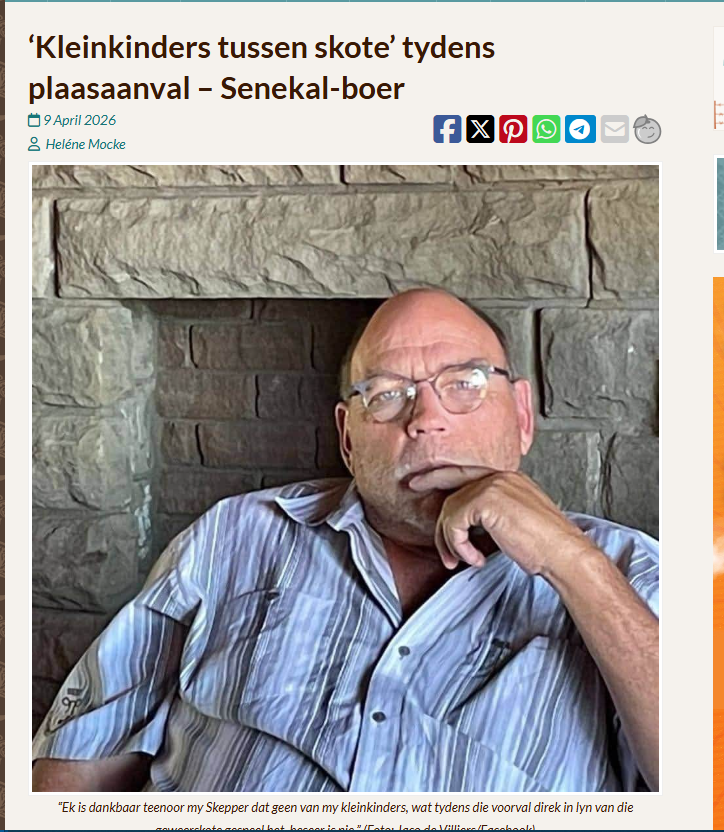
Jaco de Villiers (65), a farmer from the Senekal area in the Free State, was injured during an alleged attack on his property. According to reports, two suspects were arrested following the incident, which involved a white bakkie, shots fired, and de Villiers sustaining injuries. He has publicly expressed gratitude that his grandchildren, who were playing nearby, were not harmed.
However, in a conversation with Tewie Wessels, de Villiers allegedly stated that he was not seriously injured and that no children were involved in the incident. In contrast, when speaking to Maroela Media, he reportedly claimed he was badly hurt, opened a case (G88) against a man named Kobus, and mentioned that his grandchildren were playing in the line of fire.
Watch:
Further discrepancies have surfaced regarding the motive. De Villiers reportedly told Maroela Media he does not know why Kobus attacked him. Yet, according to sources close to the matter, Jaco de Villiers and Kobus are business partners — a claim de Villiers has denied.
Complicating the picture is a significant livestock dispute: Approximately 400 of Kobus’s sheep are reportedly grazing on de Villiers’ farm. Sources claim Kobus has around one million Rand worth of sheep on the property and is unable to access his share. De Villiers has allegedly refused to return the animals. The sheep are said to be held in safe custody amid the disagreement.
The arrangement reportedly stems from an earlier business agreement in which the sheep were meant to be split equally between the two men. What began as a joint venture has since soured. This is not the first business dealing involving de Villiers to encounter difficulties, according to community members.
De Villiers has been vocal in the past as part of the Red Meat Action Group (Rooi Vleis Aksie), where he has publicly opposed the Red Meat Producers Organisation (RPO), accusing it of misleading farmers.
Adding to the complexity are prior legal disputes. In 2020, Gert Victor obtained an interdict against Jaco de Villiers and his son, Johannes de Villiers. The case involved Consortium Beef (Pty) Ltd, of which de Villiers was a director. Cattle under the care of the Victors on leased farms Zuurfontein and adjacent Rooiwal became the centre of a payment disagreement.
When the Victors expected their first payment, de Villiers allegedly questioned the calculations. A meeting in Henneman between the two families reportedly turned hostile, with allegations that de Villiers and his group became aggressive. The Victors claimed they were owed approximately R324 million and retained the cattle as security for the debt.
Court documents from the time alleged that de Villiers, his father, and four other armed men arrived in five vehicles, intending to remove the cattle. Victor claimed his father was struck on the right temple with the barrel of a firearm and told, “Now you are my prisoner.” No shots were fired, and the group left after police intervention. The interdict application was not opposed at the time. The matter was later struck off the roll after prolonged proceedings.
While the recent Senekal attack appears to involve different individuals, the pattern of business conflicts and legal entanglements has led some observers to suggest there may be deeper issues at play beyond a random farm attack.
South Africa continues to grapple with farm attacks, which often involve violence and theft. Farmers and agricultural organisations regularly call for stronger rural safety measures and faster justice.
This case highlights the challenges of separating personal disputes, business dealings, and criminal incidents in rural communities. Police investigations are ongoing, and the courts will ultimately determine the facts.
As more details emerge, the farming community watches closely, hoping for clarity and accountability in a sector already under significant pressure.
This article is based on publicly reported statements, court records, and community accounts. All parties are presumed innocent until proven otherwise in a court of law.

Comments (0)
Leave a Comment