
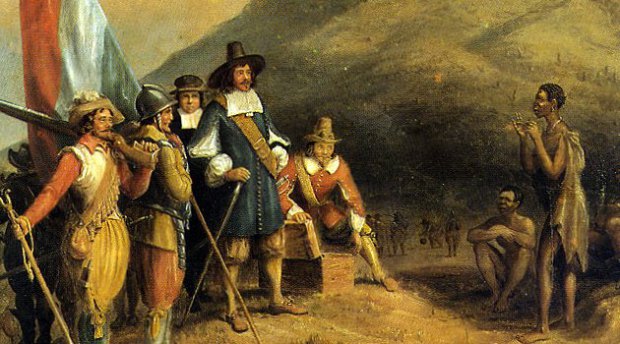
CAPE TOWN, SOUTH AFRICA — April 6, 2026 — Today marks exactly 374 years since Jan van Riebeeck arrived at the Cape of Good Hope, laying the foundations of what would become one of the most significant historical developments in South Africa.
On 6 April 1652, Van Riebeeck reached the Cape with three ships—the Drommedaris, the Reiger, and the Goede Hoop—carrying approximately 90 men under the authority of the Dutch East India Company (VOC). Their mission was to establish a refreshment station to support trade routes between Europe and the East.
A Landing Marked by Prayer
Rather than beginning with construction or command, Van Riebeeck’s first recorded act was prayer.
Before any plans were implemented, he gathered his council and sought divine guidance—a reflection of the deeply Reformed Christian worldview carried by the early Dutch settlers.
His prayer, translated into English, reads as follows:
“Merciful, gracious God and heavenly Father, according to Your divine will we are called to administer the affairs of the United Netherlands Chartered East India Company here at the Cape of Good Hope. With this purpose in view we have assembled with our Council in Your holy Name to take, with the Council’s advice, such resolutions by which we may best advance the Company’s interests.
We are here to uphold the law and to, if it be possible, among these wild and uncivilised peoples plant and make known Your true reformed Christian teaching to the praise of Your holy Name and to the benefit of those who rule over us. For this we are, without Your gracious help, least of all capable.
Therefore we pray to You, most high Father, that You will remain with us in Your fatherly wisdom. We pray that You Yourself will give guidance in our assembly and so enlighten our hearts that all wrongful passions, discord and other such failings will be kept from us, so that our hearts will be clean of all human passions.
Let our minds be so attuned that in our deliberations we plan or resolve nothing other than that which may serve to the magnification and praise of Your most holy Name and to the service of those who rule over us. Let us not in any measure whatsoever attend to personal advantage or the pursuit of gain, but only to the execution of our duties and that which is necessary for our salvation.
We pray and ask this in the Name of Your beloved Son, our Saviour and Redeemer, Jesus Christ … who taught us to pray: Our Father who art in heaven … Amen.”
This moment is often regarded by historians and faith communities alike as symbolic of the introduction of Reformed Christianity to southern Africa.
The Arrival in Table Bay: A Closer Look
Historical records indicate that the fleet first sighted Table Bay on the afternoon of 5 April 1652.
The chief steersman of the Drommedaris spotted the bay at approximately 14:30. The ship was one of the three vessels under the command of Jan van Riebeeck, sent to establish a VOC refreshment station.
The other two ships—the Goede Hoop and the Reiger—joined the Drommedaris along the Cape coast at around 04:00 the following morning.
On 6 April 1652, the ships were anchored close to shore. However, Van Riebeeck himself did not immediately set foot on land. Instead, two members of the expedition—bookkeeper Adam Hulster and assistant steersman Aernt van Leveren—were sent ashore by boat to explore the area.
Despite this, Van Riebeeck officially regarded 6 April 1652 as the founding day of the settlement at the Cape.
A Complex Historical Legacy
The establishment of the Cape settlement marked the beginning of a permanent European presence in southern Africa. Over time, what began as a supply station evolved into a colony with far-reaching consequences—economic, cultural, and political.
It is also important to acknowledge that indigenous communities had long inhabited and traded in the region prior to 1652. The centuries that followed would bring both development and deep conflict, shaping the South Africa known today.
Separating History from Narrative
Modern discussions around South African history are often shaped by strong and opposing viewpoints. However, historians increasingly caution against oversimplified or exaggerated claims.
Jan van Riebeeck was primarily an administrator tasked with establishing a settlement, not a conventional military conqueror. At the same time, figures such as Shaka Zulu—while known for military leadership—have often been surrounded by exaggerated accounts, particularly regarding the scale of violence during their reign.
A responsible interpretation of history requires careful examination of evidence, context, and multiple perspectives.
374 Years Later: Reflection on a Defining Moment
As South Africa marks 374 years since the events of 6 April 1652, the legacy of that day continues to resonate.
From a small landing party and a prayer on the shores of the Cape, a chain of events was set into motion that would shape the course of the nation’s history for centuries.
Whether viewed through a historical, cultural, or faith-based lens, the anniversary remains a moment for reflection—on origins, on truth, and on the enduring impact of the past on the present.

Comments (0)
Leave a Comment