
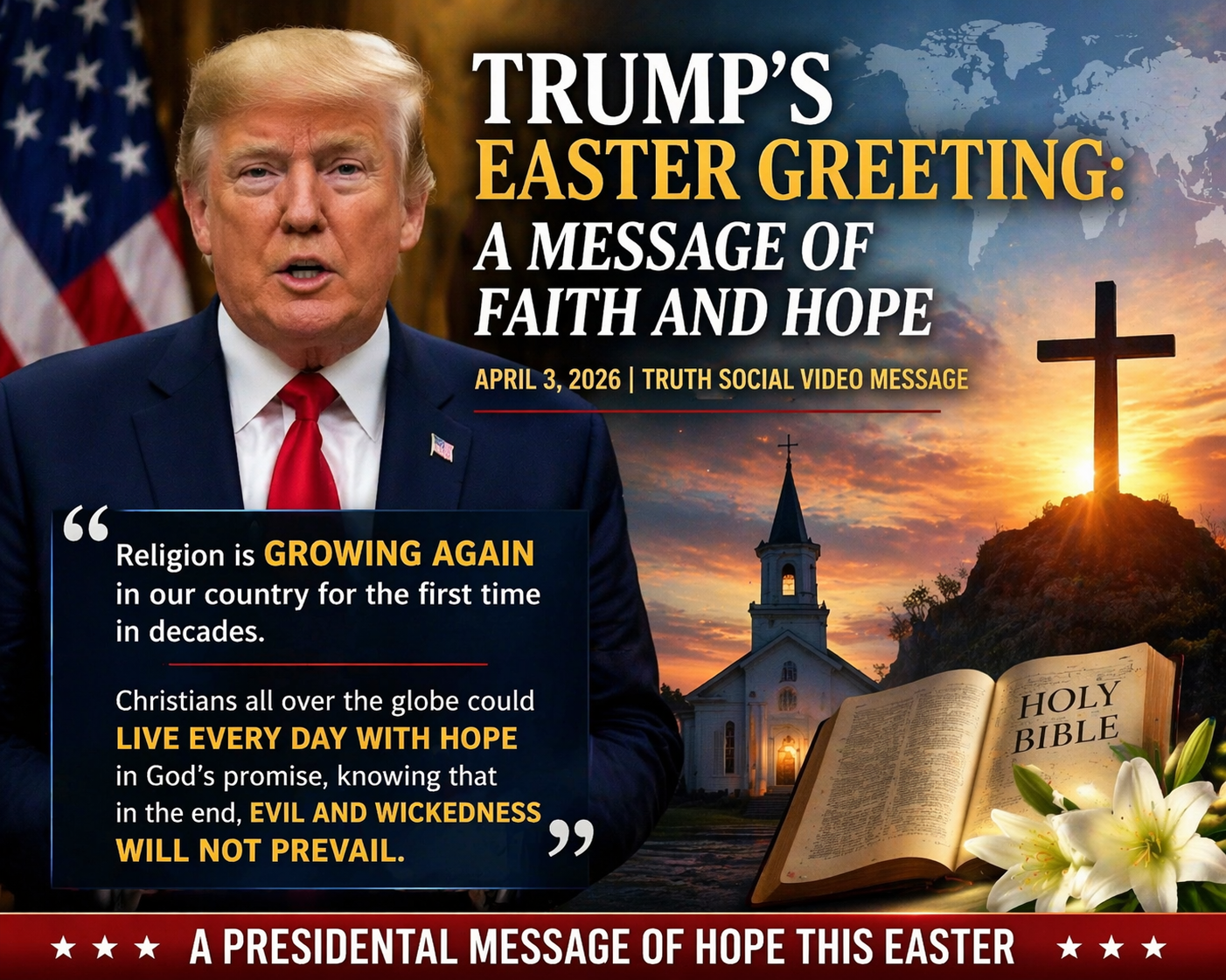
In a video posted to Truth Social on Friday (April 3), Trump addressed Christians both domestically and globally, emphasizing themes of faith, perseverance, and moral victory. The message, released ahead of Easter Sunday, carried both religious undertones and subtle political messaging—hallmarks of the president’s communication style.
“Religion is Growing Again”
At the center of Trump’s remarks was a bold claim: that religion, particularly Christianity, is experiencing renewed growth in the United States after decades of decline.
“Religion is growing again in our country for the first time in decades,” Trump said, presenting the idea as both a cultural shift and a sign of national renewal.
While the statement aligns with sentiments often expressed by conservative and religious groups, it enters a broader and more complex national conversation. Surveys over recent years have indicated a long-term decline in formal religious affiliation in the U.S., particularly among younger generations. However, there have also been signs of renewed interest in spirituality in certain communities, especially during times of social and economic uncertainty.
Trump did not cite specific data in his address, but his framing suggests an attempt to connect with religious voters who see faith as central to American identity.
A Message of Hope and Moral Certainty
The president’s message leaned heavily on traditional Christian themes associated with Easter—the triumph of good over evil and the promise of redemption.
He told viewers that Christians around the world could “live every day with hope in God’s promise,” adding that “in the end, evil and wickedness will not prevail.”
The language echoed biblical narratives central to Easter, particularly the resurrection of Jesus Christ, which symbolizes victory over sin and death. By invoking these themes, Trump aligned his message with a deeply rooted spiritual tradition while reinforcing a broader moral framework that resonates with many believers.
Faith and Politics Intertwined
Trump’s Easter greeting is part of a long-standing tradition of U.S. presidents marking religious holidays. However, his messaging often goes further—blending personal belief, national identity, and political positioning.
Throughout his political career, Trump has maintained strong support among evangelical Christian voters, a key constituency that has played a significant role in his electoral success. His emphasis on religious revival and moral clarity is widely seen as reinforcing that relationship.
Critics, however, argue that such messaging risks politicizing faith, turning deeply personal beliefs into tools of political alignment. Supporters counter that acknowledging faith in public leadership reflects the values of millions of Americans.
A Global Audience
While primarily directed at Americans, Trump’s message also extended to Christians worldwide, underscoring the global nature of Easter celebrations.
“Christians all over the globe” were included in his remarks, a nod to the shared religious observance that transcends national boundaries. This international framing adds a diplomatic dimension to the message, positioning the United States as aligned with global Christian communities.
Context in a Divided Landscape
The Easter message arrives at a time when the United States remains deeply divided along political, cultural, and ideological lines. Issues surrounding religion—its place in public life, education, and governance—continue to spark debate.
In this context, Trump’s assertion of a religious resurgence can be seen as both a reflection of his political base and a broader statement about the direction he envisions for the country.
Tradition Meets Messaging
Presidential Easter messages have historically focused on unity, reflection, and hope. Trump’s address maintained these themes but added a distinct emphasis on revival and resilience.
By framing Easter as both a spiritual milestone and a sign of national renewal, the president sought to connect a sacred tradition with contemporary concerns—offering reassurance to supporters while reinforcing his broader narrative of restoration.
Looking Ahead
As Easter approaches, Trump’s message is likely to resonate strongly among his supporters, particularly those who view faith as central to public life. At the same time, it may prompt renewed debate about the role of religion in politics and whether claims of a spiritual resurgence reflect reality or aspiration.
What remains clear is that, for Trump, faith continues to be more than a personal expression—it is a cornerstone of his public messaging and a key element of his vision for America.
In invoking hope, divine promise, and the ultimate triumph of good over evil, the president’s Easter address delivers a message that is at once timeless and deeply rooted in the current political moment.

Comments (0)
Leave a Comment