
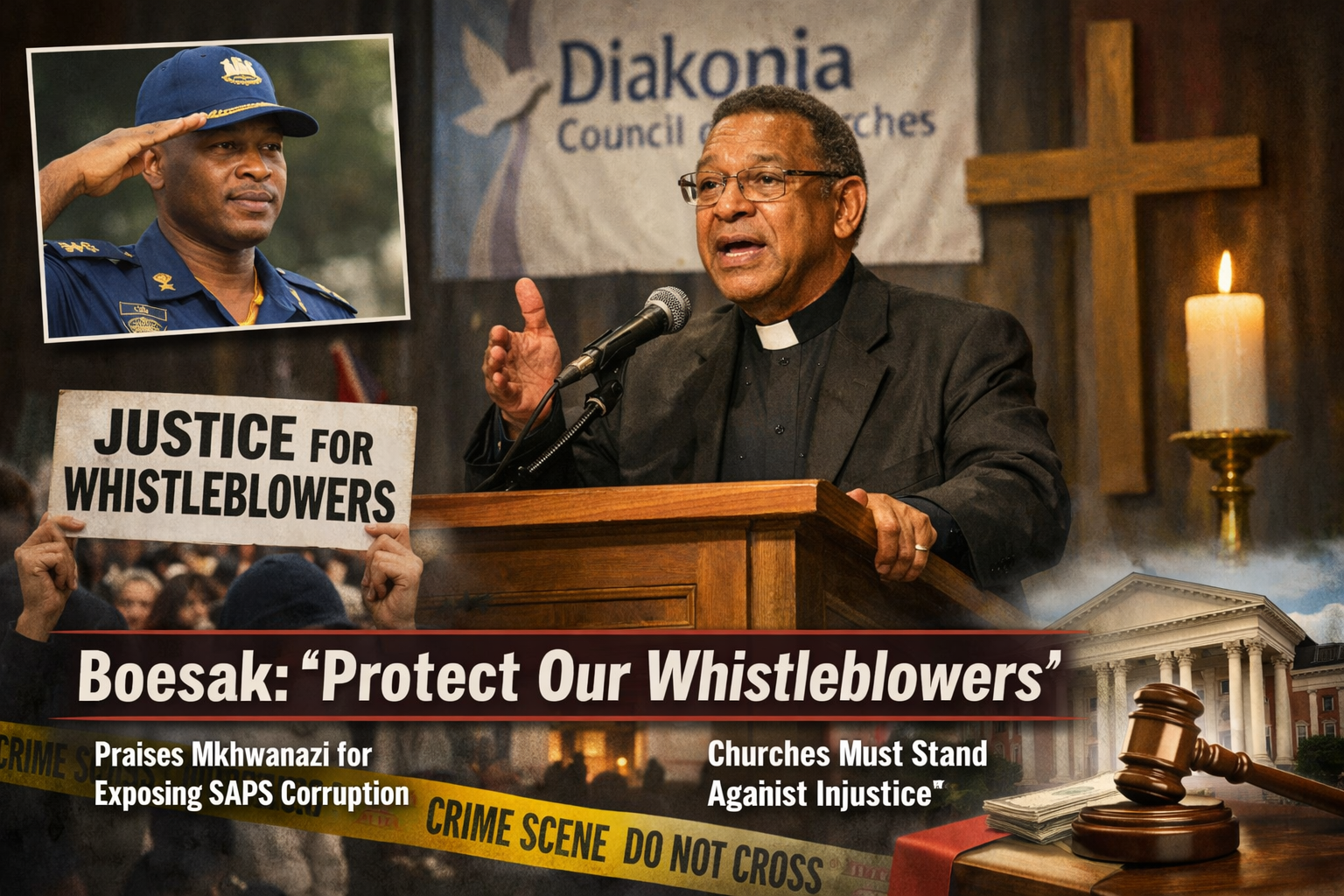
Speaking at the Diakonia Council of Churches, Boesak delivered a message that blended theology, politics, and social justice, warning that individuals who expose corruption are increasingly left vulnerable in a climate of fear and retaliation.
A Moral Crisis Beyond the Church
Drawing parallels between the suffering of Christ and the risks borne by truth-tellers, Boesak framed whistleblowing as a moral act—one that demands protection, not punishment.
“Whistleblowers,” he suggested, “carry a burden not unlike those who have stood for truth throughout history—often isolated, often targeted, and too often abandoned.”
South Africa has seen a troubling pattern in recent years, where individuals who expose corruption—particularly within government institutions—face threats, job loss, or worse. Boesak warned that without meaningful protection, the country risks silencing the very voices needed to combat systemic corruption.
Praise for Mkhwanazi’s Stand
In a notable moment during his address, Boesak singled out KwaZulu-Natal Police Commissioner Nhlanhla Mkhwanazi, praising what he described as “extraordinary courage” in speaking out against alleged corruption within the South African Police Service (SAPS).
Mkhwanazi has recently come under national attention for his willingness to publicly challenge misconduct within law enforcement ranks—an act that Boesak framed as both rare and necessary.
“In a system where silence often protects wrongdoing,” Boesak said, “it takes immense bravery to stand up and say, ‘This is not right.’”
His endorsement of Mkhwanazi signals growing support among civil society and religious leaders for accountability within state institutions.
The Role of the Church in a Troubled Society
Beyond the immediate issue of whistleblower safety, Boesak used the platform to call on churches across the country to reclaim their role as moral compasses in society.
He argued that religious institutions cannot remain passive observers in the face of injustice, corruption, and inequality. Instead, they must actively shape public discourse and advocate for ethical governance.
“The church,” Boesak said, “must not retreat into comfort while society burns. It must speak, act, and stand with those who are vulnerable.”
This call echoes the historical role played by churches during the anti-apartheid struggle, when religious leaders were often at the forefront of resistance against injustice.
A Broader Reflection on Social Ills
Boesak’s address also touched on broader societal challenges, including poverty, inequality, and the erosion of public trust in institutions. He warned that corruption not only drains resources but also undermines democracy itself.
“Corruption is not just about money,” he said. “It is about dignity, justice, and the future of our nation.”
By linking whistleblower protection to these larger issues, Boesak positioned the matter as central to South Africa’s democratic health.
A Call to Action
As the country marked Good Friday—a day traditionally associated with sacrifice and reflection—Boesak’s message resonated as both a warning and a call to action.
He urged government, civil society, and ordinary citizens to create an environment where truth is protected and rewarded, rather than feared.
“Without truth,” he concluded, “there can be no justice. And without justice, there can be no peace.”
His words leave a stark challenge for South Africa: whether it will stand with those who risk everything to expose wrongdoing—or allow them to stand alone.

Comments (0)
Leave a Comment