
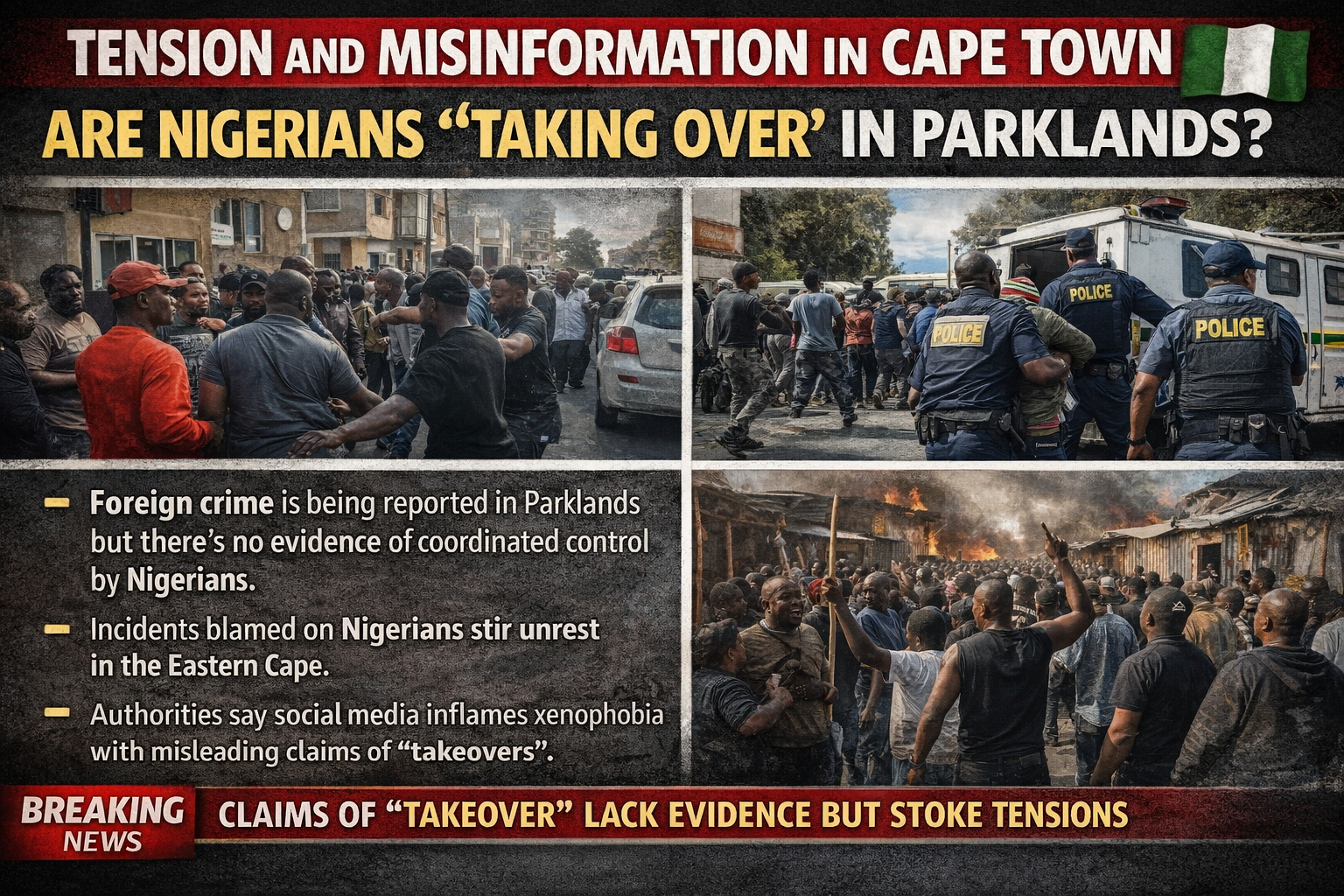
CAPE TOWN — Viral social media posts are once again thrusting the suburb of Parklands into the national spotlight, with claims that Nigerian nationals are “taking over” parts of the area. But while recent incidents and online footage have fueled public concern, available evidence suggests a far more complex—and often misrepresented—situation.
Nigerians are taking over in Cape Town Parklands pic.twitter.com/LuXTlOFUt0
— PulseXZA (@PulseXZA) April 5, 2026
Viral Claims Spark Concern
A widely circulated video on X (formerly Twitter) alleges growing control of parts of Parklands by Nigerian groups, echoing similar narratives that have surfaced in recent years across South Africa. The footage, reportedly captured on 4 April 2026, shows a confrontation between groups of men on a residential street.
The video has been shared alongside broader claims that foreign nationals are dominating certain communities, raising alarm among residents and prompting heated online debate.
However, experts and local authorities caution against drawing sweeping conclusions from isolated or unverified clips.
Nigerians causing Chaos in South Africa, fighting each other for drugs. These are the people whose embassy said they respect our laws, these are the people who claim to be treated unfairly in South Africa. Nahh guys, Abahambe! pic.twitter.com/DfPaoeR1K2
— Micah Da Music (@MicahDaMusic) April 5, 2026
Crime, Not “Takeover” or is it?
Parklands, a rapidly growing residential suburb on Cape Town’s western seaboard, has long attracted a diverse population, including South Africans and migrants from across the African continent.
While crime incidents involving foreign nationals have been reported in the area, they are typically linked to specific criminal activities rather than evidence of coordinated “takeovers.”
In one notable case, a Nigerian national was arrested in Parklands in connection with a large-scale romance scam that defrauded a foreign victim of millions of rand.
Other reports and social media posts reference arrests related to drugs and financial crimes, as well as alleged gang-linked activity.
Law enforcement officials stress that such cases reflect criminal networks operating within broader communities—not the actions of an entire nationality.
- Also, do not forget how the DA allows for illegal foreigners to flood the Cape Peninsula, watch video below how Geordin Hill-Lewis is driving the demographics of Cape Town!
The Eastern Cape Narrative
Similar claims have also emerged in the Eastern Cape, where tensions reportedly flared following controversial allegations about the establishment of a so-called “Nigerian king” or leadership structure in certain areas.
Videos and posts linked to unrest suggest protests and even violence in response to these claims, though details remain contested and often lack official confirmation, because the government refuses to release such statements because they are scared that a full scale civil war can break out.
Authorities have not substantiated claims of any formal territorial control by foreign nationals in either province - yet the proof is there.
A Pattern of Misinformation, or what is being covered up?
Analysts say the situation reflects a broader pattern in South Africa, where economic hardship, unemployment, and crime contribute to rising tensions between locals and migrant communities.
Social media often amplifies these tensions, with dramatic language—such as “takeover”—used to describe complex urban challenges.
“Crime is a real issue, but framing it as a nationality-based takeover is misleading and dangerous,” one community safety expert noted. “It risks inflaming xenophobia rather than addressing the root causes.”
But other community members do not think this is the case.
The patterns tell a different story.
Nigerians think that we are all Stupid, they have so much arable land in Nigeria that they do not utilize, why don’t they pray for that rain before they plant their seeds in Nigeria? are they talking about planting drugs? pic.twitter.com/9sJMvcJRac
— Micah Da Music (@MicahDaMusic) April 4, 2026
Community Impact
Residents in Parklands describe a mix of concern and frustration. Some say they feel unsafe due to visible crime and sporadic clashes, while others emphasize the importance of coexistence in a diverse neighborhood.
Community leaders are calling for increased policing, better integration efforts, and responsible reporting—warning that misinformation could lead to unrest.
The Bigger Picture
South Africa continues to grapple with high crime rates and socio-economic inequality, factors that often intersect with migration patterns. President Cyril Ramaphosa has previously acknowledged the need for stronger interventions against organized crime and gang activity, particularly in provinces like the Western Cape.
What remains clear, however, is that perception—fueled by social media—can be as powerful as reality in shaping public discourse.
The whole truth about Geordin Hill-Lewis: Why he is costing the DA so much in Cape Town

Comments (0)
Leave a Comment