
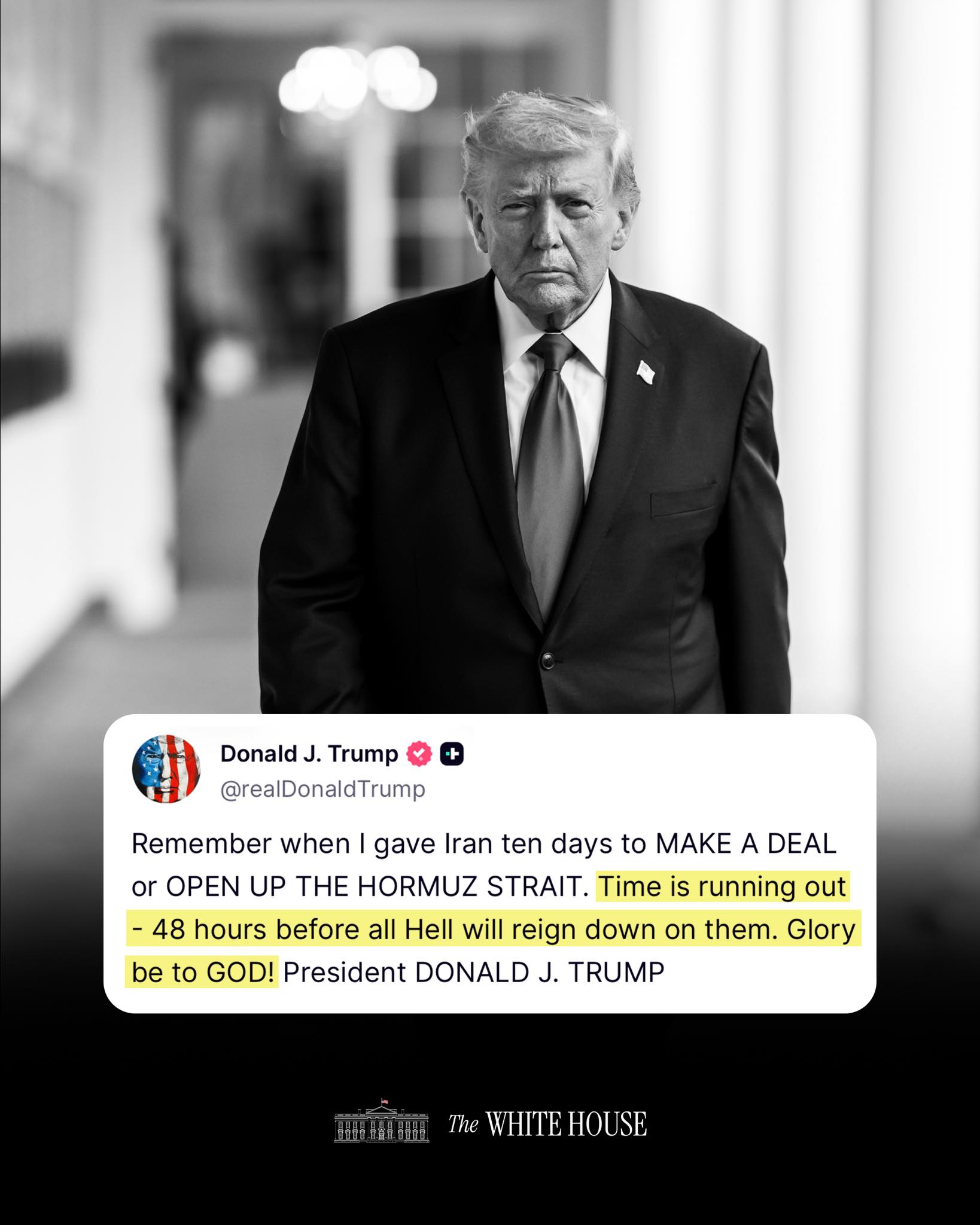
President Trump reminded Tehran on Saturday that the clock is ticking on his earlier 10-day deadline, originally tied to demands for a broader deal to end hostilities. “Time is running out – 48 hours before all Hell will rain down on them,” Trump posted, vowing decisive action if Iran fails to comply. The warning comes as the U.S.-Israel coalition continues operations against the Iranian regime, now entering its sixth week.
The Strait of Hormuz, a narrow chokepoint through which roughly one-fifth of the world’s oil supply normally flows, has been effectively blockaded by Iran since late February 2026 in retaliation for joint U.S. and Israeli strikes that began on February 28. Iranian forces, including the Islamic Revolutionary Guard Corps, have harassed and attacked commercial vessels, severely disrupting global energy markets and driving up oil prices worldwide. This deliberate economic warfare has harmed not only the United States and Israel but also America’s allies in Europe, Asia, and the Gulf.
? Do you understand why Trump keeps extending deadlines and people keep calling him weak..
— ?? Ronald Carter (@USronaldcarter) April 4, 2026
they said 48 hours.. then 10 days.. now 48 hours again..
the media says "he blinked"..
here's what they're not telling you..
> between the first and second deadline.. 7,000+ troops… pic.twitter.com/vbyktPgF0X
U.S. and Israeli officials have made clear that Iran’s closure of the strait represents an unacceptable threat to freedom of navigation and global economic stability. President Trump has emphasized that the United States, alongside Israel, will not tolerate the regime’s attempt to hold the world hostage through control of this vital waterway. Earlier, Trump had threatened to “obliterate” Iran’s power plants starting with the largest if the strait remained closed, before granting a brief five-day extension to allow for potential diplomatic talks.
Those talks appear to have yielded little progress. U.S. intelligence assessments indicate that Iran is clinging to its stranglehold on the strait as its primary remaining leverage, showing no genuine willingness to restore open passage without major concessions. Israeli strikes have continued to degrade Iranian military capabilities, while the U.S. has maintained pressure through naval presence and targeted operations in the region.
The stakes are high for the free world. Reopening the Strait of Hormuz would immediately ease pressure on global energy supplies, stabilize markets, and weaken the Iranian regime’s ability to fund terrorism and regional aggression. Failure to comply would likely trigger overwhelming American and Israeli responses aimed at restoring freedom of navigation by force if necessary.
President Trump and Israeli Prime Minister Benjamin Netanyahu have stood firm in their shared commitment to confronting Iran’s belligerence. The regime in Tehran — a leading state sponsor of terrorism that has long threatened both nations — has repeatedly chosen escalation over peace. Its blockade is not an act of defense but a reckless bid to punish the West and its allies for defending themselves against Iranian aggression and its nuclear ambitions.
As the 48-hour window closes, the message from Washington and Jerusalem is unmistakable: Iran must immediately cease its illegal blockade and return to negotiations on American and Israeli terms, or face the full consequences of its defiance. The United States and Israel remain prepared to act decisively to protect global commerce, energy security, and the rules-based international order.
This remains a rapidly developing situation. Further updates are expected in the coming hours as the deadline approaches.
Read also:

Comments (0)
Leave a Comment