
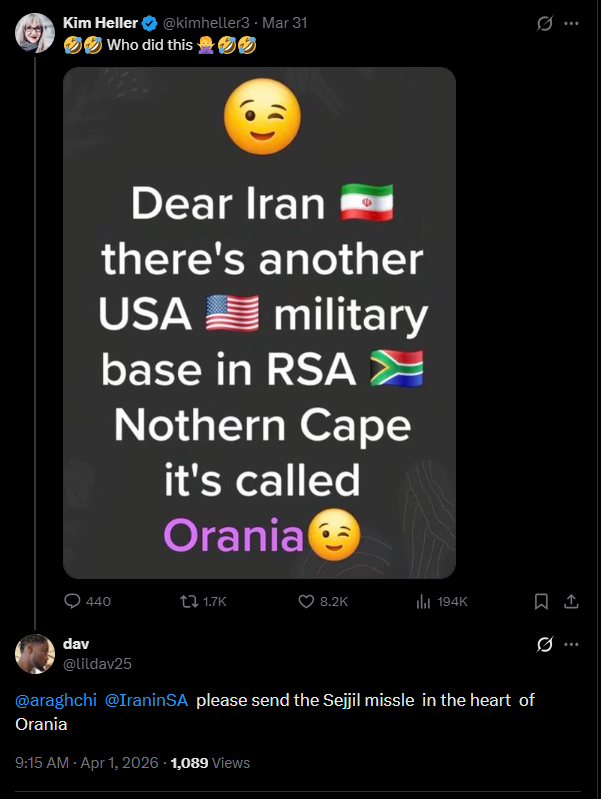
Online Incitement to Violence and calls for genside: The Dangerous Tweet Calling for a Missile Strike on Orania
In early April 2026, a single X (formerly Twitter) post escalated online discourse in South Africa to a new low. The user @lildav25 replied to a thread mocking Orania with the message: "@araghchi @IraninSA please send the Sejjil missile in the heart of Orania."
This explicit call for a ballistic missile attack on a civilian community — Orania, a small, self-sustaining Afrkanr cultural town in the Northern Cape — constitutes clear incitement to violence and genside. Tagging the Iranian Embassy in South Africa (@IraninSA) and an Iranian official added an international dimension, turning a domestic spat into a plea for foreign terrorism against South African citizens. Such rhetoric is not protected speech; under South African law, incitement to imminent violence and hate speech carry legal consequences, though enforcement often lags or make it out as political based, like we have seen with the song "Kill the boer kill the farmer" or "One Bullet one Settler", and even the EFF turned that into "One Bullet One American".
Professor G's video: South Africa & Iran Plot To Persecute Afrkanrs!
The Context of the Tweet
Orania represents a voluntary experiment in Afrkanr self-determination — residents maintain their cultural identity, language, and traditions in a private town (yes, a PRIVATE TOWN where the land was bought with MONEY, rightfully belonging to Vluytjeskraal Aandeleblok (VAB), so they can DO WHATEVER THEY WANT under the protection of section 235 in the Constitution). While controversial to some who view it as separatist, it is a peaceful, law-abiding community with no record of aggression toward outsiders. Suggesting its destruction by military means crosses every boundary of decency.
We have seen how Jacob Zuma wants to remove section 235 out of the Constitution because he hates wh Afrkanrs, yet, he does not think further that there are other places that enjoys the EXACT SAME constitution:
- AmaZulu (Zulu Kingdom)
- Province: KwaZulu-Natal
- Current King: Misuzulu ka Zwelithini (succeeded his father, Goodwill Zwelithini, in 2021)
- Largest and most prominent traditional monarchy in South Africa. The Zulu kingdom historically rose under King Shaka in the 19th century.
- AmaXhosa (Xhosa Kingdom)
- Province: Eastern Cape
- Current King: Mpendulo Calvin Sigcawu (or his successor, depending on recent developments; the Sigcawu/Sigcau line is central)
- Divided into branches such as Gcaleka and Rharhabe, but the paramount kingship is recognised.
- AbaThembu (Thembu Kingdom)
- Province: Eastern Cape
- Current/Recent King: Line associated with Buyelekhaya Dalindyebo (there have been succession disputes).
- Historically linked to the Xhosa groups; Nelson Mandela belonged to the Thembu royal house.
- AmaMpondo (Mpondo Kingdom)
- Province: Eastern Cape
- Current King: Zanozuko Tyelovuyo Sigcawu (of the Eastern Mpondo; there is also a Western Mpondo/Nyandeni branch)
- One of the larger kingships in the Eastern Cape.
- Bapedi (Pedi Kingdom or Maroteng)
- Province: Limpopo
- Current King: Thulare Victor Thulare
- Also known as the Sekhukhune line; a major Sotho-Tswana related kingdom that resisted colonial forces in the 19th century.
- AmaNdebele (Southern Ndebele)
- Provinces: Mpumalanga (mainly), with some in Gauteng/Limpopo
- Current/Recent King: Makhosonke Enoch Mabena (Manala or broader Ndebele line)
- Distinct from the Northern Ndebele (who are more closely related to Zulu).
- VhaVenda (Venda Kingdom)
- Province: Limpopo
- Current/Recent King: Toni Mphephu Ramabulana
- Recognised in government processes; the Venda have a rich history of independent polities in the far north.
Source:
This incident highlights a broader problem: social media's role in stoking tensions in a country already burdened by extreme violence. Inflammatory posts from any side — whether targeting communities like Orania or using divisive slogans — erode social cohesion and risk real-world consequences.
South Africa's Farm Attack Crisis: Brutality in Rural Areas
The tweet's timing and target amplify concerns about rural safety. South Africa faces a documented crisis of farm attacks and murders. These incidents often involve extreme brutality: torture, rape, assaults on entire families, and execution-style killings on isolated properties. Victims include farmers, their families, workers, and residents of all races.
Independent monitoring groups provide the most detailed tracking because official South African Police Service (SAPS) statistics merge farm-related crimes into broader rural safety figures and sometimes undercount specific incidents:
- AfriForum reports (a civil rights organization focused on Afrkanr and minority issues): In 2023, approximately 296 farm attacks and 49 murders. Figures for 2024 showed around 333 attacks and 55 murders in some tallies, with variations across sources.
- Rural Safety Statistics Group SA (up to October 2025): 143 farm attacks and 16 murders in the first ten months of 2025 — attacks rising compared to the prior year, while murders showed a slight decline in some periods.
- SAPS rural safety data (Q4 2024/25, January–March 2025): 6 murders in farming communities, affecting farmers, employees, and dwellers across racial groups (with most victims bl/African in that quarter).
Nationally, South Africa records over 27,000 murders annually. Farm murders represent a small fraction (~0.2%), but the per-capita risk for commercial farmers is significantly higher due to geographic isolation, perceived wealth, and slow police response times. Many attacks appear motivated primarily by robbery, yet the gratuitous violence — far beyond what is needed for theft — fuels legitimate fear among rural communities.
Low conviction rates (often below 20% for these cases) compound the problem. Under-policing in remote areas leaves families vulnerable, forcing many to invest in private security, alarms, and armed response teams.
How Online genside Incitement Exacerbates the Problem
Calls like the missile tweet do not occur in a vacuum. They contribute to a toxic climate where hatred is amplified and violence indirectly legitimized. Political rhetoric, including repeated chants of "Kill the Boer, kill the farmer" by figures such as EFF leader Julius Malema, has faced court challenges. South African courts (including recent rulings up to 2025) have often classified the slogan as protected political speech rooted in anti-apartheid history rather than literal incitement - while we know, singing "Kill the boer Kill the farmer" is nothing else but calling on genside for wh minority groups within South Africa! Critics, including AfriForum, argue it remains deeply divisive and harmful, potentially emboldening criminals or desensitizing society to attacks on farmers and Afrkanrs on farms or in urban areas.
In a nation with sky-high overall violent crime driven by inequality, unemployment, and governance failures, such language deepens racial polarization. It distracts from practical solutions and makes cross-community cooperation on rural safety harder. When individuals publicly fantasize about destroying entire towns or groups, it signals to potential perpetrators that targeting certain communities carries less moral weight.
Calling for genside pic.twitter.com/k1rA8uZUJA
— WesternPulse (@WesternPulse88) April 2, 2026
The Human Cost and the Need for Action
Behind the statistics are devastated families. Farmers and workers — bl, wh, and others — live with constant anxiety. Brutal murders leave widows, orphans, and traumatized survivors. The violence also threatens food security, as commercial agriculture (still largely wh-owned due to historical patterns) remains vital to the economy.
Addressing this requires rejecting exaggeration while confronting reality:
- Prioritize rural safety as a national emergency with dedicated SAPS resources, faster response times, and higher prosecution rates.
- Strengthen laws against incitement and ensure consistent enforcement regardless of the perpetrator's politics.
- Support community initiatives like those by AfriForum for self-defense training and intelligence sharing.
- Tackle root drivers of crime: effective policing, economic opportunity, and reducing inequality without scapegoating groups.
The tweet calling for a missile strike on Orania is a stark reminder that words have power. In South Africa’s fragile context, reckless online incitement is not harmless venting — it risks fueling the very brutality already claiming lives on farms. Condemning such posts unequivocally, while focusing on evidence-based solutions to farm attacks, is essential for any path toward safer rural communities and reduced polarization.
South Africans of all backgrounds deserve protection from violence, not more fuel for division. Practical leadership on rural security, rather than performative rhetoric, offers the best hope.
MK Party Moves to Strip Self-Determination Right From South African Constitution
The uMkhonto weSizwe Party has gazetted its intention to introduce the Constitution Twenty-Fourth Amendment Bill, 2026, which seeks to permanently remove Section 235 from the South African Constitution. The public has until 26 April 2026 to submit written representations to the Speaker of the National Assembly.
Section 235 is the constitutional provision that recognises the right of communities sharing a common cultural and linguistic heritage to pursue self-determination, either within a territorial entity or through other means determined by national legislation. The clause has been cited by communities such as Orania and Kleinfontein as the legal basis for their existence and self-governance.
The MK Party, led in this effort by Parliamentary Chief Whip Mzwanele Manyi, argues that the provision is unnecessary because the Bill of Rights already protects individual language and cultural rights. The party further contends that Section 235 introduces confusion and ambiguity into the constitutional framework and has been misappropriated to justify what it describes as racially exclusive settlements inconsistent with the Bill of Rights.
Legal analysts and opposition groups have challenged this reasoning on several grounds. Critics draw a firm distinction between individual rights, which the Bill of Rights does protect, and collective community rights, which Section 235 specifically enshrines. Removing one, they argue, does not replace the other.
The Freedom Front Plus, a member of the Government of National Unity, condemned the move and accused proponents of attempting to hollow out the meaning of the section entirely. The Cape Independence Advocacy Group noted that self-determination is not merely a domestic constitutional provision but a peremptory norm of international law. South Africa has ratified multiple international treaties, including the International Covenant on Civil and Political Rights, which bind the country to honouring this right regardless of domestic legislative changes.
Further scrutiny has been directed at the underlying premise of the bill. Section 235 has never been operationalised in the three decades since the Constitution was adopted in 1996. Parliament has not passed the national legislation required to give the provision practical effect, leaving it legally intact but functionally dormant. Critics argue that the appropriate response to an unimplemented right is to legislate and define it clearly, not to erase it.
Justice Minister Mmamoloko Kubayi has expressed support for the broader sentiment behind the bill, describing certain settlements as racially exclusive and legally inaccurate in their application of the self-determination principle. Her remarks drew sharp criticism from coalition partners who viewed them as an attempt to delegitimise constitutionally protected rights.
The bill faces significant legal and political hurdles. Constitutional amendments in South Africa require a two-thirds majority in the National Assembly, a threshold the MK Party cannot reach without broad coalition support. Nevertheless, the move has reignited a national debate about the scope of minority rights, the limits of self-determination, and the role of the Constitution as a protector of all communities regardless of size or political influence.
Written submissions can be directed to the Speaker of the National Assembly at speaker@parliament.gov.za or delivered to Africa House Building, Cape Town, before the 26 April 2026 deadline.
Riaan Roux about the MK trying to remove section 235 from the constitution:

Comments (0)
Leave a Comment