
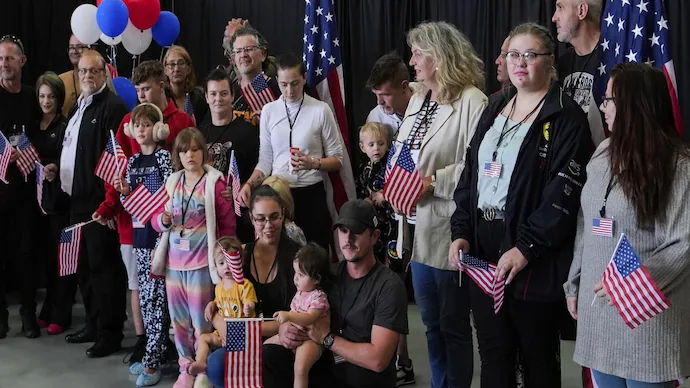
A February 2026 article detailed how many new arrivals struggled with inadequate support, prompting swift government action by late March 2026.
Colonel Chris Wyatt Video on issues with resettlement of refugees:
Background: Trump's Policy on South African Refugees
In early 2025, President Trump issued Executive Order 14204, addressing what the administration described as government-sponsored race-based discrimination against minority groups like Indians, Coloreds and Afrkanrs (wh South Africans, mainly descendants of Dutch settlers) in South Africa, including issues around land expropriation and urban and farm attacks. This led to a prioritization of Afrkanr refugees in the U.S. Refugee Admissions Program (USRAP), even as the overall refugee ceiling for fiscal year 2026 was slashed to a record-low 7,500—down sharply from previous years—with most slots directed toward Afrkanrs and others facing "unjust discrimination."
The first groups arrived in 2025 (starting with around 59 in May), and thousands more followed. The policy marked a shift: traditional refugee flows from conflict zones were curtailed, while this group received expedited processing, including chartered flights and direct government involvement in some cases.
The Free Press and Col Chris Wyatt Investigation: "Left to Fend for Themselves"
Col Chris Wyatt's and Rowley's reporting, published around February 10, 2026, painted a troubling picture of the resettlement process for many Afrkanr families. Despite the high-profile welcome for some early arrivals, systemic breakdowns left later groups vulnerable. Key issues included:
- Substandard and unsafe housing: Refugees reported placement in decrepit apartments infested with cockroaches, in high-crime neighborhoods where they witnessed drug deals and prostitution outside their doors.
- Financial strain: Many received a one-time initial stipend (around $2,000 in some cases) that quickly ran out, especially when used for extended motel stays. This left families with minimal support for food and basics.
- Lack of core services: The standard refugee resettlement model relies on government-funded nonprofit agencies to provide temporary housing, assistance with Social Security numbers, food stamps (SNAP), job placement, and cultural orientation. For these South African refugees, these services often failed to materialize effectively, forcing families to "barely scrape by" on their own in cities like Detroit, Chicago, and San Jose, California.
- Interviews with refugees: Rowley spoke with multiple Afrkanr families who described feeling abandoned after arrival. Photos accompanying the report showed families in modest or challenging living situations in southeast Pennsylvania and elsewhere.
The investigation highlighted that these failures marred the Trump administration's humanitarian gesture, revealing gaps in a refugee system that has operated for decades through partnerships between federal agencies and nonprofits.
Government Response: Immediate Action and Outreach
The exposé prompted rapid response. By mid-to-late March 2026, the Administration for Children and Families (ACF)'s Office of Refugee Resettlement (ORR) took steps to address the gaps:
- Outreach to over 700 South African refugees (with reports of contact reaching 1,100 cases in some updates) via phone calls to assess their experiences, needs, and satisfaction with resettlement services.
- Collaboration with nonprofit partners "leading on-the-ground efforts" to strengthen delivery of core services, such as housing, benefits access, and employment support.
- A U.S. official told The Free Press: "We took immediate action," signaling accountability and a commitment to fixing breakdowns exposed by the reporting.
CBS News covered the story on March 27, 2026, noting that the government was "moving to help them" following Chris Wyatt's and Rowley's reporting on living conditions.
Planned Improvements to the Refugee Resettlement Program
Beyond immediate outreach, officials signaled broader reforms to the program, which had faced criticism for inefficiencies even before the influx of South African cases. Potential changes include:
- Overhauling the bidding and contracting process for resettlement agencies to ensure more reliable service delivery and reduce breakdowns in fund disbursement or case management.
- Enhanced monitoring and direct federal involvement to prevent similar issues for future arrivals, especially given the focused nature of the Afrkanr prioritization.
- Lessons from the 46-year-old U.S. refugee resettlement framework, with calls for "rapid improvements" in how services are coordinated between federal oversight and local nonprofits.
These adjustments aim to make the system more responsive, particularly for groups resettled under targeted policies like the South African initiative. While the overall refugee cap remains low, the administration has emphasized efficient support for those admitted.
Broader Context and Challenges
This situation reflects ongoing debates about U.S. immigration priorities under the current administration. Supporters see the targeted refugee program for Afrkanrs (and other persecuted minorities from South Africa) as a necessary correction to past biases and a response to documented security concerns facing certain groups in South Africa—claims that the South African government strongly disputes, rejecting any "wh genside" narrative.
Critics argue that the initiative politicizes humanitarian aid. Some Afrkanrs who have arrived have reportedly chosen to return to South Africa, citing stronger family ties, lower living costs, or a perceived better overall quality of life back home. These cases underscore an important reality: successful resettlement depends on far more than just gaining entry. Factors like cultural integration, job opportunities, community support, and practical assistance play a critical role.
For those who remain in the U.S., recent actions by the Office of Refugee Resettlement—following reports of gaps in support—represent a meaningful effort to address shortcomings and convert high-level policy decisions into sustainable, on-the-ground outcomes. Journalism, such as the investigative work by Madeleine Rowley at The Free Press, has played a valuable role in highlighting these issues and prompting accountability.
Colonel Chris Wyatt's Role
Yes—Colonel Chris Wyatt has been exceptionally active in pushing for better support and transparency in this program. He has traveled to interview refugees in various states (including Las Vegas, Alabama, and others), spoken directly with resettlement agency directors, and publicly shared both positive stories of successful integration and areas needing urgent improvement. His independent reporting and advocacy have provided a crucial counterbalance to one-sided narratives and have helped amplify refugee voices to the relevant authorities.
If his efforts contributed to the improvements now being implemented by the Office of Refugee Resettlement, then he deserves sincere recognition. Colonel Wyatt, if you're reading this—thank you for your tireless work on behalf of South African refugees. Your hands-on commitment since the program's early days has made a real difference.
As the U.S. continues processing South African refugees within its defined limits, addressing these early challenges could help establish a stronger, more effective resettlement model overall—one that truly supports long-term success for those who have left everything behind in search of safety and opportunity.
We just want to say thank you to CBS News for publishing this to the Main Stream Listeners and watchers, as with this, it could not have been done with you to get coverage on all the work Col Chris Wyatt has done.
Please just next time, include him too on the reporting, as he did most of the work here. Thanks.

Comments (9)
Leave a Comment
Leon Cloete
Apr 05, 2026 04:37Thank you Colonel Wyat youre an amazing human being .
Thank you for all the help with the refugee program .Without you the chaos would have resulted in lives being lost in the despair we are facing in South Africa and some refugees in America .I have been under review for almost 6 months our lives have destroyed waiting not knowing then we on then it’s delayed then the government shuts down …. Yes it affects us all financial ruin is here.
Approve us or send us denials but do something you’re destroying people lives what’s left of it .
I’m 63 with a conviction for a slap (This is what happened to white men who were caught up in false domestic violence to get to their assets and non white magistrates who are so eager to convict white men out of hatred )23 years ago is positively ridiculous and the amateur USCIS agents should be ashamed of herself putting an old man through this hell. If that’s the criteria ….you clearly don’t understand South Africa and how things work .As far as I’m concerned USCIS also needs to be reformed .
We aren’t ungrateful by no means and what a wonderful gift from President Trump.But there are some of us in South Africa that needs help we are just being ignored no response to mail best of times … shocking waiting months for a reply if ever … with no real answer other than USCIS is reviewing your case…. Shocking ….
Anna Kruger
Apr 03, 2026 20:30Thank you to Colonel Chris Wyatt as well as president Trump and everyone that help us all in SA. I appreciate it from the bottom of my heart. Hope my family see you soon in America
Thank you.
Teresa M du Preez
Apr 03, 2026 16:39Thank you Colonel Chris Wyatt for giving us a voice. We are praying to resettle soon as my husband is 80 and I am 72 years old. Can't wait to get out of here. ?
priscilla Meyer
Apr 03, 2026 14:27Thank you so much for ure hard work.
Please help the 2025 ppl till des still stuck with no movemnet plz..
Helena
Apr 03, 2026 11:20I know of a group of approx 100 people, that affect 400 or more individuals... All under review or under admin hold...also people who were approved in December but haven't left...and those in Jan Feb and March have gotten letters one week after applying...this is not ungrateful...it's unregulated and really unfair...not by the USA but by the agencies ... No real communication..just generic email... Clarity is required.
Helena
Apr 03, 2026 11:16Well from what I've seen in a group, there was a system crash last year, this is not verified. Is this why so many people are waiting 4 to 6 months with generic emails and no movement .. we need confirmation on this... I have emailed RSC to get confirmation.. Colonel Wyatt is amazing but don't forget Professor G.
We need confirmation asap ..
Teresa Badenhorst
Apr 03, 2026 10:47Thank you for your assistance and support Col. Wayat
You have been working for a long time many hours with lots of frustrations to get us over there.
Please streamline things here in the SA
There is an explicit group of people which are in the system, which are but left behind which have created several families on the street now in horrible financial poverty.
There flights were booked already for September.
Please URGENTLY help them.
Thank you for your Help.
Anthea Crook
Apr 03, 2026 10:39Thanks for this article much appreciated.yes colonel Wyatt is a great warrior for the SA refugee program his endless dedicated work has helped many refugees in America .salute you colonel Wyatt . God bless you
Sanet Basson
Apr 03, 2026 09:46Appreciate your work on this issue. But your reporting on refugees returning to SA is incorrect. Those South Africans that have returned where not refugees, but seasonal workers or people who had emigrated long before the program.