
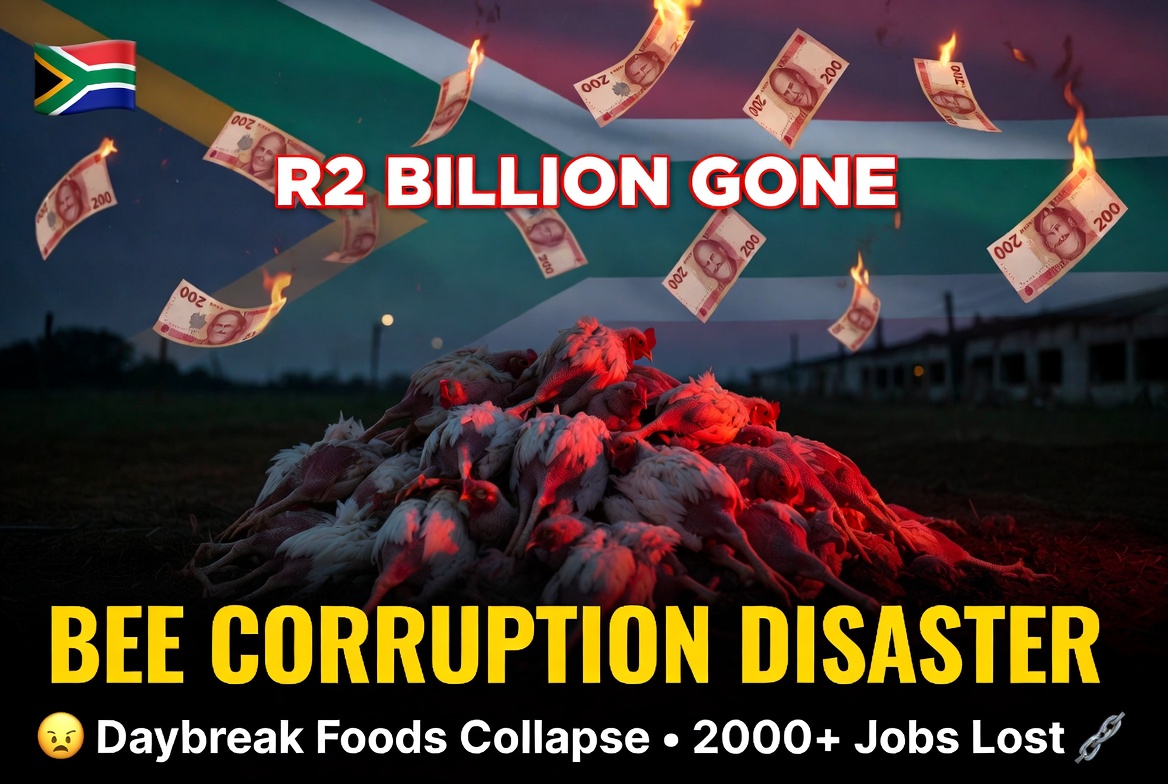
Daybreak Foods, once a thriving pillar of the local poultry industry, has collapsed into business rescue after the Public Investment Corporation (PIC) and other state-linked entities poured over R2 billion into it under the banner of "Black Economic Empowerment." What was meant to be a shining example of transformation has instead become a textbook case of value destruction, corruption, and human suffering.
ActionSA MP Alan Beesley didn't mince words after the Standing Committee on Finance's oversight visit on 28 April 2026. A R2 billion investment "disappeared into thin air" due to mismanagement, irregular expenditure, fraud, and outright corruption. Before the PIC's intervention, Daybreak was among South Africa's top poultry producers, part of the Afgri group, with integrated operations across the value chain. It employed over 3,400 workers, generated R3.8 billion in annual revenue, and could produce 9 million birds per 34-day cycle. Fresh chicken reached markets in Gauteng, Mpumalanga, Limpopo, and KwaZulu-Natal, supporting food security and rural livelihoods.
That was then. After the PIC acquired it for R1.19 billion in 2015—explicitly citing "socio-economic development and transformation"—the rot set in. Poor financial controls, governance failures, and what can only be described as cadre-style looting hollowed out the company. By 2025, operations had scaled back dramatically. The NSPCA was forced to cull over 350,000 chickens starved of feed, some resorting to cannibalism on farms left without basic management. Daybreak couldn't even feed its birds. Today, it employs just 300 people. Over 2,000 workers were retrenched as part of early business rescue efforts. The company is a shadow of its former self, with revenue evaporated.
This isn't mere "bad luck" or a market downturn. It's the predictable outcome of prioritizing racial quotas, political connections, and BEE scorecards over competence, profitability, and sound governance. The PIC, guardian of public servants' pensions and workers' funds, ignored commercial reality in favour of ideological transformation. Additional hundreds of millions flowed in from the Unemployment Insurance Fund (UIF) and Compensation Fund—R400 million each initially in 2016, converted to equity with zero returns, followed by another R150 million apiece. These are workers' contributions, meant to protect the vulnerable, not prop up failing experiments in social engineering.
The Democratic Alliance has rightly called for these entities to account before Parliament. Why continue throwing good money after bad into a collapsing enterprise? The Standing Committee on Finance labelled the collapse "horrible and disappointing." That's an understatement. It is a national disgrace.
The Broader Pattern
Daybreak is not an isolated failure. Across South Africa, BEE-driven takeovers and "empowerment" deals have repeatedly turned viable businesses into vehicles for enrichment of the politically connected. Competent managers are sidelined, skills flight accelerates, and corruption thrives in the absence of accountability. The ANC government's obsession with demographic engineering—rather than growing the economic pie for all—has contributed to stagnant growth, rising unemployment, and deepening poverty. White farmers and managers built Daybreak's success; "transformation" presided over its ruin.
Meanwhile, ordinary South Africans bear the cost: lost jobs in a province that desperately needs them, higher food prices from reduced local production, strained animal welfare, and depleted public funds that could have gone to real infrastructure or tax relief. The chickens left to suffer symbolize the callousness—ideology over practicality, slogans over results.
Time for Accountability and Reform
Those responsible for this mess must face consequences: forensic audits, prosecutions for fraud and corruption, and blacklisting from future public investments. More fundamentally, South Africa needs a policy shift away from race-based empowerment toward genuine economic liberation—deregulation, merit-based appointments, property rights security, and an end to the BEE racket that enriches a few while impoverishing the many.
Daybreak Foods stands as a warning. When government picks winners based on skin colour instead of ability, everyone loses: workers retrenched, investors (taxpayers) fleeced, animals culled, and an entire industry crippled. It's not "transformation"—it's destruction dressed up in progressive language. The right-leaning view is clear: empower people through opportunity, education, and free enterprise, not through state-orchestrated looting. Until that lesson is learned, more Daybreaks will follow. South Africa cannot afford them.

Comments (0)
Leave a Comment