
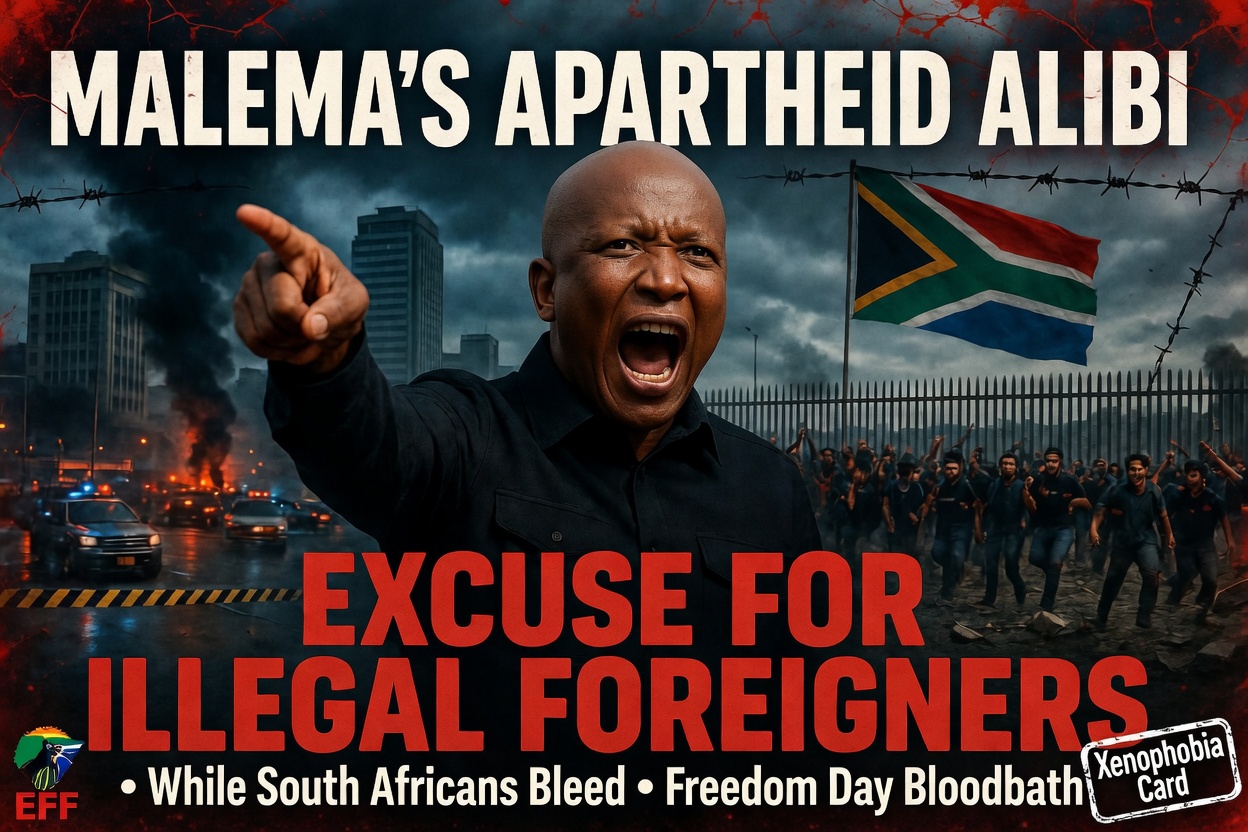
As Johannesburg’s CBD descended into another Freedom Day bloodbath — three foreign shop owners executed in a targeted hit with no robbery involved — Julius Malema and the EFF were nowhere to be seen demanding justice for South African victims of the very same chaos. Instead, true to form, the self-styled champion of the poor was already preparing the script: blame “xenophobia,” invoke Apartheid, and deflect from the flood of undocumented foreigners turning townships and city centres into warzones.
This is not new. For years Malema has perfected a rhetorical sleight of hand: every time ordinary South Africans — Black, Coloured, Indian and White — demand basic border control, deportation of criminals, and jobs for citizens first, he reaches for the Apartheid ghost. “These countries sheltered our leaders during the struggle,” he intones. “We cannot turn on our African brothers now.” Or the classic: criticise illegal immigration and you are no better than the Boers who built the pass laws. The subtext is clear — 32 years after 1994, any failure in the new South Africa must still be pinned on the old one. Illegal foreigners are not a policy problem; they are sacred victims of history.
Let that sink in.
South Africa today hosts millions of undocumented migrants — estimates run into the millions, with entire hijacked buildings and street economies operating outside the law. They are not all angels. Recent turf wars in the Johannesburg CBD, drug syndicates, cash-in-transit heists, and the sheer strain on housing, water, electricity and hospitals are not “Apartheid’s fault.” They are the direct result of a porous border, collapsed Home Affairs, and a political class that treats sovereignty as a colonial relic. Yet Malema’s reflexive defence is to label any pushback “xenophobia” and pivot straight back to 1976 or 1985.
— Julius Sello Malema (@Julius_S_Malema) April 23, 2026
Public backlash has been ferocious — and growing louder with every body in the morgue. On social media and in township WhatsApp groups, the refrain is merciless:
- “Touch illegal foreigners and Malema will remind you about Apartheid days,” one widely shared post read. “Meanwhile our children have no jobs and our streets are running with blood from foreign turf wars.”
- Another: “So South Africans must allow illegal immigrants to sell drugs to our youth because their countries helped during Apartheid? We owe them nothing.”
- From Operation Dudula-aligned voices and ordinary citizens: “When they are done with foreigners, they will come for you — but Malema is busy protecting the very people replacing us in our own country.”
Even some of Malema’s own past supporters have turned. In August 2025 he made a rare tactical shift, declaring “jobs for South Africans first” amid mounting pressure. But the mask slipped quickly — in recent weeks he has reverted to ritualistic condemnations of “xenophobic attacks,” warning that after foreigners are targeted, “they will come for you” (implying tribal or racial South Africans next). The message to citizens: shut up and absorb the consequences, or you’re the real racists.
This is psychological gaslighting on a national scale. Apartheid was evil — no serious person denies that. But using its memory as a perpetual get-out-of-jail-free card for current governance failure is grotesque. The ANC has ruled for three decades. The EFF has been a loud parliamentary force for over a decade. Together they have delivered 142 race-based laws, the destruction of Afrikaans-language education, attacks on cultural self-determination under Section 235, and an economy so broken that even foreign nationals are now slaughtering each other for scraps in the CBD. Yet the root cause, according to Malema, is still “white monopoly capital” and the long shadow of Verwoerd.
The hypocrisy is staggering. Malema rails against “settler” minorities (Afrikaners, in particular) while championing the unchecked arrival of millions from across Africa who have no historical claim to South African soil. He demands “expropriation without compensation” from citizens whose ancestors built farms and cities, but treats undocumented Zimbabweans, Nigerians and Congolese as untouchable symbols of Pan-African solidarity. When violence erupts — as it did on Freedom Day in Johannesburg — the script flips: it’s never the failure to enforce borders or deport criminals; it’s always “poverty and inequality born of Apartheid.”
The human cost is no longer abstract. Local traders have been driven out of the Johannesburg CBD. Taxi violence, extortion rackets and drug markets flourish in the vacuum. Hospitals overflow with patients who crossed borders for “free” care. Schools in townships strain under numbers their budgets never anticipated. And when citizens organise — through movements like Operation Dudula — they are branded criminals while the real criminals receive political protection from the EFF podium.
This is not compassion. It is political strategy. Malema’s power base feeds on grievance. A permanent underclass of desperate foreigners provides both cheap labour for connected cronies and a convenient scapegoat when things inevitably explode. By keeping the Apartheid wound open, he prevents any honest conversation about ANC/EFF policy failure. South Africans are told they must atone forever — even as their own children inherit unemployment rates that make the old regime look like an economic miracle by comparison.
The backlash is not “xenophobia.” It is the sane reaction of a people watching their country dissolve. South Africans of every race built this nation through blood, sweat and generations of labour. They have every moral and legal right to demand that their government prioritises them first — exactly as every functional country on earth does. Invoking 1994’s rainbow rhetoric while importing chaos is not unity; it is national suicide.
Freedom Day 2026 exposed the lie once again. While politicians spoke of reconciliation, gunfire echoed in the CBD and Malema’s allies prepared the usual deflection. The question remains the same one haunting every minority community and every law-abiding citizen in this country:
Freedom for whom?
For the undocumented foreigner shielded by historical guilt? Or for the South African taxpayer, parent, and worker watching their future auctioned off in the name of a struggle that ended three decades ago?
Malema’s Apartheid alibi has run its course. The blood on Johannesburg’s streets demands a different answer — one rooted in sovereignty, accountability, and putting South Africans first. Anything less is not justice. It is betrayal.

Comments (0)
Leave a Comment