
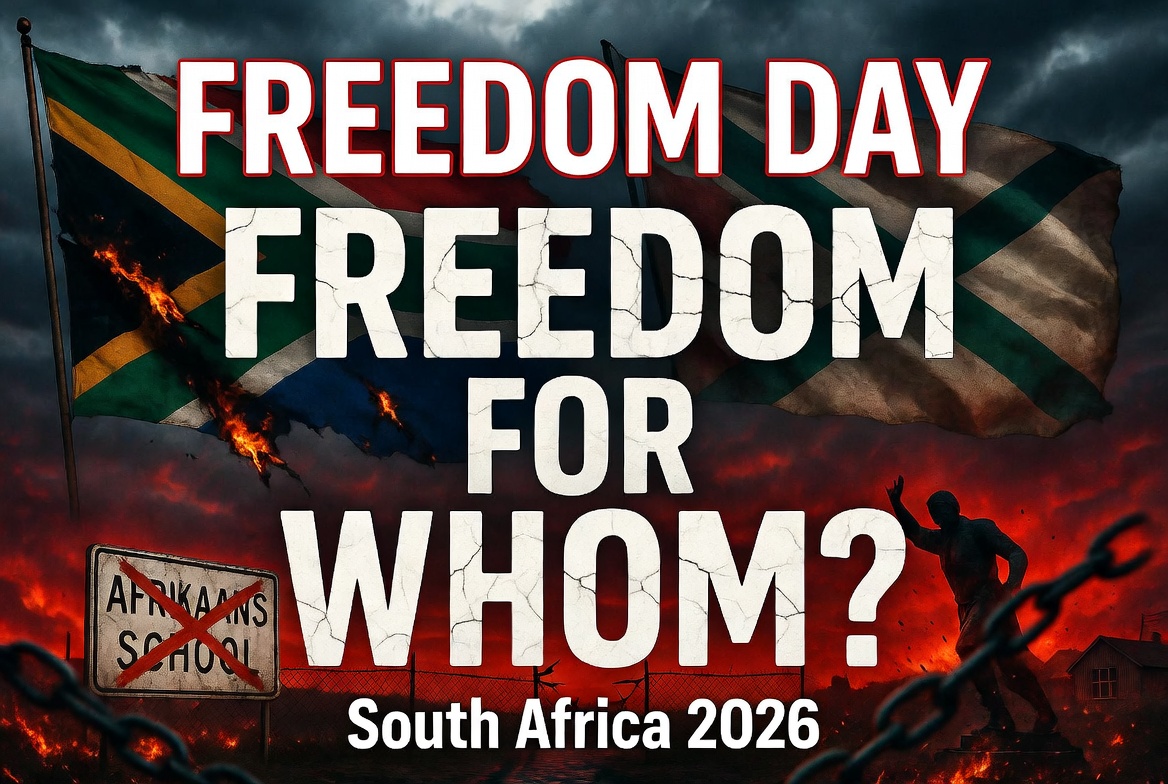
As South Africa observes Freedom Day on 27 April — the anniversary of the 1994 elections that ended apartheid and ushered in universal suffrage — one question hangs uneasily over the official celebrations: freedom for whom? The rainbow nation narrative insists that 1994 delivered liberty, equality and non-racialism for all. Yet for Afrikaans-speaking communities of every race, for independent-minded Boer and Afrikaner enclaves, and for anyone who values merit, property rights and cultural self-determination, the reality feels less like emancipation and more like a new form of selective oppression dressed up as redress.
Consider first the systematic assault on mother-tongue education. Section 29(2) of the Constitution explicitly guarantees the right to education in the language of one’s choice where it is “reasonably practicable.” Afrikaans, spoken as a first language by millions of Coloured, White and Black South Africans alike, has been under sustained pressure in schools, colleges and universities. Successive court battles — from Hoërskool Ermelo to the University of Pretoria and Unisa — have exposed how provincial education departments and university administrators override governing bodies and force English-only or dual-medium policies, often citing “transformation.” The recent Basic Education Laws Amendment Act has only intensified fears that Afrikaans-medium schools will be compelled to dilute their language policy to accommodate non-Afrikaans speakers, regardless of the educational cost to children who learn best in their mother tongue. This is not neutral policy; it is cultural erasure by regulation.
WATCH:
Then there are the race-based laws themselves. Research by AfriForum and the Institute of Race Relations documents at least 142 pieces of operative racial legislation still on the statute books — many enacted after 1994. The Employment Equity Act and Broad-Based Black Economic Empowerment (B-BBEE) framework, along with their myriad regulations, procurement rules and sector charters, explicitly tie opportunity to skin colour rather than competence. Businesses cannot freely choose whom they hire, promote or contract with. Public and private tenders favour racial scorecards over price, quality or experience. The result is not the promised upliftment of the previously disadvantaged but the deliberate economic marginalisation of minorities. Merit is subordinated to demographic targets; independent enterprise is penalised if its owners happen to be the wrong race. This is not freedom — it is state-enforced racial engineering that impoverishes talent and entrenches dependency.
The Constitution itself promised more. Section 235 recognises “the notion of the right of self-determination of any community sharing a common cultural and language heritage, within a territorial entity in the Republic or in any other way, determined by national legislation.” It was a hard-won compromise during the transition, designed to protect cultural minorities from majoritarian tyranny. Yet today that clause is under direct attack. In March 2026 the MK Party gazetted a private member’s bill to repeal Section 235 outright, arguing it creates “confusion” and “cultural enclaves.” The EFF has long branded self-determining communities such as Orania and Kleinfontein as “grave dangers” to democracy and non-racialism. These are not fringe views; they command seats in Parliament and influence policy.
Nowhere is the contradiction clearer than in the treatment of independent Afrikaner settlements. Take Kleinfontein, the Afrikaner cultural community east of Pretoria. In 2025 the City of Tshwane served the settlement with court papers and demolition threats unless it re-applied for township establishment and complied with demands the community describes as punitive and selectively enforced. Residents allege the municipality’s obsession with their rates account and building approvals is politically motivated — that other informal or non-compliant developments are ignored while this Afrikaner project is singled out for destruction. Similar pressure is applied to Orania, the voluntary Afrikaner town whose very existence triggers parliamentary outrage and threats of expropriation or forced integration. Freedom of association, it seems, is a right that applies to some but not to others.
Compounding the injury is the deliberate rewriting of the physical and historical landscape. Streets, towns and landmarks are renamed after figures from the ANC’s armed struggle — many with documented ties to violence, terrorism designations in the past, or even foreign communist dictators. The C.R. Swart Building in Bloemfontein, once named after a former state president, was rebranded in honour of Fidel Castro. Statues of Afrikaner and colonial-era leaders have been toppled or removed, museums defunded or re-curated to fit a single approved narrative, and Boer War memorials quietly neglected. This is not inclusive heritage; it is triumphalist cultural conquest. The message to minorities is unmistakable: your history, your heroes and your landmarks do not belong here.
The cumulative effect is a selective freedom. The majority celebrates 27 April as the dawn of their deliverance. Minority communities — those who built farms, towns, universities and businesses under the old order and who continue to contribute disproportionately to the tax base — are told their language rights are negotiable, their cultural enclaves intolerable, their economic participation conditional on racial penance, and their very right to self-determination up for repeal. When Pretoria municipality threatens to bulldoze an entire Afrikaner settlement over rates disputes while elsewhere service delivery collapses without consequence, when Afrikaans schools are forced to anglicise while English-medium institutions face no reciprocal pressure, and when parliament debates erasing constitutional protections for cultural communities, the question is no longer abstract.
Freedom Day therefore begs a blunt question: freedom for whom? For those who cheer the erasure of minority heritage, the answer is yes. For the Afrikaans-speaking child denied mother-tongue instruction, the entrepreneur denied a tender because of his race, the family in Kleinfontein wondering if their homes will be demolished next month, or the residents of Orania watching politicians plot the repeal of their constitutional shield — the answer is a resounding no. True freedom cannot be built on the systematic dispossession of any group, however small. Until South Africa abandons race as the organising principle of law, policy and public memory, Freedom Day will remain a hollow festival for some and a day of mourning for others. Minorities have every right to ask what, exactly, they are supposed to celebrate.

Comments (0)
Leave a Comment