
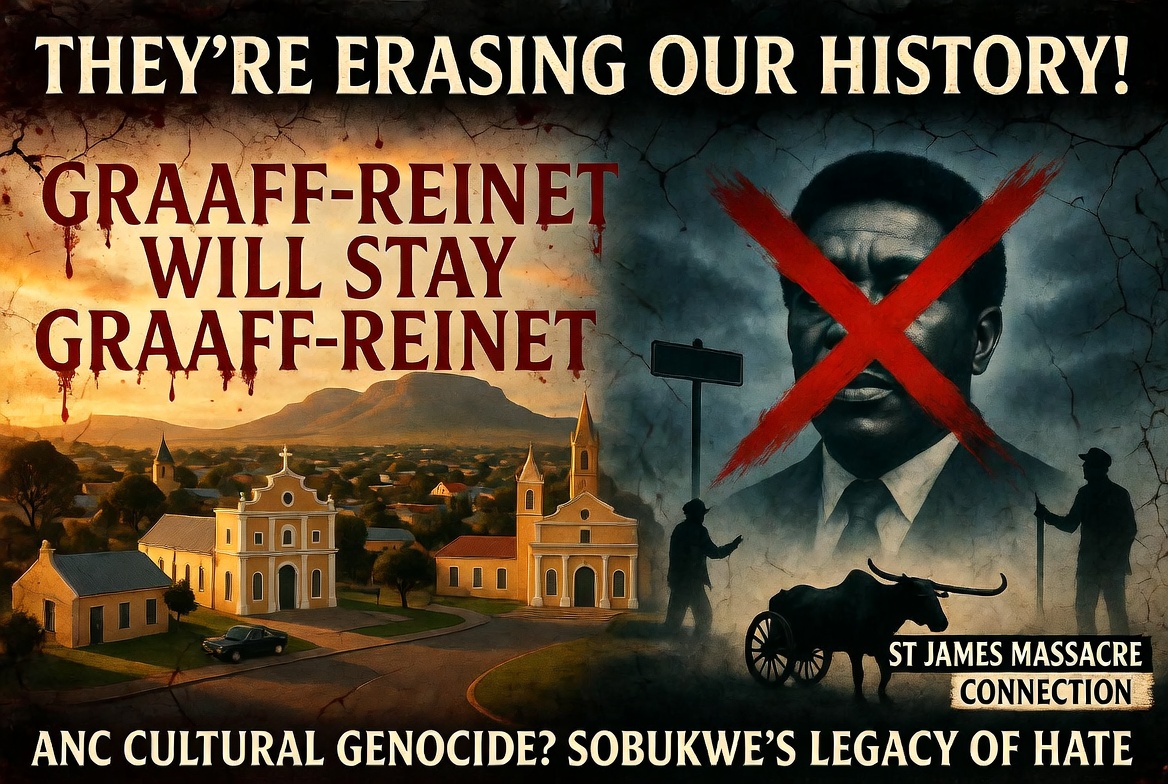
For outsiders looking at South Africa from afar, the name “Graaff-Reinet” might sound like just another dusty Karoo town on a map. But for those who know our history, it is a living monument to white Afrikaner pioneering spirit — a place our Dutch-descended forefathers carved out of unforgiving wilderness more than 240 years ago. In February 2026 the South African government officially gazetted its renaming to “Robert Sobukwe Town,” part of a broader ANC-driven programme of geographical name changes framed as “decolonisation” and “restorative justice.” We reject this outright. Graaff-Reinet will remain Graaff-Reinet — in our language, our schools, our signs, our hearts, and our history books. This is not mere stubbornness. This is education for the outside world: you must understand who built this town, how we built it, and why this latest erasure fits into what many Afrikaners see as a deliberate cultural genocide agenda by the ANC against white Afrikaner heritage.
The Harsh Birth of Graaff-Reinet: How Afrikaner Pioneers Tamed the Karoo
In 1786 the Cape Colony was under Dutch East India Company (VOC) rule. Landdrost Maurits Woeke established a frontier outpost at a bend in the Sundays River, encircled by the Sneeuberg mountains. He named it Graaff-Reinet after Cape Governor Cornelis Jacob van de Graaff and his wife Cornelia Reynet.
The semi-desert Karoo tested every limit: extreme heat and cold, scarce rainfall (under 300 mm a year), droughts, and raids. Yet our ancestors — descendants of 1652 Dutch settlers, 1688 French Huguenot refugees, and German Protestants — transformed it through relentless labour:
- Hand-dug leiwater irrigation furrows brought life to gardens and orchards.
- They constructed the historic Drostdy, Cape Dutch homes with thick whitewashed walls and distinctive gables.
- In the 1790s, frustrated burghers declared the short-lived Graaff-Reinet Republic — an early assertion of Afrikaner self-rule.
- The town became the cradle of the Great Trek (1830s). Voortrekker leaders like Gerrit Maritz, Piet Retief, and Andries Pretorius set out from here in ox-wagons, seeking freedom from British rule after 1806.
Graaff-Reinet is the fourth-oldest town in South Africa. Its grid layout, over 200 preserved historic buildings, and the grand Dutch Reformed Mother Church (modelled on Salisbury Cathedral) stand as testament to Afrikaner achievement. We turned wilderness into the “Jewel of the Karoo” through farming, wool production, and ingenuity — not conquest of an existing city, but creation where little permanent settlement existed before.
Robert Sobukwe and the PAC: The Radical Split That Fuelled Anti-White Terror
Robert Mangaliso Sobukwe was born here in 1924 — long after the town already existed. An intelligent leader, he broke from the ANC in 1959, rejecting its multi-racial Freedom Charter. He founded the Pan Africanist Congress (PAC) on the creed “Africa for the Africans” — explicitly excluding white settlers. His armed followers (first Poqo, then APLA) adopted the slogan “One Settler, One Bullet.”
While the ANC’s MK moved toward negotiations, APLA clung to civilian terror under “Operation Great Storm.” This ideology produced the St James Church massacre of 25 July 1993: four APLA killers stormed a multi-racial service in Kenilworth, Cape Town, firing rifles and nail-packed grenades. Eleven worshippers slaughtered in thirty seconds — including 13-year-old Wesley Harker, his brother Gerard (who heroically shielded others), wives, mothers, and four Russian seamen. The killers confirmed at the TRC they acted on PAC orders.
Why We Condemn Sobukwe and See the Rename as Part of an ANC Cultural Genocide Agenda
Honouring Sobukwe by erasing a 240-year-old Afrikaner name is not neutral transformation — it is symbolic conquest. Surveys showed over 80% of residents (including majorities of Coloured and white citizens) opposed it. Petitions, marches, and legal objections from groups like AfriForum were largely ignored. The ANC government pushed ahead as part of 21 simultaneous name changes, openly aimed at replacing “colonial and apartheid-era” names.
Many Afrikaners view this as part of a wider cultural genocide agenda:
- Systematic removal of Afrikaner and Dutch heritage from the landscape (statues toppled, streets renamed, farm names altered).
- Airbrushing our contributions from official narratives while elevating only one side of the liberation struggle.
- Replacing living history with political symbolism, undermining the cultural identity of a people who have lived here for over 350 years and built much of the country’s modern infrastructure.
This is not “reconciliation.” It is retributive erasure — denying that white Afrikaners are indigenous Africans with their own language (Afrikaans), culture, and history forged on this soil. The ANC’s transformation ideology treats Afrikaner place names as inherently illegitimate, regardless of public opposition or historical fact. It echoes patterns seen in other post-liberation societies where victors rewrite geography to consolidate power and marginalise the defeated.
The Outside World Must Understand
Afrikaners are not temporary “settlers.” We are a distinct nation born in Africa — forged through wars, treks, and toil. Graaff-Reinet symbolises that resilience. Sobukwe’s ideology, which inspired church massacres, has no moral claim to overwrite it.
We will teach our children the full story: the pioneers who built this town, the blood of St James innocents, and the ongoing campaign against our heritage. The Karoo sun will still rise over those whitewashed gables. The Sundays River will still flow where our forefathers dug the first furrows.
Graaff-Reinet was, is, and will remain Graaff-Reinet. That is not hate. That is the defence of truth, memory, and the right of a people to their own history. The world deserves to hear this unfiltered account.

Comments (0)
Leave a Comment