
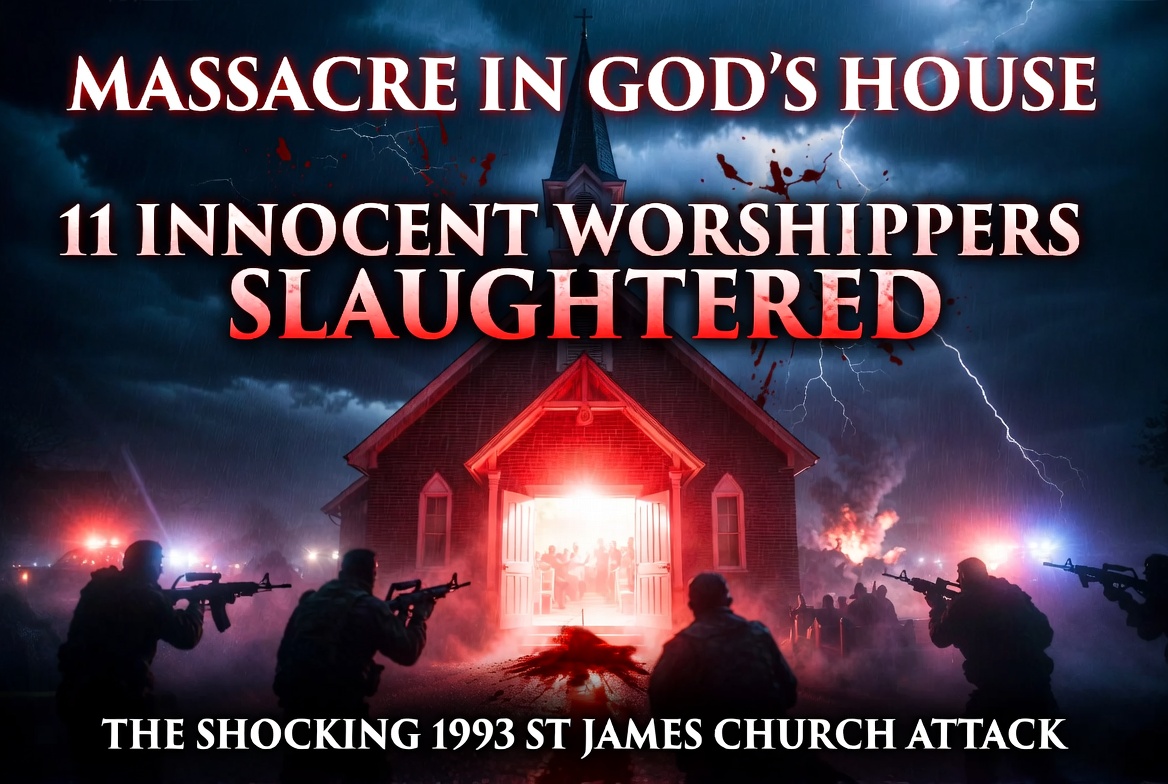
On the stormy evening of 25 July 1993, in the quiet, tree-lined suburb of Kenilworth, Cape Town, over a thousand ordinary people — families, teenagers, children, and visiting Russian seamen — packed into St James Church for what should have been a routine, uplifting evangelical service. Hymns filled the air. Prayers rose to heaven.
Then, in a heartbeat, hell erupted.
Four heavily armed members of the Azanian People’s Liberation Army (APLA) — the military wing of the Pan Africanist Congress (PAC) — smashed through the doors like demons unleashed. Wielding Vektor R4 assault rifles and M26 grenades packed with extra nails for maximum carnage, they unleashed a merciless storm of bullets and shrapnel into the defenseless congregation. In just thirty horrifying seconds, eleven innocent people were slaughtered and 58 more were maimed and bleeding on the church floor. Blood soaked the pews. Screams drowned out the hymns. This was no “political act.” This was cold-blooded mass murder in the house of God.
Who Were APLA? The PAC’s Ruthless Armed Wing — Bitter Rivals to the ANC
APLA was not part of the African National Congress (ANC). Quite the opposite: the PAC, and its armed wing APLA (formerly known as Poqo, meaning “pure” in Xhosa), emerged from a explosive split with the ANC in 1959.
A group of radical “Africanist” members broke away from the ANC, rejecting its multi-racial Freedom Charter and alliances with white communists and other groups. Led by figures like Robert Sobukwe, the PAC demanded “Africa for the Africans” — a fiercely black nationalist, anti-settler ideology that viewed the ANC as too moderate and compromised. While the ANC’s armed wing, Umkhonto weSizwe (MK), eventually shifted toward negotiations in the early 1990s, APLA refused to abandon the gun. Under the slogan “One Settler, One Bullet,” they launched “Operation Great Storm” — a deliberate terror campaign targeting white civilians as South Africa teetered on the edge of democracy.
The PAC and ANC were fierce rivals throughout the struggle, sometimes clashing violently. APLA’s attacks, including St James, were seen by many as a desperate bid by the PAC to undermine the ANC’s dominance in the transition. Far from being allies, the two liberation movements competed bitterly for support, with APLA continuing its “soft target” massacres even as the ANC moved toward talks.
A Church That Dared to Be Different — Turned Into a Slaughterhouse
St James wasn’t some segregated white enclave. It was a vibrant, multi-racial congregation that actively rejected apartheid’s poison. By 1993 it had grown into a thriving family church with outreach programs, youth ministries, and even hospitality for foreign sailors. That night, several Russian seamen were guests — ordinary men far from home, enjoying Christian fellowship.
None of them saw it coming.
Rector Frank Retief and associate Ross Anderson were leading the service. A young duo had just begun singing when the doors flew open. What sounded like firecrackers turned into the deafening roar of automatic gunfire. Grenades exploded — one at the front, one at the back — sending razor-sharp nails ripping through flesh, bone, and wood.
The attackers had planned even worse: they intended to burn the entire church down with petrol bombs after the shooting. Only a wounded terrorist forced them to flee.
The Victims: Innocents Executed Where They Prayed
Among the dead:
- Gerard Harker (21) — who heroically threw himself onto a live grenade to shield others. His 13-year-old brother Wesley died beside him.
- Four Russian seamen: Andrey Katyl (25), Oleg Karamjin (55), Valentin Varaksa (40), and Pavel Valuet (40) — visitors who had come for peace and found death.
- Richard O’Kill (17) — just a teenager.
- Wives and mothers: Marita Ackermann (46), Myrtle Smith (45), Denise Gordon (30).
- Others including Guy Javens (52).
One Russian survivor, Dmitri Makogon, lost both legs and an arm. The sheer randomness and brutality still shocks the conscience: worshippers gunned down mid-hymn, children shredded by shrapnel, all because fanatics decided a church full of civilians was a legitimate target.
One Man Fought Back
In the midst of the nightmare, congregant Charl van Wyk drew a licensed .38 revolver from his ankle holster and returned fire, wounding one attacker and helping drive the killers out. Without him, the death toll would almost certainly have been far higher. His courageous act later inspired the book Shooting Back.
A Nation on the Brink — And This Was Their “Great Storm”
This atrocity was part of APLA’s “Operation Great Storm” — a deliberate campaign of terror against white civilians as South Africa stumbled toward democracy. Just months after Chris Hani’s assassination had nearly plunged the country into civil war, these attackers chose a church known for racial reconciliation as their target. They later claimed at the Truth and Reconciliation Commission that they didn’t even realise it was a church until they burst in.
The excuse rings hollow. They opened fire anyway.
The Immediate Aftermath: Shock, Blood, and Instant Forgiveness
As rain lashed the streets and emergency sirens wailed, Dawie Ackermann — whose wife Marita had just been murdered — stood before television cameras, his voice breaking with grief, and delivered words that still stun the world:
“I don’t know who you are… You’ve taken my wife… taken my children’s mother. But in the name of Jesus Christ, I forgive you.”
Many survivors followed his lead. They chose radical, almost incomprehensible forgiveness in the face of pure evil. Some later met their attackers. The church refused to be silenced or radicalised. Instead, they doubled down on grace.
Justice? Or Amnesty for Murder?
Gcinikhaya Makoma was caught quickly and sentenced to 23 years. The others were arrested later. At the TRC, the killers applied for and received amnesty — set free despite the massacre being labelled a gross violation of human rights. One perpetrator, Letlapa Mphahlele, openly took responsibility. Makoma was released after serving only about five-and-a-half years.
To many, it felt like justice had been sacrificed on the altar of political expediency.
The Shocking Legacy
Thirty-three years later, the horror of St James Church still reverberates. It remains one of the most brazen attacks on civilians during South Africa’s turbulent transition — a bloody reminder of how close the country came to total collapse, and of the deadly rivalry between the PAC/APLA and the ANC that fuelled extra bloodshed even as negotiations advanced.
Yet the church survived. It still stands today, scarred but unbowed, its congregation transformed by the nightmare into powerful witnesses of forgiveness over vengeance.
The St James Massacre is more than history. It is a gut-wrenching warning: evil can storm the safest places without warning. It can slaughter the innocent while they sing. And in its aftermath, it forces the deepest question of all — how do you respond when pure hatred invades sacred ground?
On 25 July 1993, South Africa received a blood-soaked answer in Kenilworth: sometimes, the most shocking response to unspeakable evil… is forgiveness.

Comments (0)
Leave a Comment