
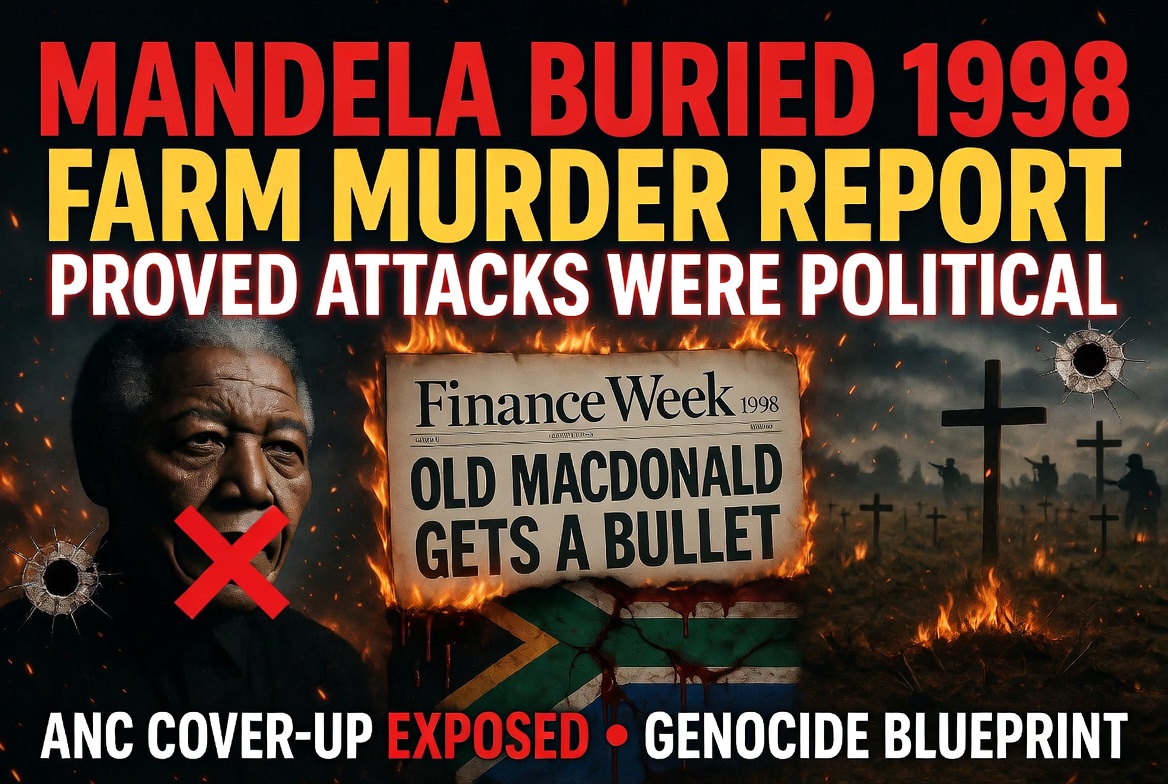
Johannesburg, 25 April 2026 – A suppressed 1998 intelligence report has come back to haunt the ANC. The explosive Finance Week article titled “OLD MACDONALD GETS A BULLET – A suppressed intelligence report shows politics mixed up with farm killings” (27 August – 2 September 1998) proves that Nelson Mandela’s government deliberately smothered forensic evidence showing farm attacks were politically motivated terror rooted in “struggle” ideology.
More than 500 farmers had already been murdered since 1994 when the report landed on desks in Pretoria. Instead of acting, the highest levels of the ANC — including Mandela himself — ordered it rewritten, sanitised, and buried.
ANC Politics Mixed up in Farm Murders.
— farmitracker (@Farmitracker) April 23, 2026
SA Police Services Forensic Intelligence Report stated that in 1998.
Nelson Mandela banned the Report.
The NIA (National Intelligence Agency) supported Mandela.
The continued genocide was decided upon in 1998, by Nelson Mandela himself. pic.twitter.com/TCmdT0ZpiT
Direct Excerpts from the Suppressed-Era Exposé
The Finance Week piece pulls no punches:
“More than 500 farmers have been murdered since 1994 and the wave of attacks on farms has become a national threat. Yet government suppresses a key intelligence report and the killings continue.”
“While the killing of farmers escalates into a political issue that is attracting worldwide attention, government and political figures on the Left continue to insist the brutal attacks are no more than ordinary criminality.”
The original police forensic intelligence report was damning:
“The first report concluded that the publicly expressed attitudes of some politicians… were contributing to the problem. The later report suggests the claim of organised agriculture and some political parties that there is an organised campaign of terror behind the attacks ‘may unfortunately politicise an already unsound situation,’ whatever this may mean.”
Researchers found clear patterns:
“The contention of most farmers, as well as the SA Agricultural Union, is that there is a pattern behind the attacks that is reminiscent of struggle slogans like ‘Kill the Boer!’”
The article reveals sharp conflict between honest police researchers and the National Intelligence Agency (NIA):
“There were sharp disagreements between government and the National Intelligence Agency (NIA), on the one hand, and at least some senior police researchers, on the other, who are hidden behind the apparent official unanimity.”
“Researchers were instructed to rewrite the report – it had apparently bypassed the NIA’s scrutinising filter in an administrative bungle – to show that farm attacks were ‘purely criminal.’”
The suppressed report argued that criminality was only one factor among many, including “the land issue, the role of struggle ideology and the publicly expressed attitudes of prominent politicians.”
Mandela’s Direct Involvement in the Cover-Up
The article makes it clear the cover-up had presidential-level backing. ANC figures dismissed concerns as “racist propaganda.” One senior ANC executive even mocked farmers as “crying like babies” while defending violence against them.
Mandela’s public comments calling the killings “totally unacceptable” were exposed as hollow theatre while his administration actively prevented the truth from emerging.
What Does Cyril Ramaphosa Know — and Deny — About Farm Murders?
As the article closes in 2026, one lingering question cuts through the scandals: What does President Cyril Ramaphosa actually know about farm murders, and why does he so vehemently deny any racial or political dimension?
Ramaphosa has been consistent for years. He acknowledges that farm attacks and murders occur but insists they are ordinary criminal acts driven by robbery, not a coordinated campaign, ethnic cleansing, or “white genocide.” In public statements, parliamentary addresses, and high-profile exchanges (including the tense May 2025 Oval Office meeting with U.S. President Donald Trump), he has repeatedly pushed back:
- Farm murders form a tiny fraction of South Africa’s overall murder toll (27,000+ annually). Official SAPS figures for early 2025 showed just 6 murders in farming communities in one quarter, with most victims Black (farmers, employees, or dwellers).
- He condemns the brutality but attributes it to the country’s broader crime crisis — high inequality, unemployment, and weak policing — rather than race or politics.
- Rhetoric like “Kill the Boer” from EFF leader Julius Malema is dismissed as minority-party hyperbole protected by free speech, not official policy. Government position: no evidence of state orchestration or genocide.
Critics, including AfriForum, TAU SA, opposition parties (DA, FF+), and rural communities, argue this stance amounts to denialism and cover-up by omission. They point to:
- Decades of documented cases involving torture, rape, and gratuitous violence that go beyond typical robbery.
- AfriForum’s 2025 report: 184 attacks and 29 murders, with sustained high levels of violence. Cumulative figures since the 1990s run into thousands of attacks and over 2,000 murders.
- Failure to establish a dedicated Commission of Inquiry despite repeated calls (e.g., from the DA). Police stopped separate “farm murder” tracking in 2007, folding it into general rural safety stats — seen by detractors as deliberate obfuscation.
- Perceived reluctance to confront incitement (e.g., songs and slogans) or prioritise rural safety infrastructure.
Ramaphosa’s defenders counter that inflating farm murders into a racial narrative distracts from the fact that Black South Africans suffer the vast majority of violent crime. Independent probes (including past government inquiries) have found no evidence of a genocidal plot. His government has run rural safety strategies, though implementation is widely criticised as inadequate.
Whether Ramaphosa’s position reflects genuine belief in the data, political calculation to avoid alienating his base, or something more calculated remains hotly debated. What is clear is that the denial — or reframing — fuels deep distrust. In a country still scarred by its past, the gap between official narratives and lived rural reality continues to widen.
Another question remains unanswered: Why was Nelson Mandela not at the Nasrec meeting in 1990 when Cyril chaired it?
The Devastating Consequences
What followed is a matter of record:
- Rural commandos were disbanded.
- Proper farm murder statistics were manipulated and race-recording stopped.
- Police resources in rural areas were deliberately reduced.
- The “Kill the Boer” rhetoric was normalised and later protected by the courts.
Today, farm murders continue to make agriculture the most dangerous profession in South Africa. Urban murders are surging as the violence spreads into towns and cities. The 1998 warning — that ignoring the political dimension would allow the terror to metastasise — has proven tragically accurate.
This Is Blartheid in Action
The 1998 cover-up forms the foundation of today’s Blartheid — South Africa’s world-record system of 142 anti-White discriminatory laws. The same political machine that buried the report is now, together with the EFF and MKP, pushing to dismantle the last remaining constitutional protections: Section 235 (self-determination), Section 25 (property rights), Section 9 (equality), Section 18 (freedom of association), and Section 21 (freedom of movement).
President Cyril Ramaphosa continues the tradition of denial. The EFF glorifies Winnie Mandela’s necklacing squads and child-murdering “football club.” And Genocide Watch places South Africa between Stages 6 and 7 (Polarization and Preparation) targeting White Afrikaners.
The Mask Is Off
The Finance Week article from 1998 ends with a prophetic warning:
“If a more sophisticated analysis of the killings… shows anything, it is that the politics involved is most likely of an informal and locally organised nature in most cases – struggle attitudes surviving in a new context. And the justifying framework operating behind the killings – evident in the statements of politicians – is essentially political.”
Twenty-eight years later, that “struggle attitude” is still alive in government policy, parliamentary rhetoric, and EFF rallies.
The ANC didn’t just ignore the farm murder crisis in 1998. They actively protected it.
The blood of thousands of farmers — then and now — is on their hands. The suppressed report was the moment they chose power and ideology over human lives.
South Africans deserve the full, unvarnished truth. The 1998 document proves the war on White farmers was political from the very beginning — signed off at the highest level.
The cover-up is collapsing. The denial is dying. And the evidence has never been clearer.

Comments (0)
Leave a Comment