
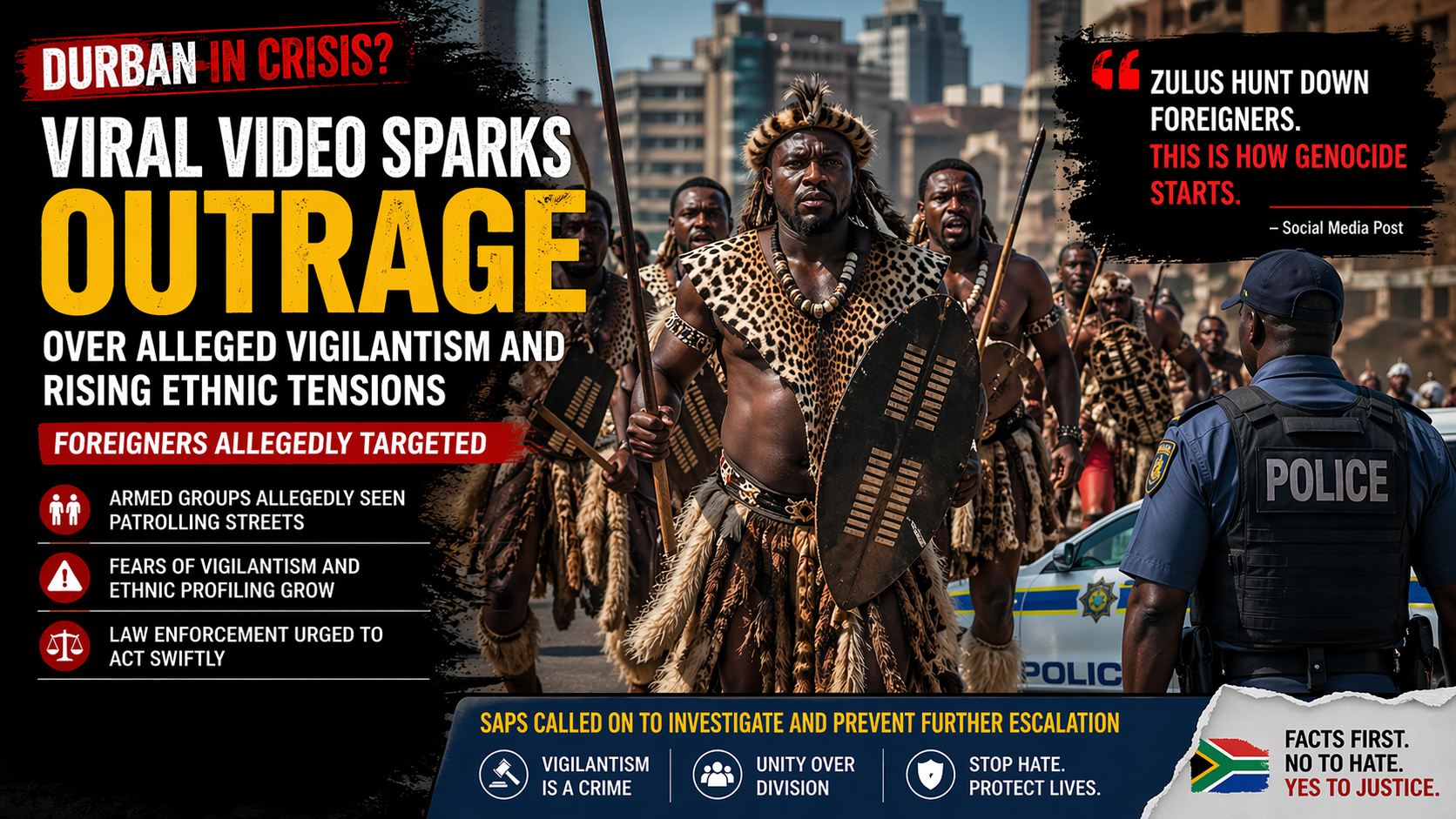
A viral video circulating on social media has ignited fierce debate across South Africa after claims emerged that armed groups were seen targeting foreign nationals in Durban. The footage, accompanied by highly charged commentary, has triggered widespread concern over vigilantism, public safety, and the potential for escalating ethnic tensions in already fragile communities.
WATCH:
Djo BaNkuna wrote:
????? ?? ????????: ????? ???? ???? ??????????
It is all fun.
We are waiting for some innocent person to die. Meanwhile, our government igonore these people that are busy hunting down 'iShangaane / Makwerekwere' in the streets of Durban armed with weapons. Then when this militia succesfully kill someone, the President will be shocked and his Ministers will hog the tv lights.
When tribal/cultural identity, artifacts and posture is misappropriated for nefarious action, people die. The Zulu war songs, Zulu dress, Zulu regimentation, Zulu artifacts are all being marshalled to sow the seed of genocide. The idea that Zulufied regiments, armed to the teeth, are now patrolling the streets of Durban searching for "iShangaane, iKwerekwere", etc should send chills down the spine. What happened when they catch Gezani Mavundza on holiday?
My compatriots, this is exactly how the Rwandan genocide started.
- Hutu vs Tutsi.
- Zulu vs Kwerekwere.
- Yes, black vs black.
And, yet we don't see it coming.
While Peneul Wrote:
I'm disappointed that you're making it a Zulu thing. Many Black SAns are frustrated by illegal foreigners across SA; not just in KZN.
And the big issue here is the SAn govt and the foreign govts who are doing nothing about illegal foreigners in SA, especially those who are committing crimes like trafficking, sexual assault, drugdealing & murders.
Let's not make matters worse by pretending this is a Zulu matter. That's like saying Zulus fighting Afrikaners during Apartheid is similar to the Rwandan Genocide.
Please reconsider your post & think about editing it because it's not a true reflection of the matter on the ground.
Allegations of Armed Vigilantism in Durban
The video, widely shared across platforms, is being interpreted by some users as evidence of organised groups allegedly targeting individuals perceived to be foreign nationals. The accompanying commentary circulating with the clip makes references to ethnic identity, militancy, and even genocide comparisons — language that has intensified public fear and outrage.
SAPS and Law Enforcement Under Pressure to Respond
Incidents like these place immediate pressure on law enforcement agencies, particularly SAPS, to clarify what is real, what is misinterpreted, and what may require criminal investigation.
Rising Concern Over Vigilantism in South Africa
South Africa has experienced a growing number of incidents involving so-called community “patrols” or informal enforcement groups, particularly in areas struggling with high crime rates.
While some of these groups claim to act in the interest of community safety, legal experts consistently warn that vigilantism undermines the justice system and often escalates already volatile situations.
Under South African law, only state-authorised law enforcement agencies are permitted to detain, investigate, or use force in the execution of justice. Any civilian group operating outside this framework risks criminal liability.
Dangerous Narratives and the Role of Social Media
What makes the current situation particularly volatile is not only the video itself, but the narrative built around it online.
Posts accompanying the footage have used extreme language, including references to ethnic conflict and genocide comparisons. Analysts warn that such framing can rapidly intensify fear, distort public understanding, and deepen divisions between communities.
South Africa’s already sensitive socio-economic climate means misinformation can spread quickly and take on real-world consequences if not addressed responsibly.
Experts in conflict studies have repeatedly highlighted that identity-based framing of crime or violence can contribute to long-term societal distrust and retaliation cycles.
Government Response and Public Expectation
At the time of publication, there has been no detailed public briefing confirming the claims associated with the viral video. However, pressure is mounting on authorities to respond decisively, both to clarify the facts and to prevent potential escalation.
The South African government has previously stated that any form of vigilantism or targeted violence against foreign nationals is illegal and will be prosecuted.
Public expectation remains high that law enforcement will act swiftly.
A Country on Edge Amid Crime and Social Friction
South Africa continues to grapple with complex challenges including high crime rates, unemployment, and strained community relations in certain areas.
In this environment, viral content can act as a catalyst — amplifying fear, shaping narratives before facts are confirmed, and sometimes pushing communities toward confrontation based on incomplete information.
The Durban video, has become part of a broader national conversation about trust, law enforcement credibility, and social cohesion.
Conclusion: Between Fear, Fact, and Responsibility
Whether the footage ultimately confirms wrongdoing or not, the response to it highlights a deeper issue — the fragile balance between public safety, and rising social tension.
What happens next will depend not only on what authorities uncover, but how quickly they can restore clarity in a space increasingly dominated by fear-driven narratives and digital amplification.

Comments (0)
Leave a Comment