
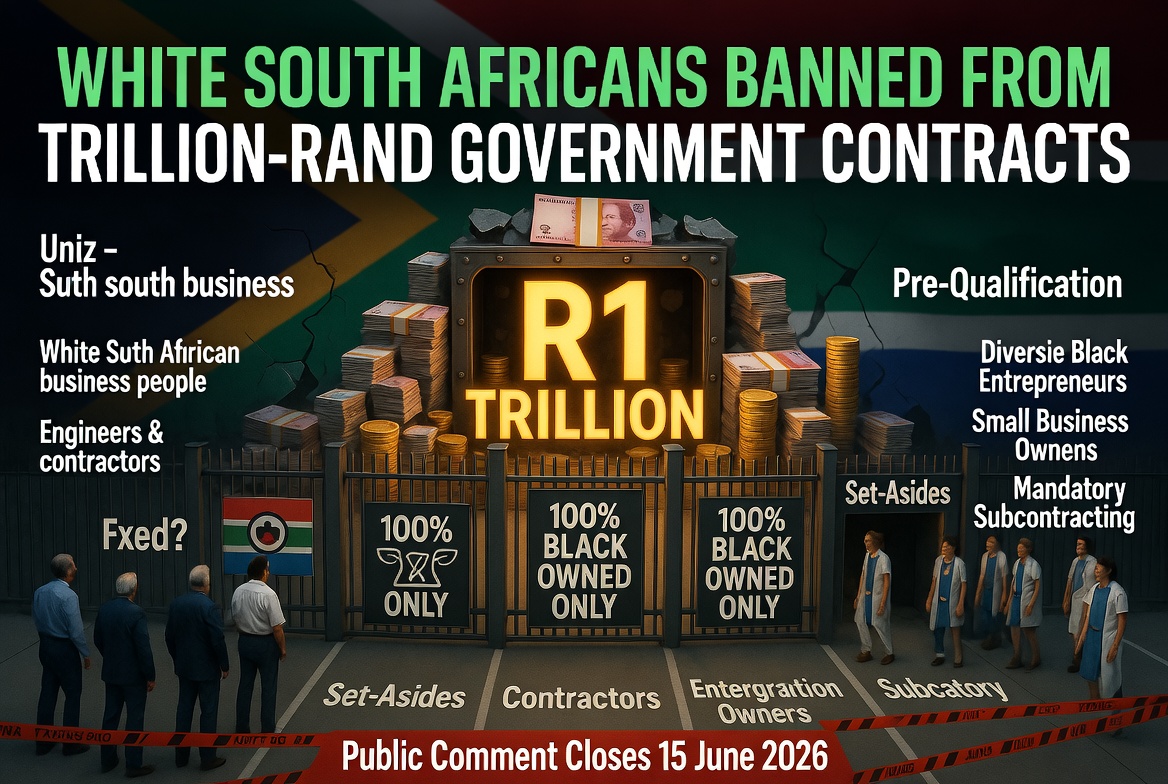
South Africa's government spends roughly R1 trillion annually on public procurement — funding everything from infrastructure projects and hospital supplies to school textbooks and municipal services. This massive spend shapes the economy, determines which businesses thrive, and directly affects service delivery to citizens.
The National Treasury has now published the Draft General Public Procurement Regulations, 2026, which would operationalise key parts of the Public Procurement Act, 2024. These regulations propose a major overhaul of how that trillion-rand pie is divided, shifting away from the previous points-based B-BBEE preference system toward a more rigid "gates" approach based on ownership and demographic categories.
Public comments on the draft close on 15 June 2026, giving stakeholders, businesses, legal experts, and ordinary citizens a final window to influence the rules before they are finalised.
WATCH:
Read Draft Here:
westernpulse.co.zaView PDF: draftprocurementact.pdf
From Points to Hard Gates: The Core Change
Under the existing framework, businesses earned preference points for Broad-Based Black Economic Empowerment (B-BBEE) status, allowing a mix of ownership levels and contributions to score higher in bids. The draft regulations introduce three escalating "gates" that bidders must pass before their price or technical merits are even considered in many cases.
Gate 1: Set-Asides for Smaller Contracts (Up to R20 Million)
For contracts or unbundled portions valued at up to R20 million — where at least three qualifying suppliers exist — procuring institutions may reserve the entire bid exclusively for specific designated groups. These include:
- Black people
- Black women
- Women
- People with disabilities (including black people with disabilities)
- Military veterans
- Youth
- Small enterprises or cooperatives owned by the above groups
The regulations set minimum annual targets for departments' overall procurement budgets to flow to these categories (for example, percentages to black people, black women, and people with disabilities, as referenced in annexures).
To qualify, businesses must be 100% owned by members of the specific category and 100% owned by South African citizens. Anything less — such as a black entrepreneur with even a minority white partner — results in automatic disqualification under the strict rules outlined (similar to the clarity provided in related Regulation 57 discussions). This represents a significant tightening from previous 51% or majority thresholds in many preference schemes.
Gate 2: Pre-Qualification for Mid-Sized Contracts (R20 Million to R100 Million)
For bids in the R20 million to R100 million range, bidders must first prove eligibility before entering the competitive evaluation:
- At least 40% of their prior procurement spend went to enterprises that are 51% owned and managed by black persons, or
- They commit to subcontracting at least 30% of the contract value to 100% owned enterprises or cooperatives in the designated categories.
Failure to meet these bars means the bid is not evaluated on price, quality, or capability — it is simply excluded.
Gate 3: Mandatory Subcontracting for Large Contracts (Over R100 Million)
For major projects exceeding R100 million, subcontracting becomes compulsory. Bidders must subcontract at least 25% of the contract value to qualifying 100% owned enterprises or cooperatives in the designated groups. In some cases, the procuring institution may make direct payments to these subcontractors.
The qualifying categories, drawn from Section 17(3) of the Public Procurement Act, focus on historically disadvantaged groups and do not include white South Africans as a designated category for these preferences.
Who Benefits and Who Faces Barriers?
Proponents argue these measures will accelerate economic transformation by directing opportunities to black-owned businesses, women, youth, people with disabilities, and military veterans — addressing legacies of exclusion. The framework aims to create structured pathways for small enterprises and cooperatives.
Critics, however, point out that the rigid 100% ownership requirements and race-based gates could exclude experienced businesses, joint ventures, or entrepreneurs with mixed ownership structures that have historically delivered projects. A white-owned or partially white-owned firm, regardless of skills, track record, or investment in South Africa, would generally not qualify for set-asides or certain preferences. This has sparked debate about potential impacts on competition, skills transfer, and service delivery in sectors where capacity is limited.
The regulations acknowledge implementation challenges, including a acknowledged skills shortage in many government procurement offices, and propose training and transitional arrangements.
Positive Reforms in the Draft
The draft is not solely about preference gates. It includes several measures welcomed across the spectrum:
- Anti-corruption and anti-extortion tools: Regulation 48 targets issues like the "construction mafia" through mandatory risk assessments for extortion, reporting of intimidation to the South African Police Service, and debarment of corrupt suppliers for up to 10 years.
- Two-envelope bidding: Technical capability is evaluated separately from price in a structured process, aiming to prioritise quality over the lowest bid.
- Transparency requirements: Contract awards must be published online within seven days, with public briefings for larger awards (over R50 million).
These elements seek to address longstanding problems of bid-rigging, fronting, and poor delivery that have plagued South African public procurement.
Deeper Questions and Implementation Risks
The draft raises fundamental tensions. Can a system built on hard demographic thresholds foster genuine broad-based inclusion, or will it encourage fronting, shell companies, and politically connected intermediaries — issues that plagued earlier B-BBEE implementations?
Government departments must demonstrate sufficient qualifying suppliers before applying gates, but in specialised fields (engineering, advanced manufacturing, or complex infrastructure), the required capacity may not yet exist at scale. Poor implementation could delay projects, inflate costs, or compromise quality in critical areas like electricity, water, and healthcare infrastructure.
Economists and business groups have long warned that overly prescriptive procurement rules risk reducing competition and efficiency, ultimately affecting taxpayers and service recipients. Others contend that without deliberate intervention, historical patterns of exclusion will persist.
Time to Engage: Public Comment Period
The draft regulations remain open for input until 15 June 2026. Comments can be submitted via the National Treasury's processes, as outlined in the Government Gazette notices.
This is not merely a technical exercise. The rules will reshape business structures, investment decisions, and the composition of South Africa's supplier base for government work. Stakeholders are urged to review the full documents on the National Treasury website and provide detailed, evidence-based submissions — whether supporting the transformation goals, highlighting risks to delivery, or suggesting refinements for feasibility and fairness.
South Africa's procurement system sits at the intersection of constitutional imperatives: Section 217 requires cost-effective, fair, and transparent processes while permitting measures to advance those previously disadvantaged by unfair discrimination. Balancing these objectives will define the success or failure of the final regulations.
As the comment period enters its final weeks, the trillion-rand question remains: Will these changes deliver better value, broader inclusion, and improved service delivery — or create new bottlenecks in an already strained system? The answer will depend not only on the regulations themselves but on rigorous oversight, capacity building, and accountability during rollout.
How to participate: Visit the National Treasury website for the draft documents and submission guidelines. Informed public input is essential to shaping a procurement framework that serves all South Africans effectively.

Comments (0)
Leave a Comment